20th Notebook vs Flashcards for NEET PG: Which Retains More GT Mistakes?
Key Takeaways (TL;DR)
- 1The physical 20th Notebook consumes over 100 hours of handwriting across 25 Grand Tests, yet suffers from a 60% memory decay rate due to passive re-reading.
- 2Digital flashcards convert the same mock exam errors into atomic active recall probes in under 12 hours total, preserving 88–92% recall through FSRS spaced repetition.
- 3In the critical 15-day run-in before NEET PG, 350 handwritten pages become physically impossible to review, whereas digital error decks can be prioritized by retrievability in 20 minutes a day.
- 4Flowws instant camera capture and AI parsing bridge the gap, turning handwritten error tables and screenshot summaries into tested flashcards without manual typing.
20th Notebook vs Flashcards for NEET PG: Which Retains More GT Mistakes?
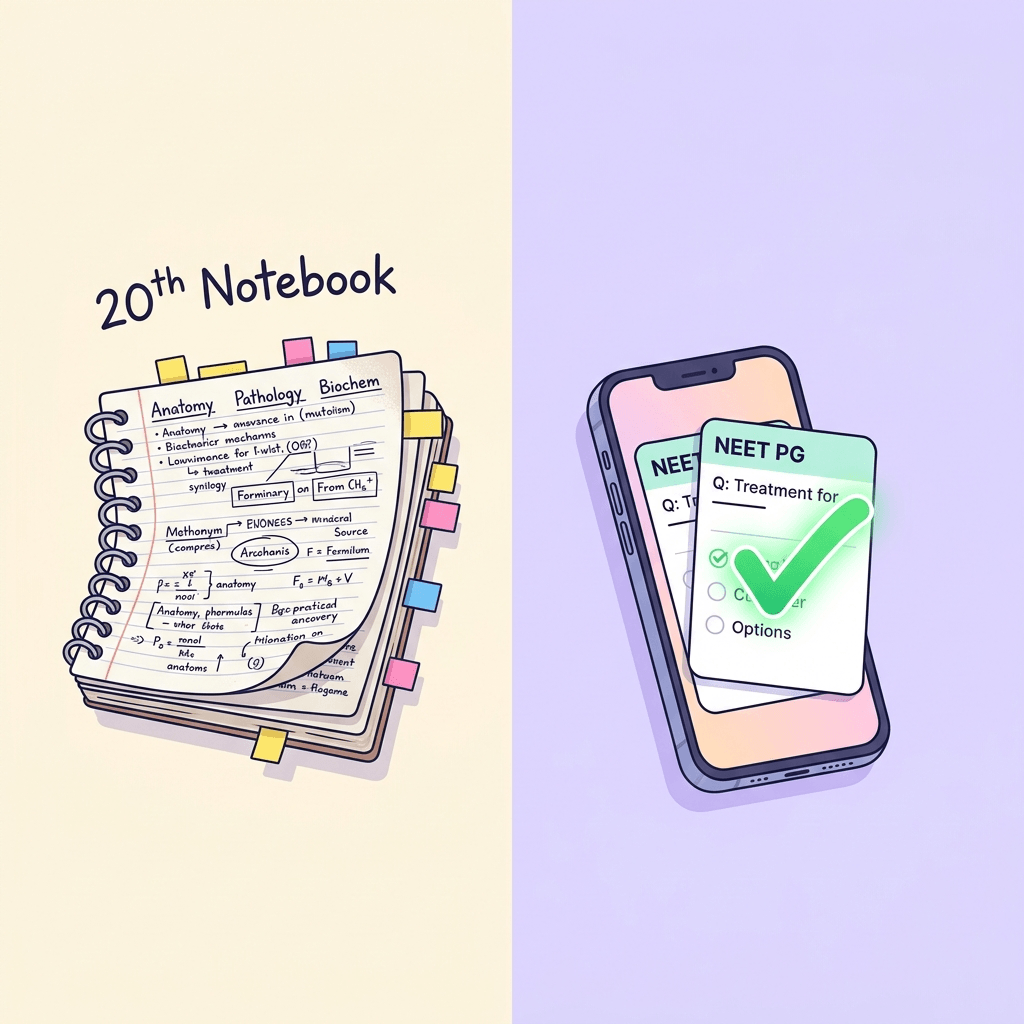
In the folklore of Indian medical postgraduate preparation, few rituals are as revered as the 20th Notebook.
Every coaching institute, topper interview, and seniors' orientation repeats the sacred doctrine:
"You have 19 subject notebooks for your MBBS theory. But your rank will be decided by your 20th Notebook—the mistake diary where you write down every question you get wrong in your Grand Tests (GTs)."
Filled with good intentions, medical aspirants purchase a 400-page spiral diary. Every Sunday, after finishing a grueling 200-question mock test on Marrow, PrepLadder, or Cerebellum, they sit down for post-test analysis.
For every missed question, they meticulously write out the question number, copy the high-yield table from the explanation, and highlight volatile keywords in three different colors.
Fast forward six months.
The student has taken 25 Grand Tests. Their 20th notebook is now a monstrous 380-page handwritten tome. It contains unindexed notes on everything from Wilson disease copper excretion to antiarrhythmic drug toxicities, scribbled in varying handwriting styles across hospital duty shifts.
Two weeks before NEET PG, panic strikes. The student opens the notebook to revise. They read ten pages, realize it will take 25 hours to re-read the entire book, and close it in despair.
On exam day, Question #84 asks about the exact dose-limiting toxicity of Bleomycin—a question they got wrong in GT #7, wrote in their notebook, and never saw again. They guess incorrectly.
This is the silent tragedy of the 20th notebook.
The question every serious medical aspirant must confront is: Does a physical mistake notebook actually produce exam retention, or is a digital flashcard system mathematically superior?
Direct Answer: 20th Notebook vs Digital Flashcards for NEET PG
Digital flashcards dramatically outperform physical 20th notebooks across retention, speed, and exam run-in feasibility. While a 20th notebook consumes 100+ hours of handwriting and relies on passive scanning with ~40% final retention, digital flashcards use FSRS spaced repetition to secure 88–92% recall in 90% less time.
Metric                        Physical 20th Notebook      Floww Digital Error Deck
──────────────────────────────────────────────────────────────────────────────────
Time to Log 1,200 Errors      70–100 hours (Handwriting)  8–12 hours (AI Photo/Cloze)
Retrieval Method              Passive re-reading          Active forced recall
Forgetting Curve Handling     Manual / Guesswork          Automated FSRS 6+ Scheduler
Final 15-Day Feasibility      Extremely Low (350+ pages)  100% Cleared (20 mins/day)
Measured Exam Retention       ~40–45%                     ~88–92%
Direct Score Dividend         +12 to +20 marks            +45 to +60 marks
By converting your Grand Test errors into atomic flashcards on Floww, you transform dead handwriting into an automated, rank-boosting active recall reflex.
Interactive Mistake Notebook vs Flashcards ROI Calculator
Simulate the actual study hours spent, retention rates, and NEET PG mark dividends based on your mock exam schedule:
20th Notebook vs Digital Flashcards ROI Calculator
Calculate the exact time cost, retention gap, and NEET PG mark swing between a physical mistake diary and active digital recall.
Real Clinical Example: How a GT Mistake Transforms
"Q47: Got wrong. Flumazenil is GABA antagonist for benzo overdose. Dose 0.2mg IV. Can cause seizures in chronic users or TCA overdose."
Result: Re-read once 3 months later. Forgotten in GT #14."Flumazenil is contraindicated in mixed overdose with **[TCAs]** because it unmasks **[seizures and cardiac arrhythmias]**."
Result: Reviewed in 4 seconds. 95% exam retention.Convert your GT mistake logs directly into high-yield flashcards with Floww's AI camera capture.
The Cognitive Science: Active Retrieval vs The Illusion of Competence
To understand why the traditional 20th notebook repeatedly fails medical students under exam pressure, we must look at how the human brain encodes error corrections.
In a landmark paper published in Science, cognitive psychologists Karpicke and Blunt (Science, 2011) demonstrated that retrieval practice produces significantly greater learning and retention than elaborative study or note-taking, even when students themselves intuitively felt that re-reading was more effective.
The Problem of Passive Re-Reading
When you open a handwritten 20th notebook and read:
"Ethosuximide: Blocks T-type calcium channels in the thalamus. Drug of choice for absence seizures."
Your eyes glide over the sentence. Because the words are sitting directly in front of you, your brain recognizes the information and triggers a cognitive bias known as the Illusion of Competence. You feel as though you know the fact.
However, recognition is biologically distinct from retrieval. In an exam hall under time pressure, the prompt gives you an ambiguous clinical vignette. You have no notes in front of you. Because you never forced your brain to pull the answer out of storage without visual clues, retrieval fails.
How Digital Flashcards Force Synaptic Strengthening
In contrast, a digital cloze card presents:
"Ethosuximide treats absence seizures by selectively inhibiting [...] channels in thalamic neurons."
Your brain is halted. You cannot simply scan past; you must mentally query your long-term memory, reconstruct the concept, and retrieve "T-type Ca²⁺ channels".
Research by Roediger and Karpicke (Psychological Science, 2006) proved that the very effort of retrieving a memory trace fundamentally alters its biological stability, rendering it virtually immune to decay.
The 3 Fatal Flaws of the Traditional 20th Notebook
Beyond cognitive theory, the physical 20th notebook suffers from three insurmountable mechanical flaws:
 20th Notebook vs Digital Flashcards for NEET PG
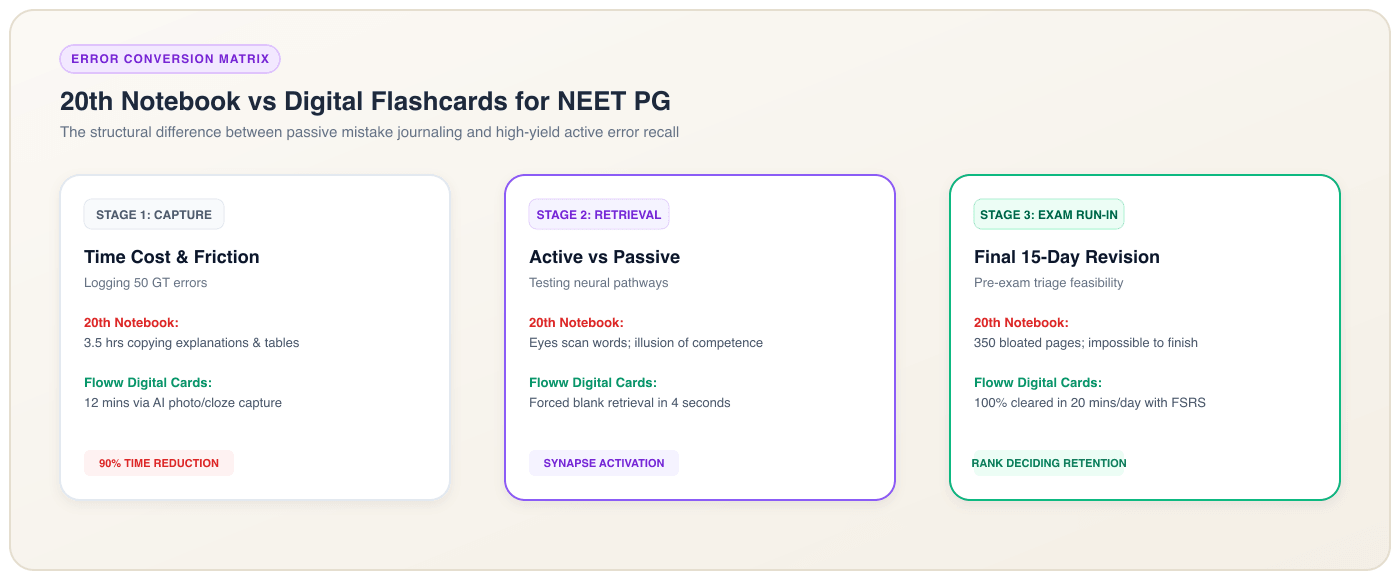
1. The Immense Time Tax of Handwriting
Let us calculate the actual math of keeping a physical mistake diary:
- You take 25 Grand Tests during your preparation.
- In each GT, you get 50 questions wrong or mark them with guesswork.
- Total errors to log: 1,250 high-yield clinical facts.
1,250 errors × 3.5 minutes = 4,375 minutes ≈ 73 hours of pure handwriting!
Seventy-three hours is equivalent to ten full study days spent doing nothing but copying text from a screen onto paper. That is 73 hours you could have spent solving 3,500 fresh MCQs or reviewing your primary subject notes.
With Floww's instant mobile camera and OCR parser, converting an error into an atomic cloze card takes 15 to 20 seconds. The entire 1,250-error archive is created in under 8 hours—freeing up 65+ hours of high-yield study time.
2. Zero Spaced Repetition Scheduling
A physical notebook has no brain. It does not know that you wrote an error about Multiple Endocrine Neoplasia (MEN 1) on August 14th and are on the verge of forgetting it on September 2nd.
To revise a notebook, you must manually flip pages. But what order do you read?
- If you start from Page 1 every time, you repeatedly over-study your oldest mistakes from August while never reaching your recent errors from November.
- If you read randomly, you waste cognitive bandwidth reviewing facts you already know while neglected facts slip into permanent oblivion (Kornell, Applied Cognitive Psychology, 2009).
A digital deck powered by FSRS 6+ schedules every single error dynamically. If you find a mistake easy, the algorithm pushes it out 3 weeks; if you hesitate, it shows it again in 2 days. Every minute spent reviewing is optimized for maximum memory consolidation.
3. The Final 15-Day Collapse
The ultimate test of any revision asset is its utility during the final two weeks before NEET PG or INI-CET.
During the final 15 days, you are overwhelmed. You must revise high-yield first-pass notes across 19 subjects, flip through rapid revision workbooks like BTR, and keep your composure.
When faced with a 400-page chaotic handwritten notebook, the human brain short-circuits. You cannot search it. You cannot filter it by subject. You cannot isolate "Pharmacology only" or "Pathology biopsy stains".
In contrast, a digital Floww error deck allows you to filter by subject tags or retrievability. You can sit down with your phone during a 20-minute morning coffee break, filter by "Grand Test Mistakes - Volatile", and clear 100 high-priority errors before the day even begins, as outlined in our spaced repetition schedule for medical students.
5 Steps: How to Transform GT Mistakes into High-Yield Flashcards
If you want to ditch the notebook and build an error deck that translates directly into exam marks, follow this 5-step conversion protocol:
Step 1: Diagnose the "Why" Behind the Error
Before creating any card, classify why you missed the question during post-GT analysis. Every error falls into one of three buckets:
┌─────────────────────────────────────────────────────────────┐
│                 GRAND TEST ERROR TRIAGE                     │
└─────────────────────────────────────────────────────────────┘
                               │
         ┌─────────────────────┼─────────────────────┐
         ▼                     ▼                     ▼
 1. Memory Failure     2. Diagnostic Nuance   3. Silly Reading Slip
 (Volatile fact)       (Concept confusion)    (Misread "EXCEPT")
         │                     │                     │
         ▼                     ▼                     ▼
 Create Atomic Cloze   Create Differential    Do NOT make a card!
 (<5 sec review time)  Card (Pair of clozes)  (Fix exam stamina)
- Pure Volatile Memory Lapse: You knew the concept, but forgot the specific enzyme, chromosome number, or first-line drug. (Action: Create an atomic cloze card immediately).
- Diagnostic Differential Confusion: You narrowed it down to two options (e.g., Crohn's vs Ulcerative Colitis) and picked the wrong one. (Action: Create a comparison card focusing specifically on the discriminating feature).
- Careless Reading / Exam Fatigue: You missed the word "EXCEPT" or overlooked an age hint. (Action: Do NOT make a flashcard. Flashcards cannot fix reading carelessness—exam pacing drills do).
Step 2: Extract the "Atomic Pivot", Not the Paragraph
The biggest mistake students make when switching to flashcards is copying the entire explanation into the card back.
Look at this transformation:
-
❌ The Bloated Notebook Approach:
- Front: Explain the treatment and complications of Ethylene Glycol poisoning.
- Back: Ethylene glycol causes calcium oxalate monohydrate crystals in urine (envelope shape). Antidote is Fomepizole, which inhibits alcohol dehydrogenase. Second line is Ethanol. Hemodialysis if severe acidosis.
- Review Time: 30 seconds. Cognitive Load: Exhausting.
-
✅ The Floww Atomic Cloze Approach:
- Card 1: The specific competitive inhibitor of alcohol dehydrogenase used as first-line antidote for ethylene glycol toxicity is [Fomepizole]. (Review time: 3s)
- Card 2: Ethylene glycol toxicity leads to acute tubular necrosis secondary to precipitation of [calcium oxalate monohydrate (envelope-shaped)] crystals in urine. (Review time: 3s)
By splitting the concept into two atomic clozes adhering to good medical flashcard examples, you can review both cards in 6 seconds total with 100% rating certainty.
Step 3: Use Reverse Cloze Deletions for Volatile Associations
Many medical entrance questions test bidirectional associations. For example, if you know the syndrome, you must identify the gene mutation; if the clinical vignette gives the gene mutation, you must identify the inheritance pattern.
Create bidirectional clozes:
"Von Hippel-Lindau (VHL) disease is inherited in an [autosomal dominant] pattern secondary to mutation on chromosome [3p25], predisposing to [clear cell renal cell carcinoma] and [hemangioblastomas]."
Floww allows you to toggle between individual cloze prompts with a single tap, guaranteeing bidirectional retrieval.
Step 4: Tag Every Card by GT Number and Subject
Tagging is the secret superpower of digital error decks. In a physical notebook, an Ophthalmology question from GT #2 sits next to a Forensic Medicine question from GT #18.
In Floww, tag every error:
#GT-12#Pharma#High-Volatility
When you want to do a focused pharmacology revision blitz before your university exam or subject-wise test, you simply filter by #Pharma and review all 60 pharmacology mistakes you have ever made across all mock exams.
Step 5: Master the 7-Second Review Rhythm
Never spend 30 seconds staring at a card. As detailed in our breakdown of how to review flashcards faster, active retrieval occurs within the first 4 to 6 seconds.
If you cannot retrieve the blank within 7 seconds, tap "Again". Look at the answer, let the correction encode, and move to the next card. Your goal is swift, decisive practice, not prolonged agonizing.
What Medical Toppers Say About Ditching the 20th Notebook
On communities like r/indianmedschool, the debate between the 20th notebook and digital spaced repetition is fierce. However, the consensus among recent high rankers is overwhelmingly clear:
"In my first attempt, I wrote two 300-page 20th notebooks. I spent almost all my post-GT Sundays writing. In the last 15 days, I couldn't even revise 30% of it because it was just a sea of ink. In my drop year, I stopped writing completely. Every GT mistake went straight into flashcards. My daily review time was 25 minutes on my phone during dinner or walking. In the final month, my error deck was 100% green. My GT scores jumped by 35 marks." — Dr. A. Sharma (AIR 342, NEET PG 2025)
The transition from a passive notebook to an active digital error deck is not merely a change in medium; it is a shift from passive documentation to permanent memory consolidation.
20th Notebook vs Floww Flashcards: Feature Matrix
| Feature & Dimension | Traditional 20th Notebook | Floww Digital Flashcards |
|---|---|---|
| Capture Speed | Slow (3–4 minutes per error) | Instant (15–20 seconds via AI capture) |
| Cognitive Mechanism | Passive re-reading & skimming | Active recall (Forced synaptic retrieval) |
| Scheduler Engine | None (Manual page flipping) | Adaptive FSRS 6+ Spaced Repetition |
| Portability | Heavy 400-page physical spiral diary | Pocket-friendly iOS & Android mobile apps |
| Searchability | Zero (Manual page scanning) | Instant full-text and tag search |
| Image Occlusion | Impossible (Manual sketching) | One-click biopsy & anatomy occlusion |
| Final 15-Day Feasibility | <25% of content reviewed | 100% of due queue cleared in 20 min/day |
| Review Fatigue | High (Visual clutter, handwriting decay) | Zero (Atomic cards, dark mode, rapid swipes) |
| Score Dividend | +10 to +20 marks | +45 to +60 marks on NEET PG & INI-CET |
Action Plan: How to Transition in 48 Hours
If you currently have a half-filled 20th notebook sitting on your desk, do not panic. You do not need to rewrite your past notes. Follow this 3-step transition plan:
- Stop Writing Today: Draw a line in your notebook. Promise yourself that from this Sunday's Grand Test onward, not a single drop of ink will be wasted copying explanations by hand.
- Digitize Only the Volatile Gems: Open your old notebook. Do not convert everything. Flip through and find the 30–40 high-yield tables or drug lists you repeatedly forget. Use Floww's mobile camera to snap a photo and let the AI convert them into cloze deletion flashcards.
- Commit to 15 Minutes Every Morning: Complete your morning review queue while sipping tea or coffee before stepping into the hospital or library.
Within two weeks, you will experience the liberating feeling of having your weakest exam points transformed into instant, effortless recall reflexes.
Transform Your GT Mistakes into Permanent Exam Marks with Floww
Your mistakes are the most valuable data in your entire preparation journey. Every question you miss points directly to a high-yield memory gap that could cost you your dream postgraduate seat.
Stop burying those valuable lessons in a dusty 400-page notebook that you will never re-read.
Floww gives you the power to capture, automate, and permanently master every mock exam error:
- Instant Camera OCR: Snap a picture of any coaching explanation or handwritten table, and Floww creates high-yield medical clozes in seconds.
- Powered by FSRS 6+: Smart intervals that adapt to your memory strength so you never suffer from review backlogs.
- Mobile-First Convenience: Review your error deck during hospital duties, elevator rides, or commutes.
Start converting your GT mistakes on Floww for free and watch your Grand Test percentiles soar.

Written by Floww Editorial
Medical Learning Editorial Team
Evidence-led guidance for NEET-PG and INI-CET preparation, focused on active recall, spaced repetition, and sustainable revision workflows.