AI Flashcard Generator for Medical Students: The Complete 2026 Guide to Clinical-Grade Card Creation

Key Takeaways (TL;DR)
- 1Generic AI flashcard generators convert whole PDF pages indiscriminately, generating noisy paragraph-long cards that violate the minimum information principle.
- 2Common AI scrapers frequently hallucinate clinical abbreviations (DOC, MOA, C/I) and blank out trivial grammatical prepositions rather than high-yield diagnostic keywords.
- 3A clinical-grade AI flashcard generator requires domain-specific medical vision, handwritten margin note parsing, and automatic atomization into 4-second retrieval cards.
- 4Floww pairs surgical 5-second photo-to-card capture with FSRS spaced repetition, eliminating authoring friction while preventing review backlog debt.
AI Flashcard Generator for Medical Students: The Complete 2026 Guide to Clinical-Grade Card Creation
For decades, medical students faced a brutal pedagogical dilemma.
On one hand, over a century of cognitive psychology research confirms that active recall coupled with spaced repetition is the single most effective methodology for mastering the 19 subjects of the medical curriculum. Top rankers on NEET-PG, INI-CET, and USMLE consistently attribute their score breakthroughs to daily flashcard reviews.
On the other hand, manual flashcard authoring is an exhausting, soul-crushing bottleneck.
To create high-quality flashcards for a single clinical subject like Pharmacology or Pathology, an MBBS student must spend 40 to 60 hours manually typing out drug mechanisms, adverse effects, cytogenetic translocations, and diagnostic criteria. For a busy intern working 14-hour hospital casualty shifts, spending two hours every night typing on a laptop keyboard is physically impossible.
Enter the promise of artificial intelligence: The AI flashcard generator for medical students.
In 2026, dozens of platforms promise to "convert your entire 100-page PDF or lecture slide deck into flashcards with a single click." Yet medical subreddits like r/medicalschoolanki and r/indianmedschool are filled with frustrated posts from students who tried these tools, only to discover that the generated decks were noisy, riddled with clinical hallucinations, and completely unusable under exam conditions.
Why do so many AI flashcard generators fail medical students? What distinguishes a generic document scraper from a true clinical-grade revision workstation? And how can you harness medical AI to supercharge your revision without succumbing to review backlog debt?
In this comprehensive guide, we dissect the architecture of medical AI card creation and demonstrate how top scorers generate exam-grade cards in under five seconds.
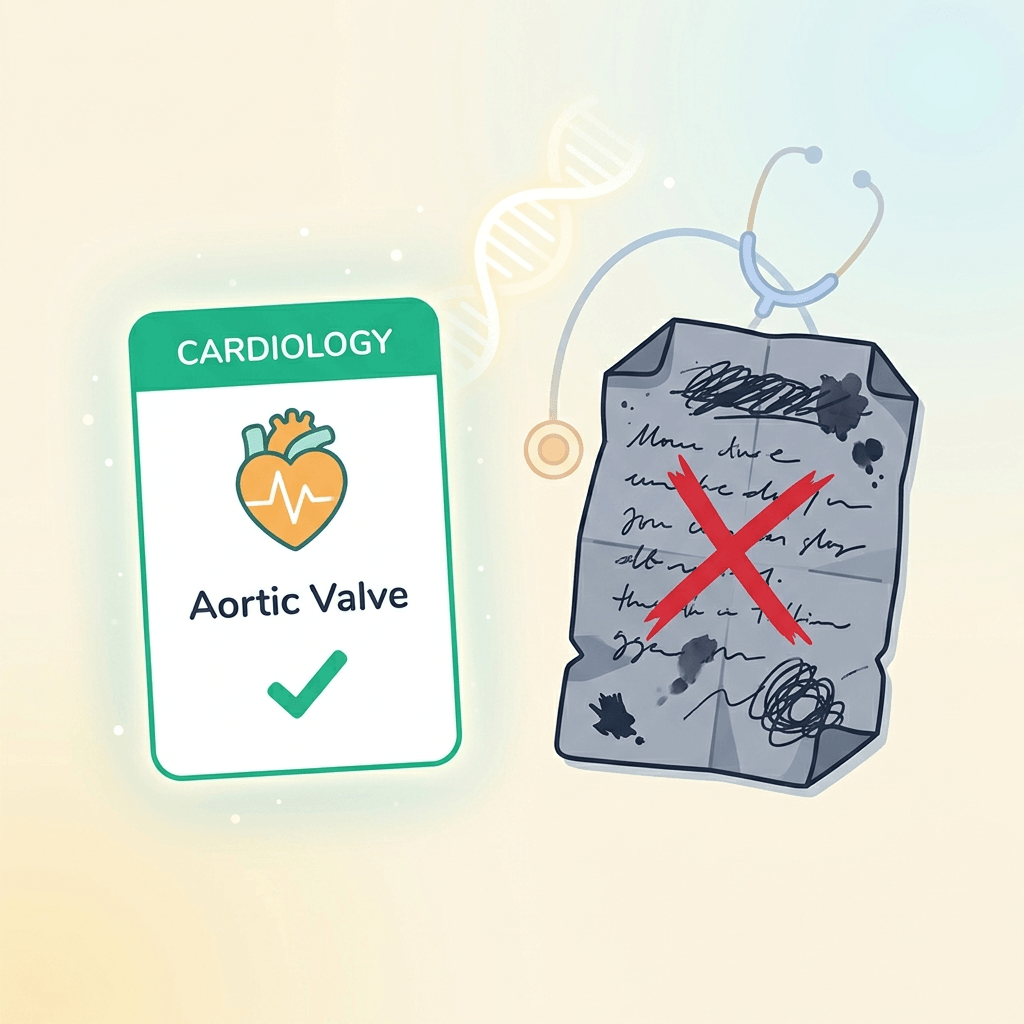
Generic AI Document Scanner vs. Medical-Grade Vision AI
Compare how raw medical study notes are transformed by generic PDF converters versus Floww's clinical-grade card engine.
"Pt w/ severe beta-blocker tox (bradycardia, hypotension, hypoglycemia). DOC = Glucagon IV (↑ cAMP via Gs bypassing beta receptors). 2nd line: High-dose insulin euglycemia (HIE)."
The Direct Answer: What Makes an AI Flashcard Generator Medical-Grade?
A dependable AI flashcard generator for medical students must fulfill three non-negotiable criteria:
Generic AI tools perform indiscriminate document scraping, producing paragraph-length cards that violate the Minimum Information Principle and hallucinate medical abbreviations. A clinical-grade generator uses domain-specific vision intelligence to capture atomic clinical associations in 5 seconds, understands handwritten medical shorthand, and exports directly into an adaptive FSRS spaced repetition engine.
According to Piotr Wozniak’s foundational research on knowledge formulation (SuperMemo Research, 1999) and studies on retrieval-based learning by Karpicke & Blunt (Science, 2011), card authoring quality directly dictates review speed and long-term exam retention. A poorly formatted AI card takes 20 seconds to review; an atomic medical AI card takes 4 seconds. Over 300 daily reviews, this represents the difference between a brisk 20-minute morning session and a grueling 2-hour slog.
The 5 Fatal Flaws of Generic AI Flashcard Generators
When students test generic AI note converters—such as general PDF-to-Anki scrapers or non-medical study apps like Revisable—they inevitably encounter five systemic flaws:
 5 Critical Flaws of Generic AI Flashcard Generators in Medical Education
1. Violation of the Minimum Information Principle (The Paragraph Trap)
Generic AI scrapers take an entire sentence from a textbook and turn it into a flashcard:
- Raw Textbook Sentence: "In patients presenting with acute pulmonary embolism, computed tomography pulmonary angiography (CTPA) is the definitive initial diagnostic modality of choice, revealing filling defects in the pulmonary arterial tree."
- Generic AI Card:
- Front: What is the diagnostic modality for acute pulmonary embolism?
- Back: In patients presenting with acute pulmonary embolism, computed tomography pulmonary angiography (CTPA) is the definitive initial diagnostic modality of choice, revealing filling defects in the pulmonary arterial tree.
- The Problem: The student must re-read 26 words of text just to evaluate one clinical concept. Cognitive fatigue sets in within 15 minutes.
2. Cloze Blanking on Trivial Grammar Instead of Clinical Discriminators
Language models without medical fine-tuning cannot distinguish between high-yield clinical entities and grammatical glue:
- Generic AI Cloze: "Amiodarone is [associated with] pulmonary fibrosis and thyroid dysfunction."
- The card tests whether you can guess the phrase "associated with," rather than testing the drug name (Amiodarone), the biochemical mechanism (inhibition of peripheral T4 to T3 conversion), or the monitoring test (baseline pulmonary function tests and TSH).
3. Hallucination of Medical Abbreviations & Shorthand
Medical notes are written in dense, non-standard clinical shorthand:
DOC(Drug of Choice)MOA(Mechanism of Action)C/I(Contraindication)↑ JVP, pulsus paradoxus, muffled heart sounds(Beck's triad)
Generic models trained on general web text frequently hallucinate: they interpret DOC as "documentation," Rx as "reaction," and misread mathematical inequalities like platelets < 50,000 as typographical syntax errors.
4. Overloading Multiple Diagnostic Thresholds on a Single Card
When scanning clinical criteria—such as Duke Criteria for Endocarditis, CURB-65 for Pneumonia, or Ranson Criteria for Pancreatitis—generic AI dumps all 5 to 8 criteria into a single card. The student recalls four criteria, forgets the fifth, and is trapped in an ambiguous grading dilemma: "Did I pass or fail this card?"
5. The "Passive Upload" Backlog Trap
When an application invites you to "Upload your 500-page Robbins Pathology PDF", it triggers a dangerous psychological trap. The AI spits out 1,400 raw cards in two minutes. You feel an immediate surge of artificial productivity.
However, because you played zero role in curating the cards, they feel completely foreign. Within five days, you face a terrifying daily review queue of 600 overdue cards. Overwhelmed and demoralized, you abandon the deck entirely.
How Floww Solves Medical AI: The Targeted Concept Capture Engine
Floww was engineered from the ground up to solve the specific cognitive demands of medical entrance exams like NEET-PG, INI-CET, and USMLE.
Instead of indiscriminate bulk scanning, Floww introduces Targeted 5-Second Concept Capture.
1. Medical-Grade Vision Intelligence
Floww's AI Photo-to-Flashcard tool utilizes a vision model fine-tuned on medical textbooks, histopathology micrographs, and Indian PG coaching notes:
- Handwriting & Margin Recognition: Effortlessly decodes non-linear handwriting, margin notes, and arrows in Dr. Zainab Vora's BTR workbooks or Marrow class notes.
- Biochemical & Pharmacological Ontologies: Recognizes receptor subtypes (alpha-1, beta-2, 5-HT2A), enzyme cofactors, and oncogenes without hallucinating symbols.
- Table Parsing: Converts complex multi-column comparison tables into discrete, atomic memory cards.
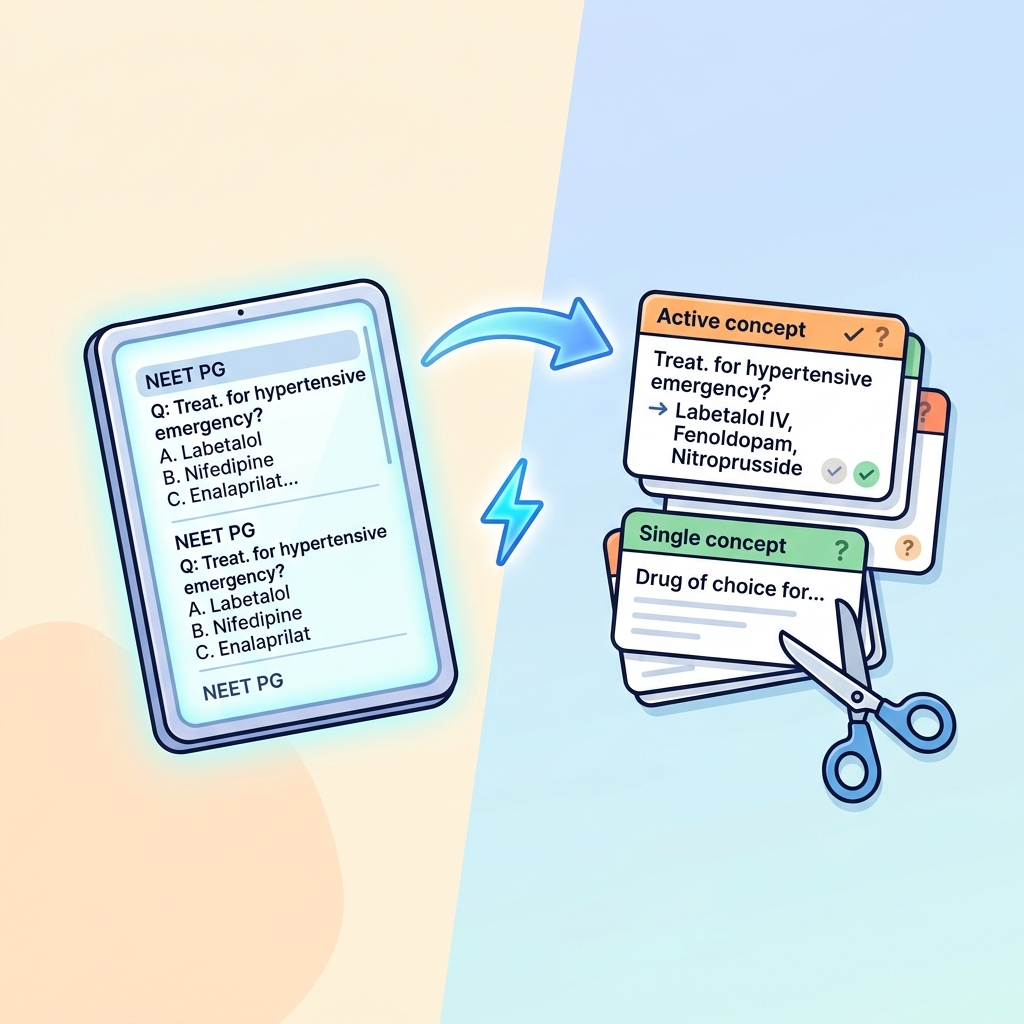
2. The 5-Second Surgical Capture Workflow
You don't upload entire textbooks into Floww. Instead, you capture the exact pivot point you struggled with during your active study session:
 Floww 5-Second Surgical Concept Capture Workflow from Notes to FSRS Queue
3. Pedagogical Format Intelligence
Floww's engine understands the pedagogical nature of medical facts:
- For Anatomical Relations & Biomarkers: It generates atomic Cloze Deletion cards where only the critical anatomical landmark or marker is blanked out.
- For Diagnostic Differentials: It generates Clinical Vignette Q&A cards, placing the presenting symptom complex on the front and the differential on the back.
- For Diagnostic Micrographs: It allows you to occlude histological features using image occlusion flashcards for anatomy and pathology.
Read our deep dive comparing Floww vs Revisable AI to see why generic document scanning cannot compete with medical-grade capture.
Comparison: Generic AI Scrapers vs Floww vs Manual Authoring
The following table summarizes the operational and cognitive differences between authoring approaches:
| Evaluation Dimension | Manual Typing (Anki/Notion) | Generic AI Scrapers (Revisable/PDF2Anki) | Floww Medical-Grade AI |
|---|---|---|---|
| Card Creation Speed | 2–3 minutes per card (Exhausting) | 1 click for 200 cards (Chaotic) | 5 seconds per targeted concept |
| Card Quality & Atomicity | High (if disciplined) | Very Poor (Paragraph-long clozes) | High (Strict Minimum Info Principle) |
| Medical Shorthand Support | Manual | Poor (Hallucinates abbreviations) | Full clinical abbreviation recognition |
| Handwritten Note Parsing | Impossible (Manual typing required) | Fails on margin annotations | Seamless handwritten workbook OCR |
| Average Review Time | 6–8 seconds | 18–25 seconds (Cognitive overload) | 4–6 seconds (Rapid mobile review) |
| Backlog & Burnout Risk | Low (few cards created) | Extremely High (Overwhelming volume) | Zero (Controlled surgical capture) |
| Spaced Repetition Engine | Legacy SM-2 (Ease hell risk) | Generic fixed intervals | Modern FSRS (Dynamic stability decay) |
| Mobile Integration | Clunky sync protocols | Web-only or basic mobile view | Native mobile workflow for duty hours |
Review our comprehensive guide on the best flashcard app for NEET PG to evaluate platform features across all 19 subjects.
Step-by-Step Tutorial: How to Build an Exam-Ready Deck in Floww
Here is the exact daily protocol used by top rankers to build and maintain high-yield decks using Floww's AI engine:
Step 1: Complete Your Conceptual Pass
Watch your regular video lecture (e.g. Marrow, PrepLadder, Cerebellum) or read through your main notes once to understand the physiological or clinical narrative. Do not create cards while watching the lecture; maintain active listening.
Step 2: Identify Volatile Facts During Question Practice
Immediately solve 30 to 50 topic-wise MCQs. Pay close attention to:
- Questions you got wrong.
- Questions you guessed correctly but felt uncertain about.
- Volatile memory facts (drug dosages, tumor markers, chromosomal loci, criteria thresholds).
Step 3: Capture the Concept via Floww Photo-to-Card
Open the Floww mobile app or desktop workstation:
- Tap Create → AI Photo Capture.
- Point your camera at your handwritten note, BTR table, or question bank explanation.
- Floww's medical AI analyzes the text, isolates the clinical association, and presents a preview of 2 to 4 atomic cards.
- Verify the cards (make any quick edits if desired) and tap Add to Deck.
Step 4: Clear Your Daily FSRS Queue Every Morning
Spend 15 to 25 minutes reviewing your daily spaced repetition queue before starting new topics. Because Floww cards are strictly atomic, you will easily review 150 to 200 cards in 20 minutes, locking volatile facts into permanent memory without cognitive fatigue. Learn how to optimize your daily volume in our guide on how many flashcards to do per day for NEET PG.
Best Practices to Avoid Flashcard Pitfalls
Even with advanced AI tools, disciplined study habits remain paramount. Avoid these critical mistakes:
- Don't Card Everything: Flashcards are for volatile facts and diagnostic decision points, not general prose. Never card basic concepts you easily understand. Review our guide on the 7 deadly flashcard mistakes medical students make.
- Always Review the AI Preview: Floww’s medical AI achieves near-perfect clinical accuracy, but you should always spend 2 seconds verifying the card preview before adding it to your deck. The act of previewing reinforces your cognitive ownership.
- Keep Card Review Paced: If you spend longer than 10 seconds staring at a card, mark it as "Hard" or "Again." Spaced repetition works through rapid, frequent retrieval drills—not prolonged contemplation.
- Tag Cards by Subject & Source: Use Floww's built-in tagging system (
#Pharma #AntiArrhythmics #GT-Error) to quickly filter your deck before grand tests or subject exams.
Conclusion: Reclaim 10 Hours a Week with Clinical AI
In competitive medical entrance exams, your time is your most precious and perishable asset.
Spending 15 hours every week manually typing flashcards on a laptop is a luxury no medical aspirant or hospital intern can afford. But relying on generic AI tools that dump hundreds of noisy, paragraph-long cards into your queue is a recipe for study burnout and review debt.
Floww gives you the best of both worlds: the surgical precision of custom-crafted atomic flashcards with the instantaneous speed of modern medical AI.
Stop wasting hours on mechanical typing. Stop drowning in unvetted PDF dumps. Take back control of your study schedule, master the 19 subjects with clinical confidence, and let intelligent spaced repetition power your rank.
Explore Floww’s flexible options on our Pricing Page or start generating clinical flashcards today at app.floww.website/login.

Written by Floww Editorial
Medical Learning Editorial Team
Evidence-led guidance for NEET-PG and INI-CET preparation, focused on active recall, spaced repetition, and sustainable revision workflows.