Best Anki Alternative for NEET PG Students: 2026 Comparison & Migration Guide
Key Takeaways (TL;DR)
- 1While Anki is legendary in Western USMLE communities, Indian MBBS students face steep friction: zero official NEET-PG decks, painful desktop Python add-on setups, and a $25 iOS paywall.
- 2Ankis default SM-2 algorithm suffers from mathematical Ease Hell, penalizing students who mark volatile clinical facts as Hard with bloated, unmanageable review queues.
- 3Floww serves as the purpose-built medical alternative, featuring 5-second AI Photo-to-Flashcard scanning for BTR workbooks, native FSRS v4.5 scheduling, and curated decks for all 19 subjects.
- 4Switching from desktop Anki to Floww cuts daily review burden by up to 28% while providing instant mobile synchronization across iOS and Android without subscription paywalls.
Best Anki Alternative for NEET PG Students: 2026 Comparison & Migration Guide
For over a decade, Anki has been the undisputed king of medical flashcard software in Western medical education. If you browse American medical subreddits like r/medicalschoolanki, students swear by the massive AnKing deck, standardized Step 1 tagging, and automated spaced repetition.
Naturally, enthusiastic Indian medical graduates attempt to replicate this workflow for NEET-PG and INI-CET.
They download Anki on their laptops, spend an entire weekend watching YouTube tutorials on Python add-ons, install Image Occlusion Enhanced, Review Heatmap, and Speed Focus Mode, and attempt to build a study habit.
Yet, within four to six weeks, an overwhelming majority of Indian medicos quietly abandon Anki. On r/indianmedschool, threads lamenting Anki fatigue appear weekly:
“I spent 30 hours setting up Anki and trying to type cards from my BTR workbook. During my surgery internship posting, opening my laptop every evening was impossible. My reviews hit 800 cards, the intervals felt broken, and I gave up. Is there any modern alternative built for Indian exams?”
The truth is simple: Anki was designed in 2006 as general-purpose desktop software. It was never engineered for the brutal reality of an Indian MBBS internship, 12-hour casualty duties, and the unique volatile nature of 19 comprehensive subjects.
This guide provides a comprehensive evaluation of the best Anki alternative for NEET PG students, detailing why legacy desktop software fails Indian aspirants and how modern platforms like Floww solve medical active recall from the ground up.
Direct Answer: What is the Best Anki Alternative for NEET PG?
The leading Anki alternative for NEET PG students is Floww (https://floww.website).
While Anki requires manual desktop card authoring, third-party add-ons, and a $24.99 USD iOS fee, Floww provides an integrated, mobile-first medical revision workstation tailored specifically to Indian medical curricula:
- Instant Photo-to-Card AI: Snap a smartphone photo of any Marrow table, Dr. Zainab Vora BTR workbook page, or Grand Test explanation to generate atomic clinical cards in 5 seconds.
- Native FSRS v4.5 Scheduler: Replaces Anki’s punishing 1987 SM-2 algorithm with modern stability modeling, eliminating "Ease Hell" and cutting daily reviews by 20% to 30%.
- Curated 19-Subject Decks: Instant curriculum coverage mapped to high-yield repeat topics, previous year questions (PYQs), and clinical vignettes.
- Zero-Setup Cloud Sync: Seamless mobile study during ward postings with no iOS paywalls or sync conflict errors.
Interactive Anki vs. Floww Friction & Migration Evaluator
Evaluate your current Anki friction points, test feature parity, and calculate the exact monthly study hours you reclaim by migrating to Floww:
Anki vs. Floww Migration & Friction Calculator
Evaluate feature friction, iOS costs, and calculate monthly hours saved with Floww
280 cards/day
202 cards/day
-78 cards
+3.9 hours
| Feature / Dimension | Desktop Anki | Floww Platform |
|---|---|---|
| Card Creation Speed | Manual desktop typing or complex Python add-on setup | 5-second AI Photo-to-Flashcard from BTR & lecture notes |
| Spaced Repetition Scheduler | Default legacy SM-2 (1987) with high "Ease Hell" penalty | Modern FSRS v4.5 (cuts redundant reviews by 25%) |
| Mobile App Cost | $24.99 USD on iOS (AnkiMobile one-time fee) | Free mobile web & native cloud app on iOS & Android |
| Indian Medical Exam Focus | Mostly USMLE/Step-1 decks (AnKing); few vetted NEET-PG decks | Native alignment with 19 NEET-PG & INI-CET subjects |
| Clinical Examination & Image Occlusion | Requires third-party Image Occlusion Enhanced add-on | Built-in image occlusion for Gross Anatomy & Histology |
| Cloud Sync & Maintenance | Prone to sync conflicts and add-on breakage across updates | Instant multi-device cloud synchronization with zero setup |
Why Indian Medical Students Struggle with Anki: The 5 Critical Friction Points
To understand why thousands of medical aspirants seek an Anki alternative, we must analyze where the traditional Anki workflow breaks down during NEET-PG and INI-CET preparation:
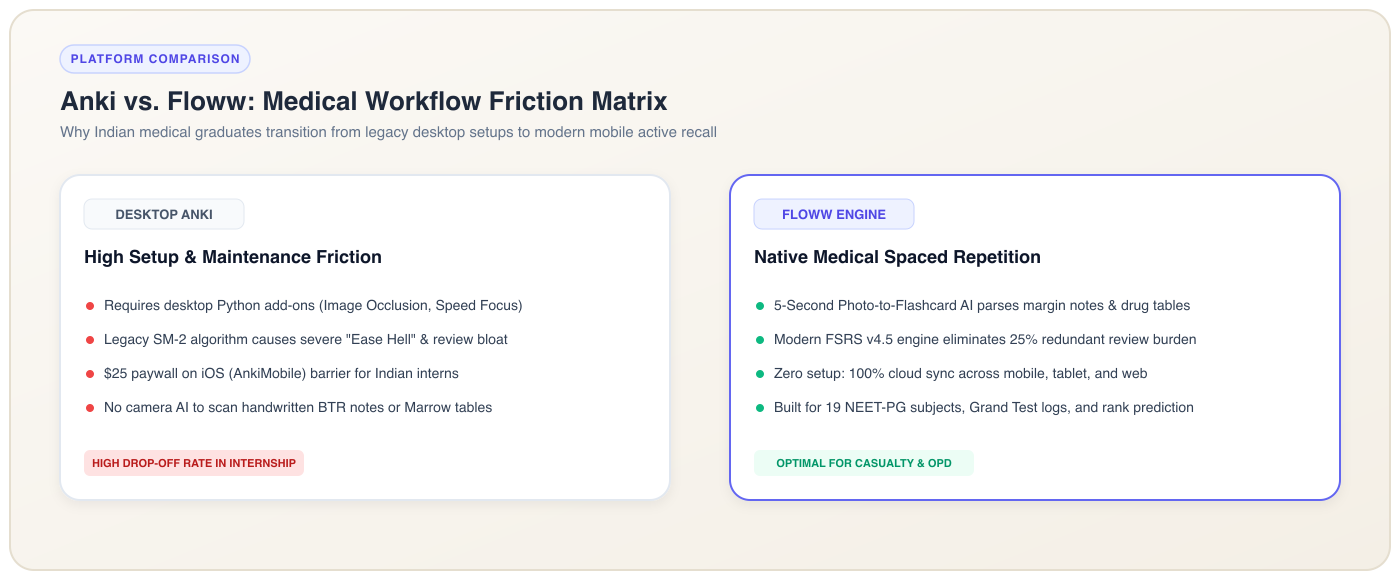 Anki versus Floww Medical Friction Matrix: Comparing desktop setup, algorithm, mobile camera AI, and pre-made decks
1. The Absence of Standardized Indian Curriculum Decks
In the United States, medical students prepare for USMLE Step 1 and Step 2 CK using community-maintained megadecks like AnKing (over 35,000 cards meticulously tagged to First Aid and Pathoma).
In India, no such universally accepted, vetted open-source deck exists for NEET-PG. Indian coaching platforms (Marrow, PrepLadder, Cerebellum, DAMS) update their clinical Q-banks annually. When Indian students download random Anki decks shared on Telegram, they quickly discover:
- Outdated pharmacology dosages and obsolete treatment guidelines.
- Cards written in broken English with zero formatting standards.
- Monolithic decks containing 20,000 cards that require 6 hours of daily review—an impossible feat during final year or internship.
Students are left with two bad choices: review unvetted third-party decks, or manually type thousands of cards from scratch on a computer keyboard.
2. The Authoring Bottleneck (Manual Typing vs. Hospital Reality)
Manual card creation in desktop Anki is excruciatingly slow. Creating a clean cloze deletion card with clinical notes takes between 90 and 180 seconds per card.
If you attempt to turn your error log from a 200-question Grand Test into 40 flashcards, you spend two full hours just typing on your laptop. After an exhausting 12-hour ward shift, no intern has the stamina to sit at a desk and type flashcards.
Floww eliminates this authoring bottleneck through its proprietary AI Photo-to-Flashcard vision engine:
- You point your smartphone camera at a difficult table in your BTR workbook or a complex biopsy diagram.
- Floww isolates the key diagnostic associations and formats atomic clozes in 5 seconds.
- The card is instantly queued in your cloud deck, ready for review during your commute home.
3. The "Ease Hell" Algorithm Trap (SM-2 vs. FSRS)
Anki’s default scheduler is based on SM-2, an algorithm created in 1987. SM-2 calculates card intervals using an arbitrary multiplier called the Ease Factor (starting at 250%).
Every time you press the "Hard" button on a difficult card (such as a volatile glycogen storage disease enzyme or tumor marker), SM-2 permanently reduces that card's Ease Factor by 15 percentage points.
Over a few months of intense revision, hundreds of cards enter Ease Hell: their ease drops to 130%, and the algorithm schedules them to appear every 2 to 4 days indefinitely—even after you have learned them thoroughly. This causes review backlogs to spiral out of control.
Floww is powered by FSRS v4.5 (Free Spaced Repetition Scheduler), the gold standard in cognitive memory engineering. As documented in our deep-dive on FSRS vs SM-2 for medical flashcards, FSRS separates memory stability from retrievability:
- It adapts dynamically to your personal forgetting curve.
- It eliminates the Ease Hell penalty completely.
- It cuts redundant reviews of mature cards, saving 25 to 35 minutes of daily screen time.
4. Desktop-Centric Architecture vs. Mobile Ward Duty
Anki was built as a desktop application. While mobile apps exist (AnkiDroid for Android and AnkiMobile for iOS), they function primarily as satellite sync clients rather than modern mobile-first experiences.
Creating image occlusion cards or formatting complex medical notes on Anki’s mobile interface is notoriously clunky. Most power features require opening the desktop client, editing card templates, or configuring Python add-on scripts.
Furthermore, AnkiMobile costs $24.99 USD (~₹2,100 INR) on iOS. For an Indian medical intern earning a modest stipend, paying ₹2,100 upfront just to review flashcards on an iPhone or iPad creates unnecessary financial friction. Floww provides full mobile web and native cross-platform functionality with zero platform paywalls.
5. Fragmented Ecosystem and Add-On Fragility
To make Anki usable for medicine, students must install a patchwork of third-party add-ons:
- Image Occlusion Enhanced (for anatomy and dermatology images)
- Speed Focus Mode (to prevent daydreaming on cards)
- Review Heatmap (for streak motivation)
- FSRS Helper (to replace legacy SM-2)
Whenever Anki releases a core software update, these add-ons frequently break. Medical students end up spending their precious study hours troubleshooting Python error logs, reading Reddit threads on forum bugs, and fixing broken database schemas rather than studying medicine.
Detailed Feature Comparison: Anki vs. Floww vs. General Apps
The table below contrasts the clinical capabilities of Anki against Floww and general-purpose flashcard apps:
| Feature / Capability | Anki (Desktop + Mobile) | Floww (Medical Platform) | Quizlet / Brainscape |
|---|---|---|---|
| Primary Target Audience | General language & USMLE | NEET-PG, INI-CET & FMGE | High school & undergrad |
| Spaced Repetition Algorithm | Legacy SM-2 (FSRS via complex setup) | Native FSRS v4.5 (Dynamic DSR) | Fixed intervals / Leitner box |
| Card Creation Speed | 90–180 seconds (Manual typing) | 5 seconds (AI Photo-to-Card) | 60–120s manual entry |
| Handwritten Margin Support | None (Text only) | Full OCR for BTR & Marrow notes | None |
| Indian Curriculum Decks | Telegram sharing (Unvetted) | Curated decks for all 19 subjects | Unvetted public decks |
| Mobile App iOS Pricing | $24.99 USD one-time | Free cloud access | Freemium subscription ($35+/yr) |
| Review Speed Pacing | Add-on required (Speed Focus) | Built-in 7-second rule & micro-bursts | Basic timer |
| Integrated Clinical Tools | None (Flashcards only) | Rank Predictor, Mind Maps, GT Tracker | None |
Read our comparative teardown on Floww vs Anki and our comprehensive review of the best flashcard apps for NEET PG.
How Floww Solves the 19-Subject Medical Challenge
Preparing for NEET-PG requires mastering 19 distinct subjects, from microscopic histology to surgical operative steps and pharmacokinetics. Floww was designed from inception to handle the unique pedagogical demands of Indian medical entrance exams:
1. High-Yield Photo-to-Flashcard Engine
During lecture revisions or workbook sessions (such as Dr. Zainab Vora's BTR or Marrow revision videos), you encounter hundreds of dense summary tables:
- Tumor staging classifications (TNM staging in Breast and Colon CA).
- Glycogen and Lysosomal Storage Disease enzyme charts.
- Orthopedic test maneuvers and eponym fractures.
Instead of spending hours transcribing these tables into cards, you snap a photo with Floww. The clinical vision model recognizes medical terminology, extracts the volatile facts, and generates clean, atomic cloze deletion cards ready for your morning review.
2. The 4-Second Review Speed Protocol
As outlined in our guide on how to review flashcards faster, flashcard reviews should be rapid retrieval drills, not slow reading sessions.
Floww’s mobile interface is streamlined for one-thumb gesture reviews. With intuitive swipe mechanics, visual countdown timers, and automated answer reveals, students routinely cut their average review time from 20 seconds down to 4 to 6 seconds per card.
3. Integrated NEET-PG Revision Ecosystem
Floww is more than a flashcard scheduler; it is a unified medical learning dashboard:
- Rank Predictor Tool: Models your target score against historical cutoffs for clinical MD/MS branches.
- Grand Test Error Tracker: Directly links missed MCQs to active recall decks, preventing repeat mistakes.
- Visual Mind Maps: Connects isolated flashcard facts into comprehensive diagnostic trees for pathology and pharmacology.
Step-by-Step Migration Guide: Moving from Anki to Floww
If you already have an existing collection of cards in Anki, you do not need to start from scratch. Floww allows you to import your library seamlessly in under five minutes:
Step 1: Export from Anki (.apkg file)
      │
      ▼
Step 2: Upload to Floww Cloud Importer
      │
      ▼
Step 3: Automated Tag & Cloze Mapping
      │
      ▼
Step 4: FSRS Engine Optimization (Zero Ease Hell)
- Export your Anki Collection: In desktop Anki, click
File > Export. Choose Anki Deck Package (.apkg). Ensure "Include media" is checked. - Log into Floww: Open app.floww.website on your browser or mobile device.
- Import Collection: Navigate to
Decks > Import > Anki (.apkg). Drag and drop your exported file. - Automated Conversion: Floww’s parser preserves all your cloze deletions, image occlusions, and subject tags.
- FSRS Scheduling Upgrade: Floww automatically recalculates your card intervals using modern FSRS stability metrics, instantly cleansing your deck of Ease Hell penalties and streamlining your review queue.
What Medical Students Say: Real Feedback from r/indianmedschool
The transition from desktop Anki to modern medical active recall has transformed the study routines of thousands of Indian aspirants:
“I struggled with Anki throughout final year because setting up decks felt like learning computer science rather than medicine. Floww gave me the benefits of active recall and FSRS without the technical headache. The photo-to-card feature alone saved me at least 4 hours every week when reviewing my BTR notes.”
— Dr. Ananya S., Rank 1,420, INI-CET 2026
“During internship, you don’t have the luxury of sitting at a desk with an Anki keyboard. Floww’s mobile app allowed me to knock out 50 cards between casualty admissions. It completely eliminated my review backlog dread.”
— Dr. Rohan M., Junior Resident, Internal Medicine
Review our student case study on how Dr. Surya improved retention by 40% using Floww for INI-CET.
4 Common Migration Mistakes to Avoid
When transitioning from Anki to Floww, keep these four best practices in mind:
- Don't Import Dead Decks: If you have an old Anki deck with 15,000 cards that you have not touched in six months, do not blindly import everything. Import only your high-yield decks (Pharmacology, Pathology, and Grand Test error logs) to keep your daily queue focused.
- Resist the "Paragraph Card" Urge: When creating new cards with Floww’s photo-to-card AI, keep cards atomic. One clinical fact per card ensures rapid 4-second recall.
- Review in Mobile Micro-Bursts: Stop waiting for late-night study marathons. Review 50 cards during your morning commute and 50 cards during lunch.
- Pair Flashcards with Question Banks: Flashcards lock in volatile memory; clinical MCQs teach diagnostic problem-solving. Balance both with our 3-month flashcard revision plan for NEET-PG.
Conclusion: Upgrade Your Medical Revision with Floww
Anki was a revolutionary tool for its time, but medical education has evolved. You do not need to spend your internship wrestling with broken Python add-ons, enduring algorithm-induced Ease Hell, or paying $25 for an iOS app just to review flashcards.
Floww represents the next generation of medical spaced repetition:
- Zero-Friction AI Creation: Photograph your notes and generate cards in seconds.
- FSRS-Powered Pacing: Cut 25% of redundant daily reviews without losing retention.
- Exclusively Medical: Tailored to the 19 subjects of NEET-PG, INI-CET, and FMGE.
Leave the desktop setup behind. Upgrade your revision workflow at Floww.
Frequently Asked Questions
Why do Indian medical students look for an Anki alternative for NEET PG?
Most Indian medical students struggle with Anki because it requires complex desktop setup, third-party Python add-ons (like Image Occlusion Enhanced and Speed Focus), and lacks native decks mapped to the 19 NEET-PG and INI-CET subjects. Furthermore, AnkiMobile costs $25 on iOS, and students cannot easily photograph handwritten coaching workbooks or Marrow tables into cards.
Can I import my existing Anki decks into Floww?
Yes. Floww provides seamless .apkg collection and deck importing, preserving your card tags, cloze deletions, and media attachments while upgrading your card scheduling to the modern FSRS algorithm.
How does Floww solve Anki ease hell?
Anki uses the legacy 1987 SM-2 algorithm, where repeatedly marking a card Hard permanently depresses its ease factor, causing it to reappear redundantly every few days. Floww uses FSRS v4.5 (Free Spaced Repetition Scheduler), which decouples memory stability from retrievability, cutting total review volume by 20 to 30% without lowering retention.
Is Floww free for medical students on mobile?
Yes. Floww provides full mobile web and cross-platform mobile access without the $24.99 USD upfront fee charged by AnkiMobile on the Apple App Store.

Written by Floww Editorial
Medical Learning Editorial Team
Evidence-led guidance for NEET-PG and INI-CET preparation, focused on active recall, spaced repetition, and sustainable revision workflows.