Best Flashcard App for NEET PG (2026): Floww vs Anki vs Neuroflip vs Revisable
Key Takeaways (TL;DR)
- 1The best flashcard app for NEET-PG must solve the 19-subject volume crisis: combining an adaptive spaced repetition algorithm (FSRS) with instant capture for Grand Test (GT) mistakes.
- 2Floww ranks as the top all-in-one workstation for Indian medical graduates, pairing 40,000+ curated high-yield clinical cards with 5-second AI photo-to-card creation and modern FSRS scheduling.
- 3Anki remains a formidable open-source powerhouse for desktop tinkerers with months to spare, but steep configuration curves, lack of native Indian exam decks, and legacy SM-2 ease hell cause high abandonment among busy interns.
- 4Neuroflip offers pre-packaged rapid revision notes but completely locks users out of custom card creation, while Revisable AI generates noisy, text-dense document cards that violate atomic active recall principles.
Best Flashcard App for NEET PG (2026): Floww vs Anki vs Neuroflip vs Revisable
Every Indian medical graduate preparing for NEET-PG and INI-CET eventually confronts the same brutal reality: the 19-subject syllabus is physically impossible to retain through conventional re-reading.
Between 800-page coaching workbooks, 200-question weekly Grand Tests on Marrow or PrepLadder, and grueling 12-hour clinical duty shifts during internship, human memory decays rapidly. According to classic cognitive retention research by Roediger and Karpicke (Psychological Science, 2006), passive review strategies like highlighting or re-reading produce a fragile illusion of competence that shatters under high-pressure clinical exam conditions. Retrieval practice—forcing the brain to pull volatile facts from memory—is the single strongest determinant of durable exam recall.
This pedagogical reality has sparked a massive migration toward spaced repetition flashcards. But with that migration comes a high-stakes decision:
Which is truly the best flashcard app for NEET PG?
If you choose the wrong platform, you will either spend two hours every night wrestling with clunky desktop add-ons, get locked into static decks that ignore your personal Grand Test mistakes, or drown in an unmanageable 600-card daily review backlog that forces you to abandon spaced repetition entirely three months before the exam.
In this definitive 2026 evaluation guide, the Floww Editorial team analyzes the five most prominent flashcard tools used by Indian medical aspirants—Floww, Anki / AnkiDroid, Neuroflip, Revisable AI, and Quizlet—across six core clinical criteria to help you build a bulletproof daily revision habit.
Direct Answer: Which Flashcard App is Best for NEET-PG?
For Indian medical students preparing for NEET-PG and INI-CET, Floww is the best overall flashcard platform in 2026. It combines an out-of-the-box library of 40,000+ curriculum-aligned high-yield flashcards with 5-second AI photo-to-card creation for Grand Test mistake logging, powered by the modern Free Spaced Repetition Scheduler (FSRS) to prevent review pileups.
Students with extensive technical patience and 2+ years before their exam can consider Anki, while students seeking passive faculty summary notes without custom card creation often look at Neuroflip. However, for interns and final-year students needing maximum retention in minimum daily time, Floww delivers the most complete, clinical-grade workflow.
NEET-PG Medical Flashcard App Decision Engine
Compare Floww, Anki, Neuroflip, Revisable, and Quizlet across the 6 clinical criteria that determine whether an app improves your GT percentile or causes study burnout.
Floww is your top recommendation
During internship or final preparation, you cannot afford 2 hours of manual desktop typing or Anki’s infamous "ease hell" backlog. Floww’s 5-second medical photo-to-card engine captures your Marrow/PrepLadder Grand Test mistakes immediately, while FSRS keeps daily reviews under 35 minutes.
The 6 Essential Criteria for Evaluating Medical Flashcard Apps
General academic study apps built for high school language learning or law school vocabulary fall apart when subjected to medical entrance preparation. To accurately rate each tool, we established six non-negotiable criteria tailored specifically to the Indian medical syllabus:
1. Spaced Repetition Algorithm & "Ease Hell" Prevention
A flashcard app is only as good as its scheduling math. Legacy tools rely on the SM-2 algorithm developed in the late 1980s. When you mark a card as "Hard" under SM-2, its ease factor drops permanently, trapping volatile clinical facts in an aggressive daily review loop known in medical student forums as Ease Hell.
Modern platforms implement FSRS (Free Spaced Repetition Scheduler) (Open Spaced Repetition, 2023), which models human memory stability and retrievability independently. FSRS reduces total review count by 20% to 30% without sacrificing target retention, preventing the catastrophic review pileups that cause students to quit.
2. Medical Curriculum & Pre-Made Deck Alignment
Does the platform offer pre-compiled decks specifically indexed to NEET-PG, INI-CET, and the Indian MBBS curriculum? While community decks exist for USMLE Step 1 (such as AnKing), their clinical focus diverges sharply from Indian exams:
- USMLE emphasizes underlying basic pathophysiology and generic drug names.
- NEET-PG and INI-CET heavily test volatile one-liners, Indian national health guidelines, forensic jurisprudence (IPC/BNS sections), trade names, and high-frequency PYQ repeat topics.
3. Grand Test (GT) Error Capture Speed
Your rank leap does not come from memorizing what everyone already knows; it comes from converting your 60–80 personal Grand Test mistakes into spaced repetition cards each week.
- If an app forces you to manually type questions on a laptop, authoring 60 mistake cards takes 2.5 to 3 hours.
- If an app offers medical vision AI, you photograph your tablet or workbook screen and generate clean, atomic cards in 5 seconds.
- If an app is read-only (like Neuroflip), you cannot capture mistake logs at all.
4. Support for Visual & Clinical Recall Formats
Medical exams are increasingly visual, featuring gross specimen pathology, CT/MRI cross-sections, histological staining, ECG strips, and anatomical plexuses. The best app must natively support:
- Image Occlusion: Masking specific anatomical structures or histological labels without leaving the app.
- Cloze Deletion: Testing specific enzyme cofactors or diagnostic thresholds within a clinical sentence.
- Two-Way Clinical Testing: Testing both symptom-to-diagnosis and diagnosis-to-investigation.
5. Mobile Usability During Hospital Postings
Medical interns do not study at desktop workstations for eight continuous hours. They study in 10-minute bursts: during morning rounds, in the casualty duty room, in hospital elevators, or during afternoon transport. An app must have a fast, frictionless mobile interface with offline synchronization and rapid one-handed review gestures.
6. Setup Overhead and Maintenance Friction
How many hours must you invest before reviewing your first card? Tools requiring third-party Python add-on installations, custom CSS styling templates, and manual database syncing introduce massive friction that derails study momentum.
In-Depth Analysis: The Top 5 Flashcard Apps for NEET PG
1. Floww: The Purpose-Built Medical Revision Workstation
Overall Rating: 9.8 / 10 | Best For: Interns, Post-Interns, and Final Year MBBS Aspirants
Floww was engineered specifically to solve the structural failure points of traditional flashcard software for Indian medical graduates. Rather than forcing students to choose between building cards from scratch or using static pre-made decks, Floww unifies both into an intelligent, end-to-end workstation.
Why Floww Tops the 2026 Rankings:
- Next-Generation FSRS Scheduling: Floww natively integrates FSRS 6+. Instead of punishing you with rigid intervals, Floww dynamically calculates memory decay curves based on syllabus volume. By eliminating redundant reviews on well-retained cards, Floww keeps your daily queue capped at a manageable 25–35 minutes. Read our deep dive on optimizing daily card counts for NEET PG.
- 5-Second AI Photo-to-Card Engine: When reviewing a Marrow, PrepLadder, or Cerebellum Grand Test, students simply snap a photo of the question explanation or physical workbook page. Floww’s domain-trained medical vision engine recognizes clinical abbreviations, parses structured pharmacological tables, and formats atomic cloze deletions instantly.
- Comprehensive 40,000+ Pre-Made Decks: Covering all 19 subjects—from high-yield volatile pharma mechanisms to forensic toxicology and surgical algorithms—curated specifically around previous years' question (PYQ) trends.
- Native Mobile Image Occlusion: Mask gross anatomy specimens, CT cross-sections, and dermatological rashes on your smartphone with zero external add-ons or desktop requirements.
Where Floww Can Improve:
- Floww is unapologetically focused on medical exams; students seeking non-medical flashcards (e.g., engineering, coding, or foreign languages) will find general tools more versatile.
2. Anki: The Open-Source Customization Titan
Overall Rating: 8.7 / 10 | Best For: 1st & 2nd Year MBBS Students with High Desktop Tolerance
For over a decade, Anki has stood as the gold standard of DIY spaced repetition. Its open-source architecture, vast ecosystem of user-created Python add-ons, and infinite styling customization have earned it an almost religious following on r/medicalschoolanki.
Strengths:
- Unrivaled Extensibility: If you want heatmap streaks, gamified review popups, custom font scripts, or specialized audio prompts, Anki has an add-on for it.
- Vast Community Pre-Made Ecosystem: Massive decks like the AnKing overhaul provide thousands of cards for USMLE Step 1 and basic science fundamentals.
- Zero Ongoing Cost (Desktop & Android): Completely free on Windows, Mac, Linux, and Android (via AnkiDroid).
Weaknesses for NEET-PG Aspirants:
- The Usability Wall: Anki’s desktop interface resembles a database software from 2004. Configuring card types, synchronizing profile media, and troubleshooting broken add-ons after software updates costs dozens of valuable study hours.
- $24.99 iOS Paywall: While AnkiDroid is free on Android, the official iOS app (AnkiMobile) costs $24.99—a frustrating barrier for iPad-first medical students.
- Manual Authoring Bottleneck: Anki has no native AI photo-to-card capability. Creating 50 high-yield mistake cards from a weekend Grand Test requires 2+ hours of manual keyboard typing. Read our head-to-head comparison in Floww vs Anki.
- Ease Hell Default: Anki still defaults to the legacy SM-2 algorithm. Enabling FSRS in modern Anki requires navigating advanced parameters, weights, and command-line settings that intimidate most clinical students.
3. Neuroflip: Static Rapid Revision Notes
Overall Rating: 6.4 / 10 | Best For: Passive Review of Standard Faculty Decks
Neuroflip gained traction among Indian medical aspirants by packaging popular rapid revision frameworks (such as Dr. Zainab Vora's BTR) into an accessible mobile interface.
Strengths:
- Zero Setup Time: Download the app, subscribe, and begin flipping through pre-written summary cards immediately.
- Clean Mobile UI: Intuitive, swipe-based mobile navigation designed for quick review sessions on the go.
The Critical Flaw: The "Read-Only" Wall
As we detailed in our analysis of Floww vs Neuroflip, Neuroflip's fatal flaw is that it completely lacks custom card creation:
- You cannot create flashcards for your personal Grand Test mistakes.
- You cannot snap photos of your own handwritten coaching notes or clinical diagrams.
- You cannot edit pre-made cards that contain confusing explanations.
Because competitive differentiation in NEET-PG comes from remediating your own unique diagnostic weaknesses, a closed, read-only flashcard app quickly turns into another passive reading tool rather than an active learning engine.
4. Revisable AI: Generic Document Scanning
Overall Rating: 5.9 / 10 | Best For: General College Students Scanning PDF Lecture Slides
Revisable AI attempts to solve the card authoring bottleneck by allowing students to upload entire PDFs, presentation decks, or chapter notes, which an AI model converts into flashcard decks automatically.
Strengths:
- Bulk Upload Speed: Converts an entire 40-slide PDF into a batch of flashcards within a minute.
- Modern Web Interface: Clean design with web and mobile access.
Why It Fails Medical Aspirants:
As analyzed in our teardown of Floww vs Revisable AI, generic document scanning models fail basic cognitive rules when applied to medicine:
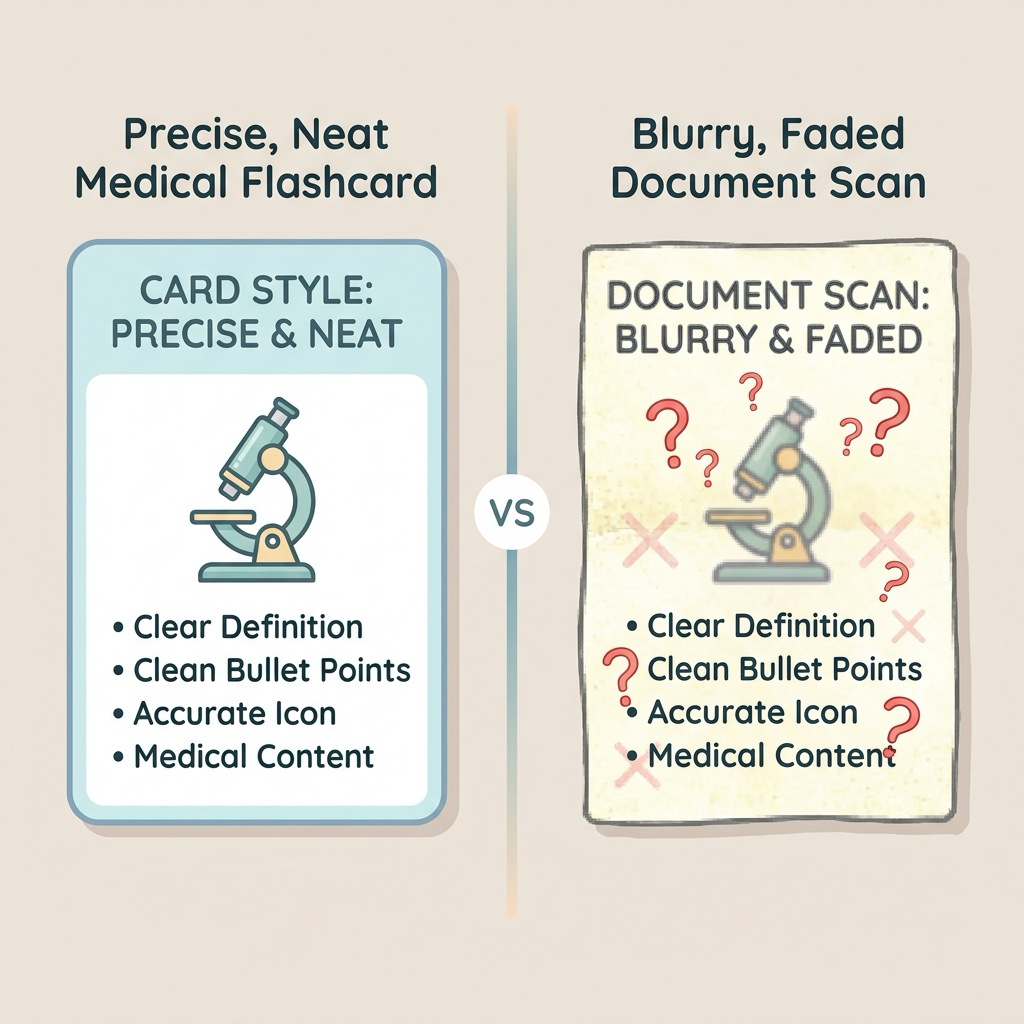
- Violation of the Minimum Information Principle: Revisable converts whole paragraphs into sentence-dense cards that take 20 seconds to read, destroying review momentum.
- Context Blindness: Generic OCR struggles with non-linear handwritten margin notes, clinical arrows, and dosage tables. The AI frequently hides irrelevant grammatical words (
"The","is","because") rather than high-yield clinical keywords, drug receptor subtypes, or diagnostic signs. - No Native Medical Image Occlusion: Cannot mask radiological imaging, histological sections, or anatomical plates.
5. Quizlet: General Vocabulary Platform
Overall Rating: 5.2 / 10 | Best For: High School Terminology & Language Vocabulary
Quizlet is arguably the world's most widely recognized flashcard application, renowned for its colorful study games, matching modes, and user-generated flashcard sets.
Strengths:
- Extremely Intuitive: Zero learning curve; anyone can start creating front/back cards in seconds.
- Cross-Platform Accessibility: Beautiful, snappy mobile and web apps.
Why It Is Inadequate for NEET-PG:
- No True Spaced Repetition on Free Tier: Quizlet has progressively moved its best learning modes behind expensive subscription paywalls, and its core algorithm lacks clinical memory stability modeling.
- Uncurated Community Decks: While millions of cards exist on Quizlet, the vast majority are authored by high school students or undergraduate learners, riddled with inaccuracies, outdated medical guidelines, and incomplete answers.
- Zero Advanced Medical Formats: Lacks nested cloze deletions, FSRS retention tuning, and clinical vignette workflows. Compare details in our Floww vs Quizlet breakdown.
Side-by-Side Comparison Matrix (2026)
The following summary matrix illustrates how the five platforms compare across key technical, pedagogical, and financial metrics:
| Feature / Metric | Floww | Anki | Neuroflip | Revisable AI | Quizlet |
|---|---|---|---|---|---|
| Spaced Repetition Algorithm | FSRS 6+ (Native) | SM-2 (FSRS optional) | Fixed Timer | Basic Spaced | Leitner / Basic |
| Pre-Made NEET-PG Decks | 40,000+ Curated Cards | USMLE Focus (AnKing) | BTR Summary Notes | None (BYO Notes) | Uncurated User Decks |
| AI Photo-to-Card Creation | 5 Seconds (Medical AI) | None (Manual only) | ❌ Locked (0 Custom) | Document Bulk OCR | Manual Typing |
| Grand Test Error Logging | Instant & Seamless | Slow (2–3 min/card) | ❌ Impossible | Noisy / Paragraphs | Manual Only |
| Image Occlusion | Native Mobile & Web | Desktop Add-on | ❌ None | ❌ None | Basic Paywalled |
| Cloze Deletion Formats | Atomic & Multi-part | Advanced (c1, c2, c3) | Fixed Bullets | Auto Paragraphs | Basic Fill-in |
| Mobile App Usability | Frictionless iOS & Android | Clunky ($24.99 on iOS) | Mobile-friendly | Mobile-friendly | Excellent UI |
| Ease Hell Vulnerability | Zero (Stability Math) | High (SM-2 Default) | High (Rigid Queue) | Moderate | N/A |
| Pricing Model | Generous Free Tier | Free (except iOS) | Paid Subscription | Monthly Sub / Tokens | Freemium / Paywalled |
| Overall NEET-PG Score | 9.8 / 10 | 8.7 / 10 | 6.4 / 10 | 5.9 / 10 | 5.2 / 10 |
How to Choose: Recommendations by Student Persona
Every medical student's preparation situation is unique. Here is how to select the right platform based on your current MBBS stage and time constraints:
Scenario A: The Busy Intern or Post-Intern (Extreme Time Crunch)
- Daily Study Time: 30 to 60 minutes between ward postings or night duties.
- Primary Goal: Quickly log 60+ Grand Test mistakes each weekend and maintain daily retention of volatile pharma/micro/forensic one-liners.
- Recommended App: Floww.
- Why: You cannot afford to waste 2 hours configuring desktop Python scripts or typing cards manually. Floww’s instant photo capture lets you convert Marrow/Prep mistakes into cards in seconds, while FSRS ensures you only review what you are about to forget.
Scenario B: The 1st or 2nd Year MBBS Student (Building Foundations)
- Daily Study Time: 2 to 3 hours of dedicated library or desk study.
- Primary Goal: Deep long-term memorization of USMLE-style basic sciences (Robbins Pathology, Guyton Physiology, Katzung Pharmacology).
- Recommended App: Floww or Anki + AnKing.
- Why: If you have 30+ months before your competitive entrance exam, enjoy desktop software configuration, and want to utilize the massive community AnKing deck, Anki is a viable option. However, make sure you configure FSRS in Anki to avoid ease hell over a multi-year period. If you want zero setup friction, Floww provides the same cognitive rigor out of the box.
Scenario C: The Student Transitioning from Handwritten BTR Notes
- Daily Study Time: 1 to 2 hours of rapid revision workbook review.
- Primary Goal: Digitizing high-yield tables, mnemonics, and volatile clinical thresholds from coaching workbooks like Dr. Zainab Vora's BTR.
- Recommended App: Floww.
- Why: While Neuroflip tempts students with pre-written BTR notes, its read-only architecture prevents you from adding your own annotations or test mistakes. Floww allows you to photograph your actual annotated workbook pages and turn high-yield tables into active recall cloze cards in seconds. Learn card authoring best practices in our guide to cloze deletion vs basic flashcards.
4 Common Flashcard Traps to Avoid for NEET-PG
Regardless of which application you choose, your study habits determine whether spaced repetition elevates your GT scores or wastes your time. Watch out for these four common pitfalls:
1. Falling into the "Deck Hoarding" Delusion
Downloading twelve different Anki decks or saving 25,000 cards in your library does not equal learning. Medical students on Reddit frequently report downloading 30,000-card USMLE decks, completing 500 cards in week one, and abandoning the app entirely by week three when their daily review queue balloons to 800 cards. Start small: master 50 high-yield cards a day before expanding your deck volume.
2. Violating the Minimum Information Principle
A flashcard must test one atomic concept. If your card prompt contains four clinical symptoms, two differential diagnoses, and an entire treatment algorithm on a single card, your brain will recognize surrounding grammatical syntax rather than retrieving the medical fact. Keep cards laser-focused on single clinical associations. See our full guide on how to make medical flashcards for NEET PG.
3. Neglecting Your Grand Test Mistake Log
The greatest predictive indicator of your NEET-PG rank is your performance on 200-question Grand Tests. The questions you get wrong or mark as doubtful are your most valuable study assets. If you fail to convert those specific mistakes into spaced repetition cards, you are guaranteed to repeat the same cognitive errors on exam day.
4. Relying on Legacy SM-2 Intervals Without Retention Tuning
If your platform uses the old SM-2 algorithm, hitting "Hard" repeatedly penalizes the card's ease factor and traps you in an unsustainable review cycle. Choose a platform powered by FSRS so your review intervals adapt scientifically to your memory decay rates.
Final Verdict
Spaced repetition is not an optional study hack—it is the only statistically proven methodology for mastering the massive 19-subject Indian medical syllabus.
While Anki remains a legendary open-source tool for desktop tinkerers with extensive time, Floww has established itself as the modern standard for NEET-PG and INI-CET aspirants. By uniting 40,000+ curriculum-aligned cards, instant 5-second AI photo-to-card creation for Grand Test mistake logging, and next-generation FSRS memory scheduling, Floww delivers the highest retention dividend per minute of study time.
Start building your personal medical revision workstation today: explore our interactive active recall guide, test your study pacing with the daily card calculator, and discover how Floww transforms your daily revision into exam-day confidence.
Written by Floww Editorial
Medical Learning Editorial Team
Evidence-led guidance for NEET-PG and INI-CET preparation, focused on active recall, spaced repetition, and sustainable revision workflows.