Cloze Deletion vs Basic Flashcards for Medical Students: Cognitive Science and Exam Strategies
Key Takeaways (TL;DR)
- 1Cloze deletions excel at memorizing discrete, highly volatile medical facts (drug mechanisms, antibody markers, anatomical boundaries) with average review speeds of 4–6 seconds per card.
- 2Basic Q&A flashcards require front-to-back cognitive synthesis (10–15 seconds per review), making them far superior for differential diagnoses, vignette-based clinical reasoning, and Grand Test mistake logging.
- 3The biggest danger of pure cloze decks is the "Context Clue Trap"—students inadvertently memorize sentence syntax, font patterns, or neighboring words instead of the underlying medical pathophysiology.
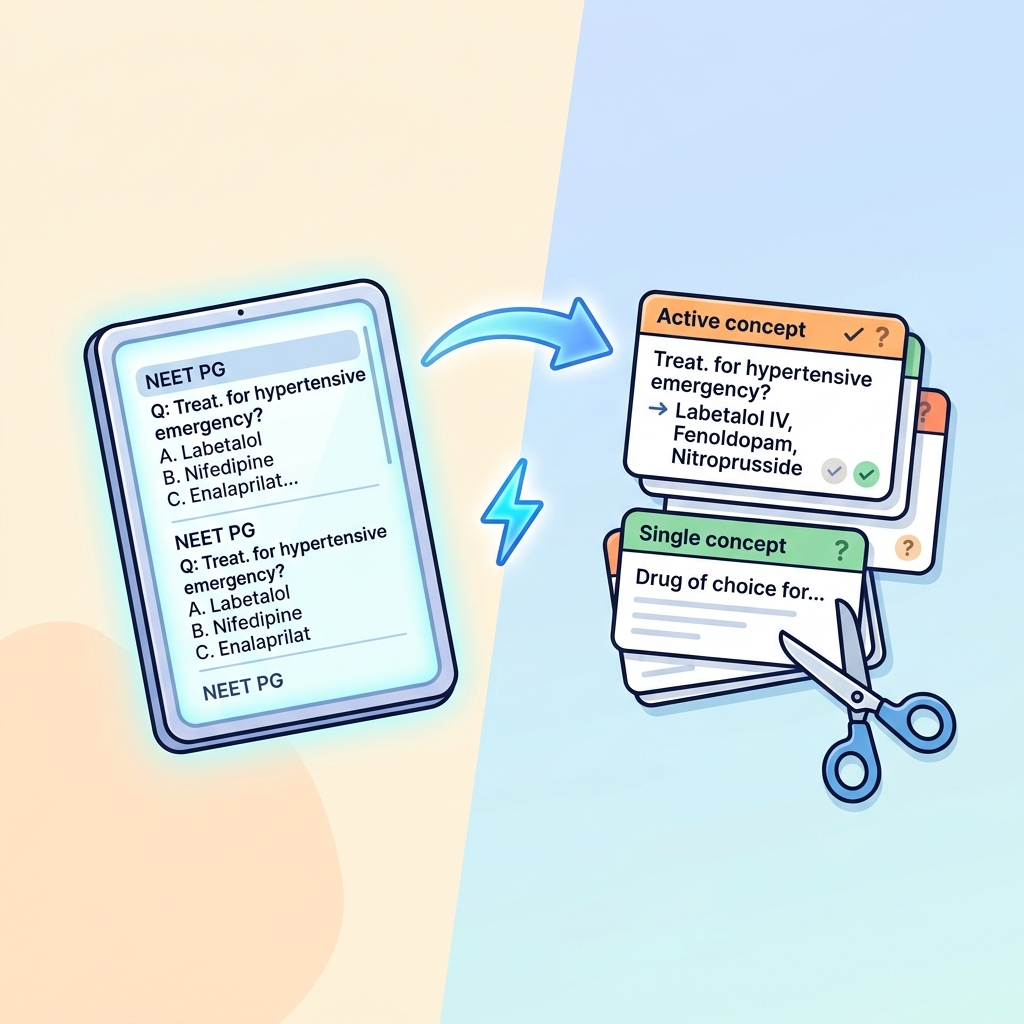
- 4A balanced 70/30 cloze-to-basic ratio combines rapid daily review volume with deep clinical decision-making, while Floww’s targeted photo-to-card workflow lets you generate both card types in 5 seconds.
Cloze Deletion vs Basic Flashcards for Medical Students: Cognitive Science and Exam Strategies
Medical school demands an unprecedented degree of memory management. Across nineteen subjects for exams like NEET-PG, INI-CET, and USMLE Step 1, students must permanently encode thousands of drug side effects, genetic markers, anatomical relationships, and diagnostic algorithms.
When adopting spaced repetition, one architectural decision determines your daily efficiency: Should you build Cloze Deletion cards or Basic Question-and-Answer flashcards?
Step into any medical discussion on Reddit—from r/indianmedschool to r/medicalschoolanki—and you will find passionate advocates on both sides. Some students insist that clozes are the only way to review 400 cards before morning clinical postings. Others caution that relying exclusively on clozes creates "illusion of competence" where you can complete sentences on your phone screen but freeze when facing an unfamiliar clinical vignette in a 3-hour Grand Test.
In this deep dive, we break down the cognitive mechanics, speed metrics, structural vulnerabilities, and optimal subject-by-subject distribution between Cloze Deletions and Basic Flashcards.
What is the difference between Cloze Deletion and Basic flashcards?
At their core, both formats trigger the testing effect—the well-documented cognitive principle that active retrieval produces significantly greater long-term memory retention than re-reading or highlighting (Roediger & Butler, Trends in Cognitive Sciences, 2011). However, they engage distinct neurological pathways:
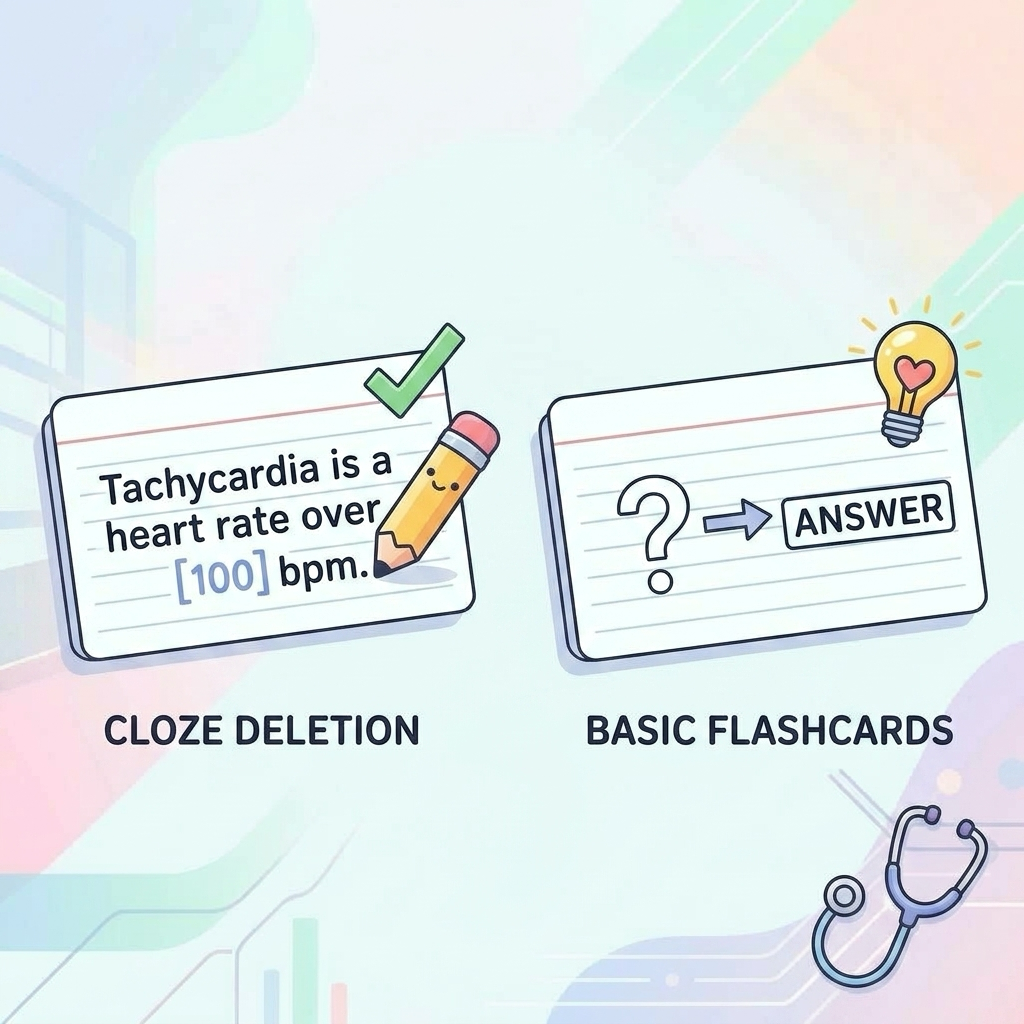
- Cloze Deletion Cards: A cloze deletion takes a sentence, table, or paragraph and replaces one or more target phrases with a bracketed prompt (e.g.,
[...]). The learner reads the surrounding sentence and retrieves the missing word. Because the grammatical framework remains intact, cognitive friction is low, allowing rapid evaluation in 3 to 6 seconds per review. - Basic (Front/Back) Cards: A basic card isolates the prompt from the answer entirely. The front presents an explicit question or clinical case vignette, and the back reveals the explanation. Retrieval requires unguided cognitive reconstruction without syntactic crutches, taking 8 to 15 seconds per card.
Cloze Deletion vs Basic Card Head-to-Head
Toggle between formats to feel the cognitive difference and spot the context clue trap.
The classic clinical triad of Horner's syndrome consists of [ ... ] , [ ... ] , and [ ... ] caused by sympathetic pathway disruption.
When Cloze Wins
Rapid retention of drug classes, enzymes, and anatomy landmarks. You can complete 200+ cards in 30 minutes with zero authoring fatigue.
When Basic Wins
Multi-step clinical diagnosis, pathophysiology chains, and Grand Test mistake logs where you must synthesize symptoms without sentence hints.
To understand how each format shapes memory in medical preparation, we must examine their strengths, cognitive traps, and clinical utility.
When to use Cloze Deletions in medical preparation
Cloze deletions have become the de facto standard of the medical flashcard revolution for good reason: they minimize authoring friction and maximize review velocity.
1. High-volume volatile data
Medical exams test massive amounts of arbitrary pairing data that cannot be deduced through first-principles logic. Examples include:
- Pharmacology: Enzyme inducers/inhibitors, receptor affinities, and drug antidote pairings.
- Microbiology: Gram stain morphology, catalase/oxidase statuses, and selective agar requirements.
- Biochemistry: Rate-limiting enzymes, cofactors, and storage disease enzyme deficiencies.
Creating a traditional question for every single enzyme ("What is the rate-limiting enzyme of fatty acid synthesis?") becomes mentally exhausting when writing hundreds of cards. A cloze deletion ("The rate-limiting step of fatty acid synthesis is catalyzed by [Acetyl-CoA carboxylase], which requires [Biotin] as a cofactor.") encodes two high-yield facts in a single sentence.
2. Multi-perspective overlapping deletions
One of the most potent superpowers of cloze deletion is the ability to test multiple angles of the same relationship using staggered deletion tags (c1, c2, c3):
"In [c1::Osteogenesis Imperfecta], the defective synthesis of [c2::Type I Collagen] leads to recurrent fractures and characteristically [c3::blue sclerae]."
When scheduled, this single card yields three distinct retrieval challenges over time:
- Given the disease and symptom, retrieve the collagen subtype.
- Given the collagen defect and symptom, retrieve the disease name.
- Given the disease and collagen defect, retrieve the hallmark clinical physical finding.
This multi-faceted testing mirrors how clinical questions approach a topic from different angles, preventing one-directional rote memorization.
3. Review speed and daily volume management
A student preparing for NEET-PG often reviews 250 to 400 cards each morning alongside full-day clinical duties or revision lectures. If every card is an extensive paragraph question taking 15 seconds, a 400-card queue requires 100 minutes of pure retrieval time.
With atomic cloze cards, average review time drops to 4.5 seconds per card. The same 400-card queue is cleared in just 30 minutes. When managing a massive 19-subject syllabus, speed is not a luxury—it is the prerequisite for avoiding review backlog bankruptcy. Learn how to calculate your sustainable daily volume in our guide on how many flashcards to do per day for NEET-PG.
The "Context Clue Trap": Why pure Cloze decks fail in exams
Despite their efficiency, cloze deletions carry a dangerous vulnerability known across cognitive psychology as cued recall dependency or the recognition heuristic (Kornell & Bjork, Journal of Memory and Language, 2008).
On Reddit, medical students frequently voice this exact frustration:
“I was scoring 92% retention on my 5,000-card Anki cloze deck, but when I sat for my 200-question Grand Test, my score barely budged. I realized I didn't actually know the pharmacology—I just knew which word filled the gap in that exact sentence font and length.”
The three cognitive traps of cloze deletions:
- Pattern Matching vs. Conceptual Retrieval: Your brain is an efficiency-seeking machine. When exposed to the same card five times over two months, your visual cortex begins recognizing peripheral visual markers—the length of the sentence, the specific punctuation, or words like "characteristically" or "predominantly"—and provides the missing word before you even read the clinical finding.
- The "Speed-Run" False Fluency: Because clozes are easy to answer quickly, students often develop a rapid reflex of tapping the screen without pausing to verify understanding. You see
[...]-induced hemolytic anemiaright after the wordfava beans, click to revealG6PD Deficiency, and rate it "Easy," even though you forgot whether the inheritance is X-linked recessive or autosomal dominant. - Inability to Synthesize Unstructured Vignettes: Real NEET-PG and INI-CET questions do not present textbook sentence structures. They present messy patient histories: a 52-year-old farmer presenting with miosis, hypersalivation, and bradycardia. If you only practiced clozes where the word "organophosphate" is hidden inside a pharmacological sentence, translating raw patient symptoms into that diagnosis requires an extra cognitive step that cloze practice did not train.
To master creating cards that avoid these pitfalls, explore our comprehensive framework on how to make medical flashcards for NEET-PG.
When Basic (Front/Back) cards are essential
Basic cards require more upfront effort to author and take twice as long to review, but they are irreplaceable for high-order medical concepts.
1. Clinical Vignette and Differential Diagnosis
When preparing for modern 3rd-order exam questions, you must practice diagnosing from clinical presentations. A basic card is uniquely suited for this:
- Front: "A 28-year-old female presents with acute right eye pain on movement, decreased color vision, and an afferent pupillary defect. MRI reveals periventricular white matter lesions. What is the most likely initial diagnosis, and what cerebrospinal fluid finding confirms the underlying etiology?"
- Back: "Diagnosis: Optic Neuritis secondary to Multiple Sclerosis. CSF Finding: Oligoclonal IgG bands with elevated IgG index. Key management: High-dose intravenous methylprednisolone."
There are no fill-in-the-blank linguistic crutches here. The student must mentally organize the signs, rule out neuromyelitis optica and acute angle-closure glaucoma, and recall the exact laboratory biomarker.
2. Grand Test (GT) and Q-Bank Error Logging
When you get a question wrong in a Marrow or PrepLadder Grand Test, the error is almost never due to missing a single isolated word. The mistake stems from:
- Misinterpreting a clinical sign
- Confusing two look-alike diseases (e.g., Crohn's vs. Ulcerative Colitis biopsy findings)
- Forgetting a therapeutic contraindication
Logging these errors as Basic cards forces you to write down your personal point of confusion on the front ("Why is Metformin contraindicated in severe renal impairment (eGFR < 30)?") and the underlying pathophysiology on the back ("Risk of fatal lactic acidosis due to decreased renal clearance and hepatic gluconeogenesis suppression").
3. Anatomical and Surgical Triads
Basic cards prevent the "rhyme memorization" of medical triads. If you learn Charcot's triad (Fever, RUQ Pain, Jaundice) via cloze deletion, you often remember the words as a musical trio. A basic card asking "What constellation of clinical symptoms heralds acute ascending cholangitis, and what additional two signs define Reynolds pentad?" ensures that each component is tied directly to clinical pathology.
Head-to-Head Comparison: Cloze vs Basic Flashcards
The following comparison illustrates how Cloze Deletion and Basic cards balance speed, cognitive depth, and authoring workload:
| Evaluation Dimension | Cloze Deletion Flashcards | Basic Front/Back Flashcards | Optimal Recommendation |
|---|---|---|---|
| Average Review Speed | 3 – 6 seconds per card | 10 – 16 seconds per card | Cloze is 2.5x faster for high volume |
| Creation Effort | Minimal (highlight text / brackets) | Moderate (must construct prompt) | Cloze minimizes authoring fatigue |
| Cognitive Depth | Targeted factual recall | Holistic synthesis & reasoning | Basic builds stronger clinical problem-solving |
| Context Clue Risk | High (syntax, card length cues) | Zero (question is isolated) | Basic forces unassisted retrieval |
| Best Medical Content | Pharma, Micro, Anatomy landmarks | Pathology vignettes, GT errors, Triads | Use a hybrid 70/30 distribution |
| Risk of Exam Illusion | High if cards are overly long | Low (demands total recall) | Keep clozes strictly atomic |
The Optimal Strategy: The 70/30 Hybrid Model
Rather than choosing one format exclusively, high-scoring medical students follow a 70/30 Hybrid Model:
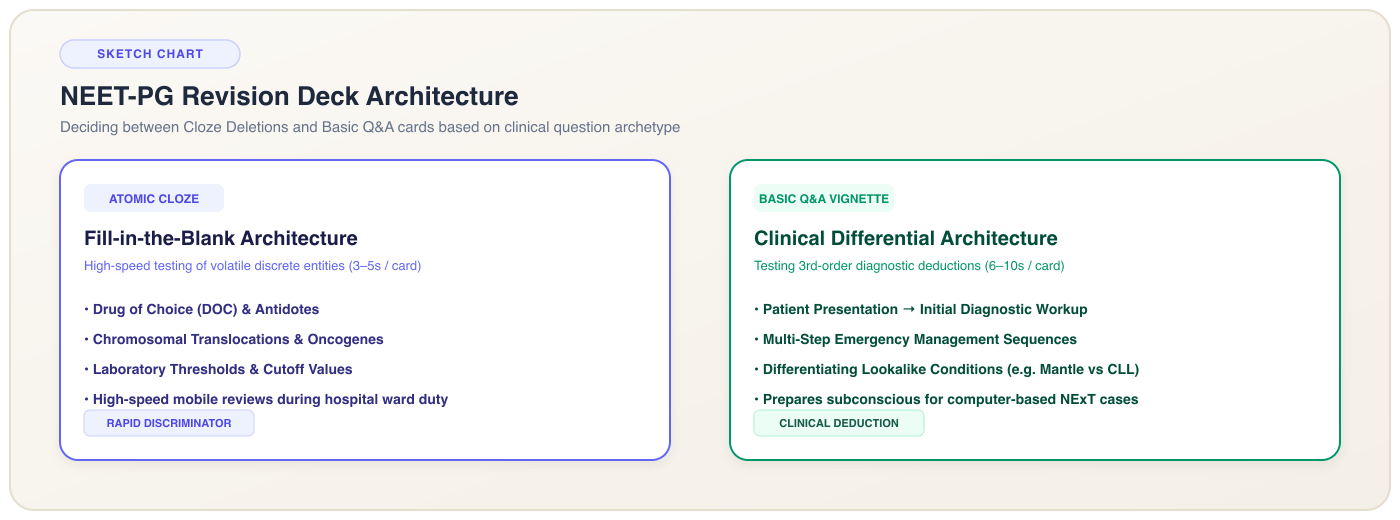 NEET-PG Revision Deck Architecture: 70/30 Hybrid Model for Cloze Deletions vs Basic Q&A Cards
This balanced architectural split enables rapid fact acquisition across complex memory tables while systematically preserving deep clinical deduction through full-retrieval case vignettes.
- 70% Cloze Deletions: Form the structural foundation of your foundational memory. You use clozes to rapidly memorize volatile tables, drug mechanisms, and diagnostic criteria.
- 30% Basic Q&A Cards: Form your clinical reasoning and mistake defense. Every time you miss a question on a Grand Test or finish a difficult clinical case study, you log a Basic card that forces complete, unassisted retrieval.
This hybrid model strikes the perfect balance between sustainable volume (keeping daily review time under 45 minutes) and diagnostic depth (preventing the false fluency of fill-in-the-blank cards).
For a deeper look at whether you should build these cards yourself or download existing decks, read our analysis on premade vs self-made flashcards for NEET-PG.
How Modern AI Solves the Flashcard Authoring Dilemma
Historically, the biggest obstacle to creating a tailored 70/30 deck was time. Typing hundreds of basic questions and carefully formatting cloze brackets in Anki took hours every evening.
This friction led many students to look for shortcuts. However, earlier platforms introduced significant compromises:
- Neuroflip: While offering pre-packaged revision decks for Indian medical students, Neuroflip completely lacks custom card creation. If you make a unique mistake in your Grand Test or need a personalized cloze card for your faculty's specific lecture note, you cannot create one.
- Revisable: While Revisable attempted to automate card creation with generic document scanning, the resulting cards often suffer from poor quality controls—generating massive, multi-sentence clozes that test irrelevant grammar rather than clinical keywords.
This is where Floww's AI Photo-to-Flashcard transforms medical revision:
- Targeted Concept Capture: Take a picture of your handwritten notes, BTR margin scribbles, or textbook diagrams.
- Intelligent Format Selection: Floww automatically detects whether the material represents an atomic fact (generating clean, non-cluttered Cloze deletions) or a multi-step clinical process (generating a structured Basic Q&A card).
- 5-Second Generation: You get medical-grade, personalized cards with zero formatting fatigue, leaving you 100% of your evening to practice active recall and questions.
Explore all Floww features or test our interactive Rank Predictor tool to benchmark your preparation progress.
Summary and Next Steps
Choosing between cloze deletion and basic flashcards is not a philosophical argument—it is an engineering decision about cognitive load and exam constraints:
- Use Cloze Deletions when you need fast, high-volume factual memorization without authoring burnout.
- Use Basic Cards when you need deep, unassisted clinical synthesis and mistake analysis.
- Maintain a 70/30 ratio to protect your review speed while safeguarding yourself against the context clue trap.
Ready to supercharge your revision with scientifically scheduled spaced repetition? Explore our flexible pricing plans and start turning medical volatility into permanent rank security.

Written by Floww Editorial
Medical Learning Editorial Team
Evidence-led guidance for NEET-PG and INI-CET preparation, focused on active recall, spaced repetition, and sustainable revision workflows.