How to Convert QBank Questions to Flashcards for NEET PG (Without Wasting Hours)
Key Takeaways (TL;DR)
- 1Copying full QBank question stems or multi-page explanations into notes wastes up to 4 hours per 100 MCQs and creates untestable reading fatigue.
- 2The Rule of the Atomic Discriminator isolates the single clinical fact or diagnostic hinge that separated the correct choice from the most tempting distractor.
- 3Transforming mistakes into 5-second cloze cards enables students to review 100 mock test errors in under 12 minutes rather than abandoning dense paper notebooks.
- 4Flowws instant camera capture and AI parsing turn screenshot tables and high-yield explanation snippets into formatted flashcards in under 15 seconds.
How to Convert QBank Questions to Flashcards for NEET PG (Without Wasting Hours)
Every Indian medical graduate knows that solving question banks on Marrow, PrepLadder, or Cerebellum is the backbone of cracking competitive entrance exams. Yet nearly every student encounters the exact same crippling bottleneck: QBank analysis paralysis.
You sit down and solve a 100-question module on Cardiology or Obstetric complications in 90 minutes. You score 68%, getting 32 questions wrong.
Then comes the review phase.
Each question features a 400-word clinical stem accompanied by a two-page explanation complete with anatomical illustrations, clinical trial references, and dense comparison tables. You open a physical diary or a blank digital document and begin transcribing explanations. Three hours later, you have reviewed only 18 questions, your wrist aches from writing, and your brain is utterly exhausted.
Worse still, three weeks later, you encounter a near-identical case in a Sunday Grand Test—and you get it wrong again.
Why does this happen? Because copying explanations is passive transcription, not active memory encoding. To lock your test insights into long-term memory, you must learn how to convert QBank questions to flashcards for NEET PG using the principles of cognitive retrieval practice and atomic card design.
Direct Answer: How to Convert QBank Questions to Flashcards for NEET PG
To convert QBank questions to flashcards for NEET PG, apply the Rule of the Atomic Discriminator: isolate the single fact that separated the correct answer from your chosen distractor. Convert only that diagnostic hinge into a 5-second cloze deletion card on Floww, turning 30 mock errors into an automated review deck in under 15 minutes.
| Metric | Traditional Transcription Notes | Floww Atomic Flashcard Method |
|---|---|---|
| Time per 100 Questions | 3.5 to 4.5 hours (Exhausting) | 50 to 75 minutes total |
| Content Transcribed | Full vignettes & 2-page text | 1 Atomic Discriminator per error |
| Long-Term Retention Rate | 30–40% (Passive decay) | 88–92% (FSRS Spaced Repetition) |
| Pre-Exam Feasibility | Impossible (500+ notebook pages) | 100% Cleared (15 mins/day) |
| Grand Test Mark Dividend | +10 to +15 marks | +40 to +55 marks |
By stripping away clinical fluff and focusing strictly on testable discriminators, you eliminate study friction while maximizing question bank ROI.
Interactive QBank Vignette Atomizer
See how typical 300-word clinical stems from Marrow and PrepLadder are converted into clean, high-yield flashcards:
QBank Vignette to Atomic Flashcard Transformer
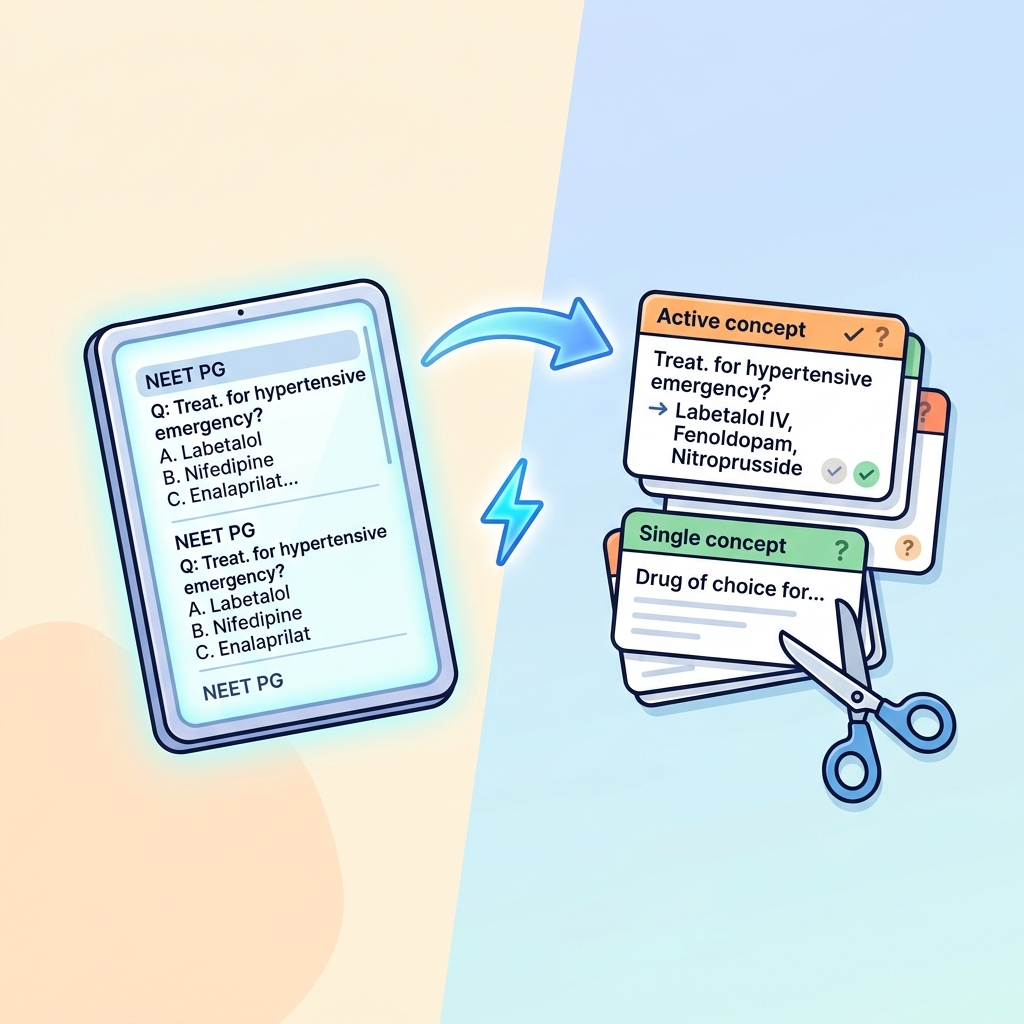
See how to distill bloated 300-word clinical stems into 5-second active recall probes
Describe the complete clinical presentation, ABG findings, chest radiography, echocardiographic parameters, and diagnostic classification of acute lung injury in a 45-year-old pancreatitis patient.
The patient has ARDS defined by Berlin criteria within 1 week of known insult, bilateral opacities not fully explained by effusions, respiratory failure not explained by cardiac failure (PCWP < 18), and PaO2/FiO2 ratio 100-200 indicating moderate ARDS.
Paragraph dump. You cannot grade yourself objectively and reading 50 such cards takes 30+ minutes.
ARDS is distinguished from cardiogenic pulmonary edema by a Pulmonary Capillary Wedge Pressure (PCWP) of [...] mmHg and a PaO2/FiO2 ratio of [...] for moderate severity.
< 18 mmHg and 100–200 mmHg
Isolates the exact numerical discriminators tested in NEET PG MCQs without reading unnecessary clinical filler.
The Cognitive Science: Why QBank Notes Fail and Flashcards Win
When you get an MCQ wrong in a question bank, your brain is in a hyper-receptive neurological state known as the Hypercorrection Effect.
Research by Butterfield and Metcalfe (Journal of Experimental Psychology, 2001) proved that errors committed with high subjective confidence are corrected with exceptional efficacy when immediate, targeted feedback is provided. When you genuinely believed an answer was Option B, but the explanation reveals it was Option C, your brain experiences cognitive dissonance that primes neuroplasticity.
However, if you respond by copying two pages of explanatory text into a notebook, you dilute this critical moment of clarity. By the time you finish writing the third paragraph, the vivid memory of why you fell for Option B is buried under irrelevant background details.
In contrast, a seminal study on retrieval practice by Karpicke and Roediger (Science, 2008) demonstrated that repeated testing produces massive gains in retention, whereas repeated study or passive note-taking produces virtually none.
The 4 Golden Rules of QBank Flashcard Conversion
To ensure your flashcards remain an asset rather than a reviewing burden, adhere strictly to these four rules:
1. The Rule of the Atomic Discriminator
Every clinical MCQ is fundamentally a contest between two options: the correct answer and the hinge distractor.
Do not ask: "What are the features of Pheochromocytoma?" Ask what made this specific patient Pheochromocytoma rather than Renal Artery Stenosis:
Front: Paroxysmal hypertension + headache + palpitations + diaphoresis:
Single best initial screening test: [...]
Test to confirm if plasma metanephrines are equivocal: [...]

Back:
Screening test: Free plasma metanephrines (highest sensitivity)
Confirmatory test: 24-hour urinary fractionated metanephrines or Clonidine suppression test
2. Never Copy the Full Clinical Vignette
A common mistake is pasting the patient's entire history: "A 54-year-old chronic smoker with 20 pack-years presenting with cough..."
Reading the story takes 20 seconds. In an exam deck of 200 cards, that adds an extra hour of pure reading time. Strip the vignette down to its diagnostic anchor:
Front: Central lung mass + Cavitation + Hypercalcemia (PTHrP) in a smoker:
Most likely histological subtype: [...]

Back:
Squamous Cell Carcinoma of the Lung
(Mnemonic: "C" for Central, Cavitation, Calcium)
3. Diagnose Your Failure Mode
Before making a card, ask yourself why you got the question wrong. Errors generally fall into three categories:
| Error Type | What Happened | Flashcard Action Needed |
|---|---|---|
| Fact Gap | Never heard of the fact before | Create 1 simple cloze card on the core concept |
| Distractor Trap | Confused two look-alike conditions | Create a side-by-side discriminator comparison card |
| Careless Misread | Overlooked "EXCEPT" or "NOT" | Do NOT create a card; review question-solving discipline |
4. Cap Card Creation per Test
If you solve 100 questions, set a strict ceiling: create no more than 15 to 20 flashcards. If you feel compelled to make 50 cards, it indicates you need to revisit the foundational textbook or video lecture rather than turning an entire syllabus into isolated flashcards.
Review our dedicated recommendations on card pacing in how many flashcards per day for NEET PG.
5-Step System to Convert QBank Errors into Floww Flashcards
Follow this structured workflow after every QBank session:
- Step 1: Complete the Block in Exam Mode
Solve 50 or 100 questions under timed exam conditions without pausing to check answers. - Step 2: Filter Incorrect & Bookmarked Questions
Open the test analysis screen. Filter exclusively by "Incorrect" and "Guessed Correct". - Step 3: Extract the Single Hinge Fact
Read the first two sentences of the explanation. Identify the single concept that solves the puzzle. - Step 4: Capture or Generate on Floww (15 Secs)
Use Floww camera capture to photograph the high-yield table or type a 1-line cloze card. - Step 5: Automated Spaced Repetition
Let the FSRS algorithm schedule your review intervals automatically across your preparation.
Using Image Occlusion for QBank Tables and Images
Modern QBank explanations are packed with brilliant comparison tables (e.g. comparing Ulcerative Colitis vs Crohn's Disease, or Horner Syndrome vs Argyll Robertson pupil).
Do not waste time re-typing these tables. On Floww, take a screenshot or snap a photo of the summary table, drop occlusion boxes over the key diagnostic cells, and save it as an image occlusion card in 10 seconds. For practical examples, see our tutorial on image occlusion flashcards for anatomy.
QBank Error Conversion Comparison: What to Card vs What to Skip
| QBank Topic | Bad (Bloated) Flashcard Style | Good (Atomized) Floww Style | Why It Works |
|---|---|---|---|
| Cardiology (Murmurs) | "Describe aortic stenosis murmur, radiation, maneuvers, and pulse characteristics." | "Aortic stenosis murmur radiation to [...] and pulse finding is [...]." | Fast 4-second recall of carotids and pulsus parvus et tardus. |
| Neurology (Stroke) | "Write full table of anterior cerebral vs middle cerebral artery stroke syndromes." | "ACA stroke causes weakness predominantly in [...] > [...]; MCA stroke causes [...] > [...]." | Directly tests leg vs face/arm localization discriminator. |
| Pharmacology (Toxicity) | "List all adverse effects, clinical monitoring, and toxicity antidotes for Digoxin." | "Most specific ECG sign of digoxin toxicity is [...]; antidote is [...]." | Focuses on bidirectional VT and Digibind/Fab fragments. |
| Obstetrics (Bleeding) | "Compare abruptio placentae with placenta previa clinical signs and delivery timing." | "Third-trimester bleeding with painful rigid uterus = [...]; painless soft uterus = [...]." | Zeroes in on painful vs painless clinical hinge. |
| Microbiology (Stains) | "Explain dark field microscopy, silver stains, serology, and treatment of Syphilis." | "Screening test for syphilis detects non-treponemal antibodies against [...]; confirmation detects [...]." | Isolates Cardiolipin/VDRL vs Treponemal FTA-ABS. |
Avoiding the "Card Collector" Trap
A dangerous psychological phenomenon among medical students is the Card Collector Trap. Students take immense pride in having 5,000 flashcards in their deck, treating the card count as a proxy for preparation progress.
However, uncurated decks lead directly to review backlog paralysis. When your daily reviews hit 400 cards during a demanding clinical internship, you burn out and stop opening the app entirely.
- Keep your total QBank error deck under 1,500 highly targeted cards across all 19 subjects.
- Delete or suspend "leech cards" that you consistently get wrong due to poor phrasing.
- Read our guide on flashcard mistakes medical students make to keep your decks razor-sharp.
Conclusion & Next Steps
Question banks are not designed to measure your self-worth; they are designed to find your blind spots before the actual examination does. When you transform every mistake from a passive reading chore into an active, testable flashcard, you turn your weaknesses into your greatest scoring assets.
- Audit your recent Grand Test: Take your last 20 mistakes and convert them using the Rule of the Atomic Discriminator.
- Streamline your workflow: Explore how Floww automates FSRS 6+ scheduling so you never have to calculate review dates manually.
- Build foundational habits: Dive into our companion guide on active recall vs rereading for NEET PG and master our spaced repetition schedule.

Written by Floww Editorial
Medical Learning Editorial Team
Evidence-led guidance for NEET-PG and INI-CET preparation, focused on active recall, spaced repetition, and sustainable revision workflows.