7 Deadly Flashcard Mistakes Medical Students Make (And How to Fix Them)

Key Takeaways (TL;DR)
- 1Creating multi-fact "encyclopedia cards" is the most prevalent error in medical education, destroying retrieval speed and inflating false confidence.
- 2Passive recognition traps occur when card question stems include excessive contextual giveaways that never appear on competitive clinical exams.
- 3Failing to suspend "leech cards" after 4 consecutive lapses traps students in repetitive review loops while neglecting broad syllabus mastery.
- 4Pairing atomic card architecture with next-generation FSRS algorithms eliminates review burnout and sustains high retention throughout residency exams.
7 Deadly Flashcard Mistakes Medical Students Make (And How to Fix Them)
Every year, thousands of medical students download spaced repetition software with high hopes of effortlessly memorizing the 19 subjects of the medical curriculum. Inspired by top rankers on YouTube and subreddits like r/medicalschoolanki and r/indianmedschool, they begin creating dozens of cards after every coaching lecture.
Yet, within eight to twelve weeks, the overwhelming majority abandon their decks.
They find themselves staring at a terrifying queue of 1,200 overdue cards, spending three exhausting hours every night mechanically clicking buttons, and watching their Grand Test scores stagnate. Demoralized, they conclude: "Spaced repetition doesn't work for my brain; I am better off reading textbooks."
The reality is that spaced repetition is supported by over a century of empirical cognitive science. Extensive meta-analyses published in Educational Psychology Review (Roediger & Butler, 2011) and research by Kornell (Journal of Experimental Psychology, 2009) confirm that retrieval testing is the single most effective tool for building durable conceptual and factual memory.
When flashcards fail medical students, it is almost never because of the underlying science. It is because of structural flashcard design flaws.
In this guide, we dissect the 7 deadly flashcard mistakes medical students make and provide the exact architectural fixes used by top 0.1 percentile scorers.
Medical Flashcard Quality & Mistake Auditor
Interactive before-and-after breakdown of common card creation traps
The Encyclopedia Card
Mistake 1: The "Encyclopedia Card" (Violating the Minimum Information Principle)
The single most destructive mistake in medical card authoring is creating the multi-fact "encyclopedia card." A student reads a textbook section on Infective Endocarditis and creates a single card:
- Front: "Discuss Infective Endocarditis (causes, clinical features, Duke criteria, and empirical treatment)."
- Back: Three dense paragraphs listing native valve organisms, Roth spots, Osler nodes, Janeway lesions, major/minor Duke criteria, and IV Ampicillin/Ceftriaxone regimens.
Why This Destroys Learning
When this card appears, your brain is confronted with fifteen distinct facts. You mentally recall that Osler nodes are painful and remember that Staphylococcus aureus is common in IV drug users, but you forget the echocardiographic criteria and dose cutoffs.
What button do you click?
- If you click "Good," you reinforce partial ignorance.
- If you click "Again," you are forced to re-read thirteen facts you already knew just to drill the two you missed.
- The review takes 45 seconds instead of 5 seconds, causing mental exhaustion after just twenty cards.
The Fix: Piotr Woźniak’s Minimum Information Principle
Every flashcard must test exactly one atomic cognitive relation. Split the encyclopedia card into atomic units:
- Card A: "Most common organism causing acute infective endocarditis in native valves? → Staphylococcus aureus."
- Card B: "Distinction between Osler nodes and Janeway lesions? → Osler nodes are painful immune-complex nodules on finger pads; Janeway lesions are painless septic microemboli on palms/soles."
- Card C: "Empirical antimicrobial regimen for acute native valve endocarditis? → Vancomycin + Gentamicin."
Mistake 2: The "Passive Recognition" Trap
Many medical students unconsciously include giveaway hints in the card prompt.
- Flawed Front: "What is the diagnosis for an infant with cherry-red macular spot, hepatosplenomegaly, and sphingomyelinase deficiency?"
- Back: "Niemann-Pick Disease."
Why This Destroys Learning
In this card, the word "sphingomyelinase" immediately gives away the answer. You are not retrieving clinical reasoning; your brain is merely matching the letter "S" in sphingomyelinase to the letter "N" in Niemann-Pick.
When you sit for NEET PG or INI-CET, questions will not hand you the enzyme deficiency. They will present a 6-month-old infant with developmental regression, motor weakness, massive abdominal distension, and an ophthalmological photograph. If your cards trained you on lexical giveaways, you will blank out on the clinical vignette.
The Fix: Test Clinical Presentations and Diagnostic Divergences
- Front: "6-month-old infant presents with developmental regression and a cherry-red macular spot. Examination reveals massive hepatosplenomegaly. Diagnostic condition?"
- Back: "Niemann-Pick Disease (Distinguish from Tay-Sachs, which exhibits NO hepatosplenomegaly due to hexosaminidase A deficiency)."
Mistake 3: Feeding the "Leech Monster" Without Refactoring
A "leech" is a card that has lapsed four or more times. Medical students often treat spaced repetition like an endurance contest: they get a difficult card wrong, hit "Again," get it wrong again tomorrow, and hit "Again" again.
Over several weeks, that single card has consumed 10 minutes of cognitive attention without ever sticking.
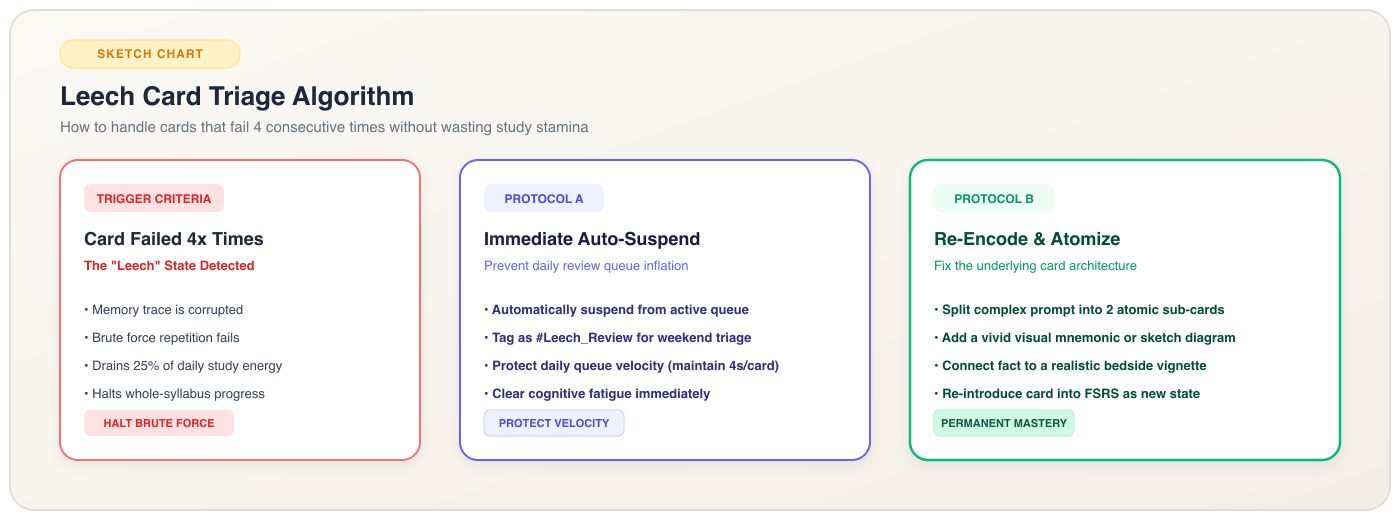 Leech Card Action Algorithm: Workflow for suspending and refactoring repeatedly failed medical flashcards
This structured decision algorithm prevents students from sinking hours into unproductive card reviews. If a fact repeatedly slips, the fundamental card architecture must be refactored rather than repeatedly hammered.
The Fix: The 4-Lapse Suspension Rule
Whenever a card fails four times:
- Suspend the card immediately. Stop letting it pollute your daily queue.
- Diagnose why it failed: Was it an unanchored number? Was it confusing two look-alike drug names?
- Re-anchor the memory: Draw a simple vector diagram, use image occlusion flashcards for anatomy, or invent a vivid clinical mnemonic.
- Re-enter as a fresh card.
Mistake 4: Creating Cards Before Understanding the Big Picture
A common trap among first- and second-year MBBS students is creating flashcards during their first pass of a video lecture or textbook chapter. They pause the lecture every 45 seconds to type a card.
This results in isolated "orphan facts"—memory islands with zero physiological context. You might memorize that Hepcidin inhibits Ferroportin, but fail to understand why iron deficiency anemia presents with low ferritin and elevated total iron-binding capacity (TIBC).
The Fix: The Understand-Then-Atomize Sequence
Always follow this strict three-step sequence:
- Step 1 (First Pass): Watch the lecture or read the clinical chapter continuously without pausing to type cards. Understand the pathophysiological mechanism from start to finish.
- Step 2 (Active Synthesis): Close your notes and sketch the disease pathway or clinical flowchart from memory on a scratchpad.
- Step 3 (Selective Atomization): Only create flashcards for volatile details that cannot be derived from first principles (e.g., specific receptor numbers, diagnostic cutoffs, first-line drug combinations).
Mistake 5: The "All-or-Nothing" Review Procrastination
Because flashcard software shows a visible count of due cards (e.g., "342 Reviews Due"), students who miss two days become overwhelmed. They feel that if they cannot sit down for two hours to clear all 342 cards in one sitting, there is no point in doing any.
This causes review debt to compound exponentially, resulting in total abandonment of the deck within two weeks.
The Fix: Micro-Session Time-Boxing
Spaced repetition is not an all-or-nothing sport. If you have 300 cards due, break them into four 10-minute micro-sprints:
- Clear 60 cards during your morning commute.
- Clear 60 cards after lunch.
- Clear 60 cards between clinical ward rounds.
- Clear the remaining reviews before dinner.
Using a clinical Pomodoro timer for medical study to enforce 20- to 25-minute focused blocks prevents cognitive fatigue.
Mistake 6: Relying on Legacy SM-2 Instead of Modern Algorithms
Many medical students continue using legacy software running the 1987 SuperMemo-2 (SM-2) algorithm. As analyzed in our definitive FSRS vs SM-2 benchmark, SM-2 uses fixed ease multipliers that punish difficult cards with catastrophic "ease hell" loops.
Upgrading to modern platforms with native FSRS 6+ scheduling cuts daily review volume by 25% to 35% while maintaining an optimal 90% retention rate. For a comprehensive overview of how algorithm engines differ, read our guide on spaced repetition algorithms for medical students.
Mistake 7: Ignoring Grand Test Error Feedback Loops
The final cardinal sin is isolating flashcards from mock exam performance. Students often review pre-made decks from USMLE or foreign sources that fail to reflect the high-yield clinical traps of Indian exams like NEET PG and INI-CET.
A top-scoring flashcard workflow must be a closed loop: every Grand Test (GT) error and coaching QBank mistake must be captured as an atomic flashcard within 48 hours of completing the test. For a step-by-step breakdown of how to integrate GT error harvesting into your timeline, review our 3 month flashcard revision plan for NEET PG.
| Flashcard Mistake | Cognitive Consequence | Top Scorer Solution |
|---|---|---|
| Encyclopedia Cards | Fatigue, false competence, slow reviews | Strictly 1 atomic fact per card (under 6s review) |
| Giveaway Questions | Passive word association, exam failure | Realistic clinical stems without lexical hints |
| Brute-Forcing Leeches | Ease hell, review backlog debt | Suspend after 4 lapses; rebuild with mnemonics |
| Orphan Fact Cards | Memory fades without context | Understand first; atomize volatile facts second |
| All-or-Nothing Mindset | Deck abandonment after 2 missed days | 10-minute pocket micro-sprints |
| Legacy SM-2 Schedulers | Severe over-reviewing and ease hell | Upgrade to modern FSRS DSR algorithms |
| Ignoring GT Errors | Repeating the same clinical traps | Convert 100% of GT errors into atomic cards |
Summary: Building a Bulletproof Revision System
Spaced repetition flashcards are the most powerful learning technology available to the modern medical student. But like a surgical scalpel, their effectiveness depends entirely on technique.
By ruthlessly eliminating encyclopedia cards, framing questions as realistic clinical vignettes, suspending leeches, and utilizing next-generation platforms like our evaluated best flashcard app for NEET PG and Floww vs Revisable analysis, you turn daily reviews from a chore into your greatest competitive advantage.
Test your performance trajectory and rank potential today with our NEET PG rank predictor to see how clean active recall transforms your exam day scores.

Written by Floww Editorial
Medical Learning Editorial Team
Evidence-led guidance for NEET-PG and INI-CET preparation, focused on active recall, spaced repetition, and sustainable revision workflows.