3-Month Flashcard Revision Plan for NEET PG: 90-Day High-Yield Blueprint

Key Takeaways (TL;DR)
- 1A 90-day flashcard revision plan divides preparation into three distinct phases: System Consolidation, Short Subject Blitz, and Final Rapid Maintenance.
- 2Grand Test (GT) mistakes must be converted into atomic flashcards within 48 hours of completing the test to turn clinical blind spots into permanent memory.
- 3Daily review caps and modern FSRS algorithms prevent review debt from suffocating primary question bank practice.
- 4New card creation must be frozen completely 30 days before exam day to ensure 100% bandwidth is dedicated to retention maintenance.
3-Month Flashcard Revision Plan for NEET PG: 90-Day High-Yield Blueprint
Entering the final 90 days before NEET PG or INI-CET is an overwhelming psychological experience. With 19 subjects spanning over 800 hours of video lectures and thousands of textbook pages, Indian medical graduates frequently experience severe syllabus paralysis.
Every medical student knows the dread of opening an internal medicine chapter revised two months ago only to realize that diagnostic cutoffs, first-line drug regimens, and staging criteria have vanished from memory.
A landmark systematic review on educational psychology published in the Psychological Science in the Public Interest (Dunlosky et al., 2013) demonstrated that distributed practice (spaced repetition) and practice testing (retrieval practice) boast the highest utility for long-term retention among all evaluated learning techniques. Furthermore, clinical trials in medical licensing exam cohorts (Deng et al., 2015) found that students who incorporated systematic spaced retrieval into their final revision months achieved significantly higher percentile scores than peers relying on linear notes.
This guide details an exact, operational 3 month flashcard revision plan for NEET PG designed to compress 19 subjects into high-yield active recall loops without inducing study burnout.
90-Day NEET PG Flashcard Revision Engine
Interactive timeline simulator calibrated for 19-subject retention
System Consolidation & GT Error Logging
Convert high-weight clinical subjects (Medicine, Surgery, OBG, Peds) and 100% of Grand Test mistakes into atomic cards.
Key Phase 1 Deliverables:
The 90-Day Architecture: Three Strategic Phases
A common mistake made by aspirants in r/indianmedschool is treating the final 90 days as an endless reading marathon. Without structured phases, students find themselves cramming fresh biochemistry cycles three days before the exam while forgetting shock management protocols.
To build an unbreakable memory network, your 90 days must be divided into three calculated phases:
Phase 1: Consolidation & The Grand Test Error Vault (Days 90–61)
The primary objective of Month 1 is stabilizing your high-weight clinical subjects—General Medicine, Surgery, Obstetrics & Gynecology, Pediatrics, and Pathology—while establishing a closed-loop system for Grand Test (GT) mistakes.
- Study Allocation: 70% QBank and GT analysis, 25% Spaced Repetition Flashcards, 5% Rapid Video Review.
- Daily Review Target: 200–300 reviews per day (30–45 minutes).
- New Cards Added Daily: 40–50 cards maximum (strictly extracted from GT errors and high-yield clinical tables).
- GT Frequency: 1 full 200-question test every 7 days.
During this phase, test analysis is your highest return on invested time. Whenever you miss an MCQ or guess correctly for the wrong clinical reason, do not copy the entire 500-word explanation into your notes. Instead, extract the single underlying cognitive pivot that tricked you into an atomic flashcard.
For example:
- Inefficient Note: "Write out the entire etiology, presentation, diagnostic criteria, and management of Pheochromocytoma."
- Atomic Card Front: "Best initial screening test for suspected pheochromocytoma in high-risk patients?"
- Atomic Card Back: "Plasma free metanephrines (highest sensitivity: 96–99%). 24-hour urinary fractionated metanephrines used for low-risk confirmation."
Phase 2: Short Subject Blitz & Volatile Memory Sprints (Days 60–31)
Month 2 represents the inflection point where rank differences are forged. While almost all serious aspirants score reasonably well in core medicine and surgery, the "short subjects"—Dermatology, Psychiatry, Radiology, Anesthesia, Ophthalmology, and ENT—contain disproportionately high scoring efficiency per page of notes.
- Study Allocation: 60% Subject-wise tests (SWTs) & revision notes, 25% Flashcard reviews, 15% Grand Tests.
- Daily Review Target: 350–400 reviews per day (45–55 minutes).
- New Cards Added Daily: 25–35 cards (focused on volatile values, antimicrobial spectra, and staging tables).
- GT Frequency: 1 full GT every 5 days.
In Phase 2, leverage visual masking tools such as image occlusion flashcards for anatomy and radiology spotters. Volatile numerical benchmarks—such as GCS scoring, Glasgow-Imrie criteria for pancreatitis, and tumor staging T-scores—must be reviewed every 4 to 6 days using the best flashcard app for NEET PG.
Phase 3: The Lock-In & Review Maintenance (Days 30–1)
The final month is strictly about defense. Your priority is preventing the decay of existing memories rather than attempting to absorb peripheral trivia that was never asked in the last ten years of exams.
Critical Rule (The Card Creation Freeze): At Day 30, permanently freeze new card creation. Zero new cards. Dedicate 100% of your flashcard energy to clearing your daily review queue and drilling high-frequency GT error tags.
- Study Allocation: 50% Rapid revision notes / PYQ marathon, 30% Flashcard queue maintenance, 20% Mock simulations.
- Daily Review Target: 400–500 reviews per day (50–60 minutes).
- New Cards Added Daily: 0 (Full freeze).
- GT Frequency: 1 GT every 4 days until Day 7. Cease all full-length mocks during the final 7 days to preserve mental stamina.
| Revision Phase | Timeline | Primary Objective | Daily Reviews | New Cards / Day |
|---|---|---|---|---|
| Phase 1: Consolidation | Days 90–61 | Major clinical subjects & GT mistake capture | 200–300 | 40–50 |
| Phase 2: Short Subject Blitz | Days 60–31 | Short subjects, volatile tables, pharma mechanisms | 350–400 | 25–35 |
| Phase 3: Final Maintenance | Days 30–1 | Zero-backlog FSRS clearing, image spotters, PYQ drill | 400–500 | 0 (Frozen) |
The Daily Schedule for Interns vs. Post-Interns
One of the biggest hurdles voiced in r/medicalschoolanki is that revision schedules designed for USMLE students with 14 hours of free study time collapse for Indian interns working 12-hour casualty duties.
Here is how to structure your 24 hours depending on your current clinical responsibilities:
The Intern Routine (4–5 Effective Study Hours)
- 06:00 – 07:00 AM (The Morning Review Trench): Clear 250 flashcard reviews before leaving for hospital duties. Completing your spaced repetition reviews before your shift ensures that even if you face an exhausting casualty night, your retention streak remains unbroken.
- Duty Downtime (Pocket Micro-Reviews): Utilize 5-minute hospital breaks (between rounds, in duty rooms, or while commuting) to review 20–30 cards on your smartphone. By the end of an 8-hour shift, you will have completed over 100 reviews effortlessly.
- 07:30 – 10:30 PM (QBank & Targeted Study): Solve 50–70 timed MCQs using your primary coaching bank. Use our focused Pomodoro timer for medical study to maintain intense 25-minute focus intervals without phone distraction.
- 10:30 – 11:00 PM (Instant Error Capture): Convert the day's missed questions into 10–15 quick flashcards for tomorrow's queue.
The Post-Intern Routine (8–10 Dedicated Study Hours)
- 07:00 – 08:15 AM (Morning Card Mastery): Complete 350–450 reviews.
- 08:30 – 01:00 PM (Clinical Subject Block): 100 QBank MCQs + targeted revision of weak systems.
- 02:00 – 05:00 PM (Short Subject Sprint / PYQs): Drill previous years' questions (PYQs) and high-yield faculty notes.
- 05:30 – 08:00 PM (Mock Test / Analysis): Grand Test analysis or subject module completion.
- 09:00 – 10:00 PM (Evening Weak-Tag Drill): Custom filtered review of flagged cards in Pharmacology and Microbiology.
Converting Grand Test (GT) Errors into High-Yield Flashcards
The single highest-leverage activity in medical exam preparation is converting mistakes into permanent memories. Most students spend four hours taking a Grand Test, spend thirty minutes scrolling through the score summary, feel demoralized, and never revisit the questions they missed.
Follow this 3-step protocol for every GT:
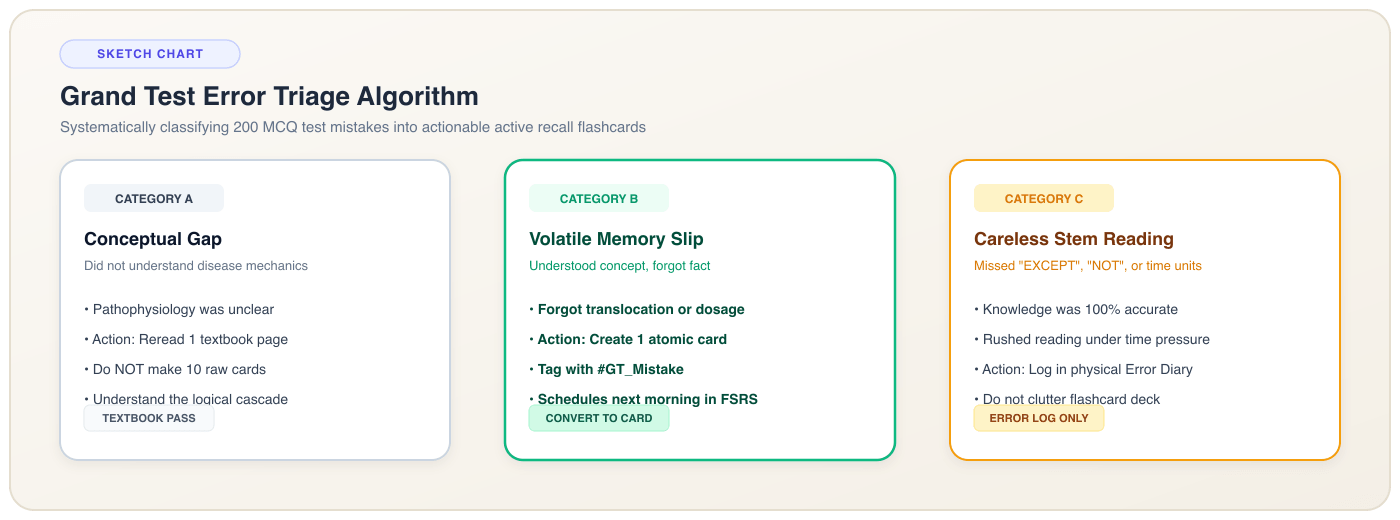 Grand Test Error Triage Workflow: Systematic 3-step protocol for converting MCQ mistakes into high-yield flashcards
This rigorous triage loop ensures that your revision deck directly targets proven weaknesses, preventing repeated mistakes on high-weight clinical exams.
When creating an error card, follow the One-Fact-Per-Card Rule. Never paste the entire clinical case stem into the question field. If a question required you to identify Acanthocytes in a patient with ataxia and retinitis pigmentosa, your card should simply read:
- Front: "Acanthocytes (spur cells) + cerebellar ataxia + retinitis pigmentosa + fat malabsorption?"
- Back: "Abetalipoproteinemia (deficiency of microsomal triglyceride transfer protein / MTP; absent ApoB-48 and ApoB-100)."
Combating Review Debt and Algorithm Fatigue
As you accumulate cards across 90 days, daily review queues naturally swell. Under older algorithms like SM-2, failing a few cards can cause reviews to snowball into unmanageable 1,000-card backlogs, known as "ease hell."
To keep your revision plan agile:
- Rely on Modern Schedulers: Ensure your platform utilizes modern algorithms like FSRS 6+ that dynamically calculate memory retrievability. For an in-depth breakdown of how algorithm weights impact daily workload, read our guide on spaced repetition algorithms for medical students.
- Target a 90% Retention Rate: Setting retention targets above 95% causes an exponential explosion in daily reviews for diminishing marginal returns. A 90% retention setting provides the optimal trade-off between exam mastery and reasonable study volume.
- Ruthlessly Suspend Leeches: A "leech" is a card you have failed more than four times. Do not keep clicking "Again" and wasting minutes daily. Suspend the card, find a creative visual mnemonic or clinical anchor, rewrite the card from a fresh angle, and re-introduce it.
To track how your daily revision consistency translates into predicted exam performance, evaluate your trajectory with our free NEET PG rank predictor and compare feature sets with our Floww vs Revisable comparison.
The Final 72-Hour Tapering Protocol: Preventing Cognitive Exhaustion
In the final 72 hours before NEET PG or INI-CET, the physiological objective shifts from active knowledge acquisition to cognitive recovery and neural stabilization. Thousands of aspirants fail to perform to their true potential not because of an absence of knowledge, but due to acute sleep deprivation and mental fatigue accumulated over months of intense study.
Follow this evidence-backed tapering protocol during the final three days:
- Day -3 (72 Hours Out): Complete your final scheduled flashcard reviews for volatile pharmacology and microbiology tables. Cap total study time at 6 hours. Stop solving new MCQs entirely to avoid last-minute panic over anomalous edge-case questions.
- Day -2 (48 Hours Out): Limit your revision strictly to high-yield visual spotters—such as classic dermatological rashes, ECG rhythms, and radiological signs. Review a maximum of 100 to 150 familiar cards in the morning, then spend the afternoon preparing your exam kit, admit card copies, and identification documents.
- Day -1 (24 Hours Out): Complete study blackout by 2:00 PM. No flashcard decks, no coaching groups, and no telegram channels discussing exam predictions. Take a light walk, eat a balanced dinner, and prioritize 8 hours of restorative sleep to ensure peak neurotransmitter replenishment.
By executing this systematic 3-month flashcard revision plan, you transform the overwhelming 19-subject syllabus into an organized, predictable active recall routine that delivers peak performance on exam day.

Written by Floww Editorial
Medical Learning Editorial Team
Evidence-led guidance for NEET-PG and INI-CET preparation, focused on active recall, spaced repetition, and sustainable revision workflows.