Floww vs Brainscape: Simplicity vs. Medical-Grade Active Recall
Key Takeaways (TL;DR)
- 1Brainscape is a simple, neat flashcard app relying on basic confidence ratings, but it completely lacks advanced integrations like note-taking or deep algorithmic scheduling.
- 2Floww bridges the gap by offering FSRS (Free Spaced Repetition Scheduler) as the pre-configured default, making your spacing mathematically optimized.
- 3Brainscape relies on text-heavy cards, leading to cognitive fatigue. Floww introduces MedComics—highly engaging visual hooks with built-in active recall quizzes.
- 4Floww integrates flashcards directly with your lecture notes using Qwicknotes context links. You can immediately jump from a difficult card to the original lecture context.
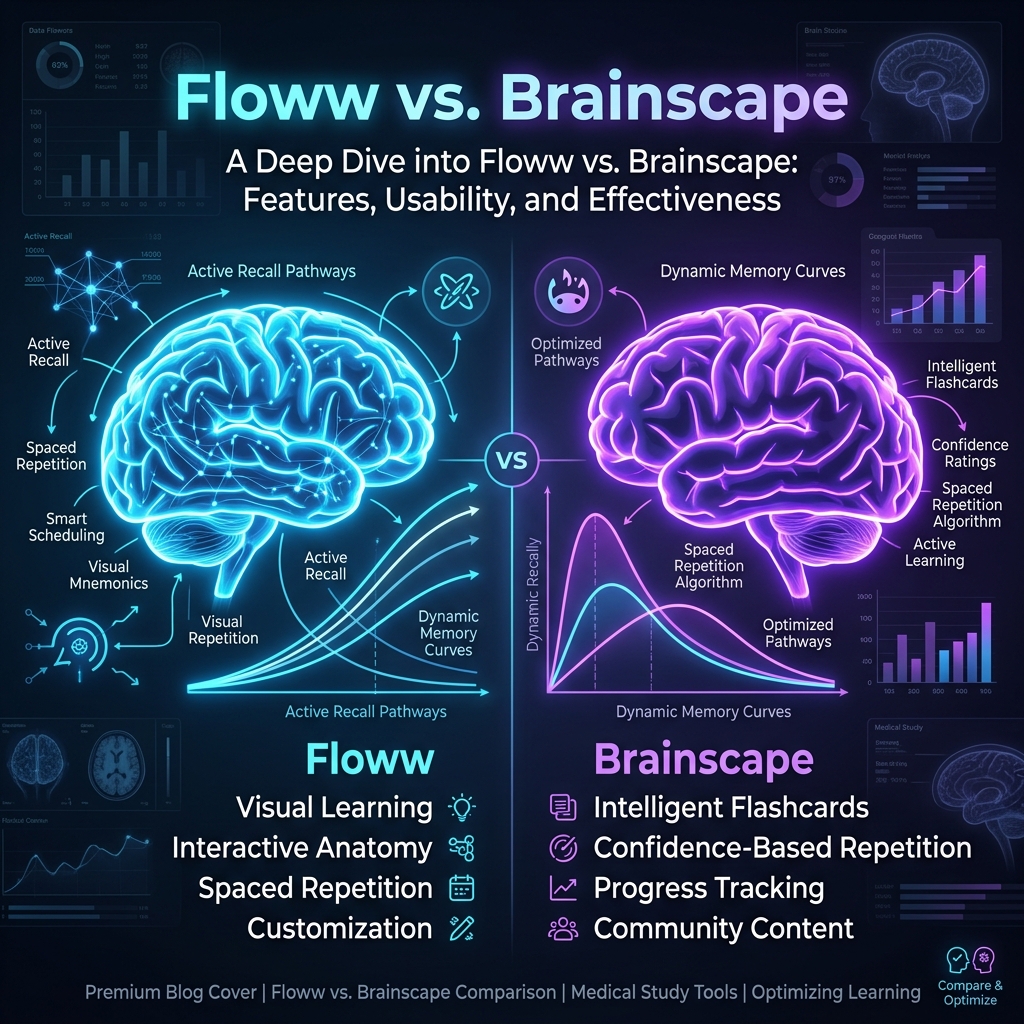
Floww vs. Brainscape: The Battle of Spaced Repetition Systems
When preparing for hyper-competitive medical exams like NEET-PG, INICET, or USMLE, standard cramming is a recipe for failure. You need spaced repetition.
Among the options available in 2026, Brainscape has stood out as a popular, simple choice for flashcard drilling. But is simplicity enough when you are studying 19 vast medical subjects?
Here is an honest, objective head-to-head comparison of Floww and Brainscape, and why medical students are shifting to Floww's highly visual, integrated environment.
Quick Summary
Floww — Best for: medical aspirants looking for high-yield visual retention, note-linked study portals (Qwicknotes), and auto-optimized FSRS algorithms out-of-the-box.
Brainscape — Best for: casual learners who want a simple, clean, card-only interface and don't need note-taking or visual study assets.
Choose Floww if...
- ✅ Advanced Scheduling: You want the modern FSRS algorithm optimized automatically in the background.
- ✅ Connected Study: You want your flashcards dynamically linked to your lecture notes (Qwicknotes).
- ✅ Visual Memory Hooks: You need MedComics and Mind Maps to simplify dense pharmacology and pathology pathways.
- ✅ Exam Interleaving: You need smart mixers to interleave multiple subjects and mimic board exams.
Choose Brainscape if...
- ✅ Basic Flashcards: You only want to study simple question-and-answer text cards.
- ✅ No Note-Taking: You do all your reading and lecture notes in a separate app (or physical book).
- ✅ Crowdsourced Decks: You want access to a massive library of general public flashcard decks (though quality varies).
1. The Algorithm: Confidence-Based Repetition vs. Mathematical FSRS
- Brainscape's signature feature is Confidence-Based Repetition (CBR). When reviewing a card, you rate how well you knew it on a scale of 1 to 5. The app uses this rating to determine how soon the card returns. It is incredibly clean and intuitive.
- However, under the hood, CBR relies on relatively simple heuristic spacing formulas. It does not separate the difficulty of a concept from your memory stability.
- Floww is powered by the modern FSRS (Free Spaced Repetition Scheduler).
- FSRS is a machine-learning based spaced repetition model. It evaluates your review history mathematically to predict your custom memory decay curve.
- The result? FSRS is proven to achieve the same target retention as legacy algorithms (like SM-2 or simple heuristics) with 30% fewer daily reviews. Floww calibrates this automatically in the background so you spend less time repeating what you already know and more time learning new material.
2. Dynamic Linking: Isolated Decks vs. Integrated Qwicknotes
- A major vulnerability of Brainscape is that it is a deck silo. Your flashcards exist entirely separate from your textbook pages, lecture PDFs, or clinical notes. If you get a question wrong during a review, you have to exit the app, open your note-taking app, and search for the context manually.
- Floww solves this with Qwicknotes.
- On Floww, flashcards are not isolated items. They are dynamically connected to your digital lecture notes.
- When studying a flashcard on Pathology, you can click a single "Context Portal" button. This instantly displays a preview of the exact lecture note, slide, or textbook paragraph from which the flashcard was created. You review cards in the context of the larger diagnostic network, turning rote memorization into real clinical understanding.
3. The Visual Advantage: Text Fatigue vs. MedComics
- Medical studies are notoriously dense. Rote text flashcards are perfect for simple drug names or anatomical terms, but they quickly trigger text fatigue when you are reviewing 200+ cards a day.
- Floww introduces MedComics.
- We turn complex, high-yield diagnostic criteria and biochemical pathways into visually memorable comics.
- Each MedComic features an interactive review quiz. When you get an answer wrong, you can instantly save that specific question as a spaced-repetition flashcard. This couples active recall with visual dual-coding, making the information stick much longer than a plain black-and-white text card ever could.
Head-to-Head Comparison Matrix
Based on publicly available product parameters in 2026.
| Feature Metric | Floww | Brainscape |
|---|---|---|
| Scheduling Model | FSRS (Auto-Optimized ML) | CBR (Metacognitive Heuristics) |
| Notes-Flashcards Integration | ✨ Qwicknotes Connect | ❌ Decks only (No Note Editor) |
| Visual Memory Assets | 🎨 MedComics & Mind Maps | ❌ Pure text/basic images |
| Exam Simulation Mixer | ✅ Interleaved Subject Drills | ❌ Linear deck study only |
| Targeted Medical Curricula | 📚 NEET-PG & INICET Focused | ⚠️ General exam prep catalog |
The Verdict
Brainscape is a lovely option for general studying where basic, text-only questions are sufficient. It is clean, straightforward, and easy.
However, medical exams require high cognitive retention and extensive clinical context. By bringing together auto-optimized spaced repetition, visual MedComics, and connected note portals, Floww is custom-designed for the intensity of medical school.
Stop wasting precious hours on disjointed tools. Integrate your notes, visual memory hooks, and spaced repetition under one unified workspace.

Written by The Floww Team
Providing evidence-based medical study techniques, exam preparation strategies, cognitive retention research, and spaced repetition algorithm analysis for NEET-PG & INI-CET aspirants.