Floww vs Neuroflip: Why Medical Flashcards Need Custom Card Creation
Key Takeaways (TL;DR)
- 1Neuroflip offers pre-compiled micro-notes based on popular rapid revision courses, but completely lacks any custom card creation or personal deck-building capability.
- 2Without custom card creation, medical students cannot log mistakes from Grand Tests (GTs) or question banks (Marrow/PrepLadder), breaking the single most effective revision loop.
- 3Floww provides full curriculum high-yield decks alongside instant AI photo-to-card creation, enabling students to capture margin scribbles and personal errors in 5 seconds.
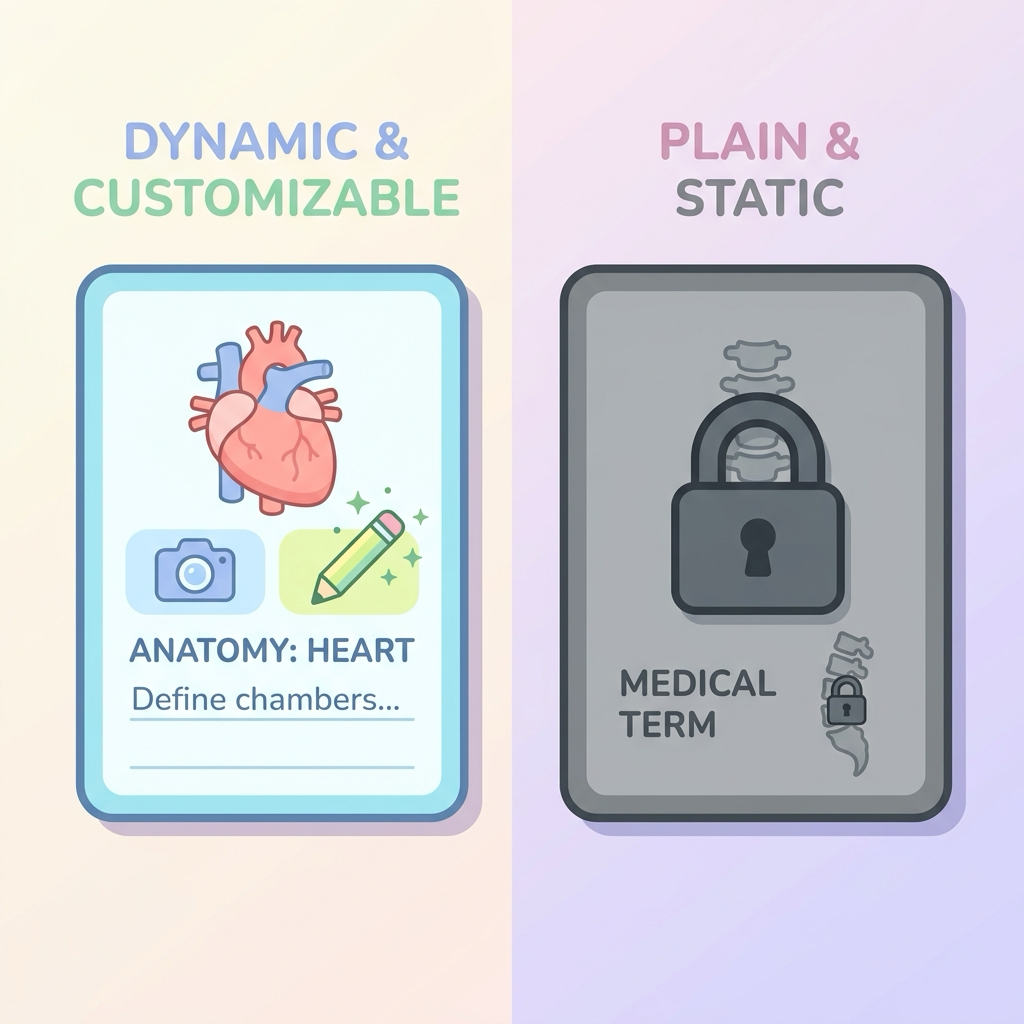
- 4While Neuroflip locks you into static authoring, Floww combines FSRS spaced repetition with customizable personal decks to maximize exam-day recall.
Floww vs Neuroflip: Why Medical Flashcards Need Custom Card Creation
As spaced repetition solidifies its reputation as the single most dependable study methodology for high-stakes medical examinations, Indian medical aspirants preparing for NEET-PG and INI-CET face an expanding ecosystem of specialized revision tools.
Two platforms frequently mentioned in peer study circles and across r/indianmedschool are Floww and Neuroflip.
At first glance, both platforms address the same pervasive problem: medical textbooks, coaching workbooks, and eight-hundred-page lecture transcripts are simply too massive to revise repeatedly in the critical final months leading up to exam day. Both promise concise, bite-sized digital cards engineered for rapid recall during brief study windows between hospital postings.
However, beneath their streamlined mobile interfaces lies a profound pedagogical divide: Neuroflip provides closed, static flashcards with zero custom card creation. Floww combines curated medical decks with instant, AI-powered card creation from your own notes, faculty lectures, and Grand Test mistake logs.
In this comprehensive head-to-head analysis, we examine why custom card creation is essential for medical aspirants, how both platforms perform in day-to-day study sessions, and how to structure your personal revision engine for maximum score improvement.
The Core Limitation of Neuroflip: The "Read-Only" Flashcard Wall
Neuroflip built its early popularity by offering pre-curated flashcard decks reflecting popular rapid revision frameworks like Dr. Zainab Vora's BTR (Beyond The Ring). For students seeking an out-of-the-box digital companion that spares them from manual typing, this initial convenience is undeniable.
However, as aspirants transition from passive reading into intensive test series (Grand Tests and Subject-Wise Tests), they inevitably hit what medical students describe as the Read-Only Wall:
1. Zero Ability to Log Grand Test Mistakes
Cognitive retention research by Roediger and Karpicke (Psychological Science, 2006) demonstrates that retrieval practice is exponentially more potent when it directly remediates retrieval failures. In competitive medical exams, your greatest rank leap comes not from re-reading standard textbook definitions, but from converting your specific exam mistakes into persistent spaced repetition cards.
When you complete a 200-question Grand Test on Marrow, PrepLadder, or Cerebellum, you are confronted with 60 to 90 mistakes and doubtful guesses. Those specific questions represent your exact diagnostic blind spots—the volatile facts and subtle clinical differentials that your brain misclassified under exam pressure.
With Neuroflip, you cannot convert those questions into flashcards. You cannot snap a photo of the answer explanation, crop an ultrasound image, or write a personalized clinical reminder. You are forced to maintain a separate handwritten error notebook or switch to a different app, fracturing your daily revision workflow.
2. The Illusion of Shared Ownership and Deck Abandonment
A persistent theme in student discussions on Reddit's medical communities is the high abandonment rate of static, pre-made flashcard decks:
“I bought a premade deck subscription, did it diligently for three weeks, and then stopped completely. When cards are written in someone else’s words with facts I already know by heart, review sessions feel like endless busywork. But because I can't edit or delete cards, I dread opening the app.”
When you cannot modify a card, you lose psychological ownership. If a card’s phrasing is ambiguous, uses confusing terminology, or omits a clinical mnemonic taught by your favorite professor, you are powerless to adjust it. Over several weeks, this friction compounds into decision fatigue, causing students to abandon spaced repetition altogether. Learn how to maintain daily consistency in our analysis of premade vs self-made flashcards for NEET-PG.
3. Subject Volatility and Guidelines Updates
Medical science does not remain static between exam cycles. Every year brings updated staging classifications (such as TNM staging for malignancies), newly approved pharmacological agents, revised national health immunization schedules, and updated clinical management guidelines (such as GOLD guidelines in Pulmonology or GINA in Asthma).
In a closed system like Neuroflip, you are entirely dependent on external app updates to correct outdated cards. In Floww, you can edit any card with a single tap or create a brand-new card the moment your clinical professor highlights a revised diagnostic threshold.
How Floww Solves the Card Creation Dilemma
Floww was designed from the ground up as a complete active learning engine rather than a static digital textbook. It recognizes that long-term retention and daily consistency depend on hyper-personalized cards tailored to your unique clinical weaknesses.
1. Instant 5-Second AI Photo-to-Card Capture
The historical justification for locked, static decks was that creating flashcards manually was excruciatingly slow. Typing questions, formatting cloze deletion brackets, cropping textbook figures, and organizing decks in traditional software consumed ninety seconds or more per card.
Floww eliminates this authoring friction completely with its AI Photo-to-Flashcard engine:
- Simply snap a picture of your handwritten lecture notes, textbook margin scribbles, ECG rhythm strips, or question bank explanations.
- Floww’s medical vision engine reads the text, identifies the core diagnostic criteria or high-yield pairings, and structures the content into an atomic, clinically accurate card within five seconds.
- You can toggle between atomic Cloze deletions for volatile facts or structured Basic Q&A cards for complex diagnostic differentials. Read our detailed guide on cloze deletion vs basic flashcards for medical students to master card formatting.
2. Next-Generation FSRS Algorithm
Neuroflip utilizes a simplified interval timer that schedules cards along rigid, predetermined intervals regardless of content difficulty or personal recall history.
Floww is powered by the Free Spaced Repetition Scheduler (FSRS), an advanced algorithm proven across millions of user reviews to outperform legacy SM-2 models (Roediger & Butler, Trends in Cognitive Sciences, 2011). FSRS independently calculates memory stability (how long a memory trace will last) and retrievability (the probability of recalling the fact today).
By scheduling cards at the exact psychological threshold before forgetting occurs, Floww reduces total daily card reviews by up to 30% without sacrificing retention. This efficiency prevents the dreaded "card backlog" that causes so many medical students to burn out during exam season.
3. Integrated Visual Mind Maps
Clinical medicine is fundamentally interconnected. Memorizing isolated flashcards without understanding their physiological foundations creates compartmentalized knowledge that fails during complex case-vignette questions.
Floww integrates dynamic Mind Maps alongside flashcards, allowing you to zoom out to see how an anatomical pathway connects to pharmacological receptors and pathological manifestations. You can test your recall with visual occlusion or drill deeper into sub-branches, bridging the gap between micro-facts and macro-clinical understanding.
Direct Head-to-Head Comparison: Floww vs Neuroflip
The following table summarizes the operational and technical differences between the two platforms:
| Evaluation Dimension | Floww | Neuroflip | Practical Medical Preparation Impact |
|---|---|---|---|
| Custom Card Authoring | ✅ Full custom editor + AI Photo-to-Card | ❌ None (completely read-only decks) | Floww (Crucial for converting GT mistakes into cards) |
| Pre-Made Curriculum Decks | ✅ 19 high-yield subjects aligned to NEET-PG | ✅ Decks based on rapid revision frameworks | Tie (Both cover high-yield exam points) |
| Card Formatting Options | ✅ Cloze deletion, Basic Q&A, Image Occlusion | ❌ Fixed single-format micro-notes | Floww (Adapts to diagrams, tables, and vignettes) |
| Spaced Repetition Algorithm | ✅ Modern FSRS (dynamic decay modeling) | ⚠️ Simplified interval timer | Floww (Cuts daily review burden by 25–30%) |
| Cross-Platform Synchronization | ✅ Web, iPad, tablet, and mobile sync | ⚠️ Mobile app only | Floww (Seamless study across hospital and desk) |
| Integrated Study Tools | ✅ Rank Predictor, MCQ Tracker, Mind Maps | ❌ Flashcard viewer only | Floww (All-in-one preparation workstation) |
| Grand Test Error Remediation | ✅ Capture mistakes in 5 seconds via photo | ❌ Impossible (must use separate notes) | Floww (Closes the critical error feedback loop) |
Subject-by-Subject Practical Breakdown
To understand how these architectural differences impact your daily routine, consider how both platforms handle three high-yield subjects:
1. Pharmacology (Volatile Mechanisms & Antidotes)
In Pharmacology, you need to memorize hundreds of drug classes, adverse reactions, and specific receptor targets.
- On Neuroflip: You review pre-made cards covering standard drug classifications. If your professor explains a high-yield memory hook for distinguishing between non-dihydropyridine and dihydropyridine calcium channel blockers, you cannot add that hook to the card.
- On Floww: You can study the curated pharmacology deck, and whenever you learn a high-yield clinical tip or mnemonic during a class, you snap a photo or type a quick cloze deletion card in seconds. Master your daily workload with our guide on how many flashcards to do per day for NEET-PG.
2. Pathology & Histology (Image-Based Questions)
Neet-PG and INI-CET place heavy emphasis on image-based questions featuring biopsy specimens, blood smears, and radiological imaging.
- On Neuroflip: Cards are primarily text-centric. If you need to practice identifying the distinctive "owl-eye" appearance of Reed-Sternberg cells or "coffee-bean" nuclei in Brenner tumors, you must rely solely on the images chosen by the app creators.
- On Floww: You can take any clinical photograph or textbook diagram, apply image occlusion to conceal key diagnostic labels, and test your diagnostic recognition directly within the spaced repetition queue.
3. General Medicine & Grand Test Review
Medicine is an integrative subject where questions rarely ask for simple definitions. They present 5-step clinical vignettes requiring differential diagnosis.
- On Neuroflip: Because cards are fragmented into isolated bullet points, they fail to train the clinical reasoning needed to synthesize multi-system presentations.
- On Floww: You can build structured Basic Q&A cards directly from your Grand Test error explanations. By forcing your brain to retrieve the diagnosis from a realistic patient vignette, you train the exact neurological pathways required on exam day. You can benchmark your performance using our interactive NEET-PG Rank Predictor to see where your test scores translate into national standing.
The Verdict: Which Tool Belongs in Your Study Arsenal?
Neuroflip is suitable if:
- You strictly want a passive, pre-packaged digital reading list to flip through during commutes.
- You have no intention of creating flashcards for your personal Grand Test errors or coaching notes.
- You prefer reading someone else’s summaries rather than personalizing your own study materials.
Floww is the superior choice if:
- You understand that competitive rank improvements come from remediating your personal weaknesses and Grand Test mistakes.
- You want the convenience of pre-made high-yield decks combined with the power of instant, AI-assisted card creation.
- You want to study smarter with the state-of-the-art FSRS algorithm, saving hours of daily review fatigue.
- You value a comprehensive ecosystem that combines high-yield flashcards, interactive mind maps, and performance tracking tools in one unified dashboard.
To master creating cards that stick permanently, read our blueprint on how to make medical flashcards for NEET-PG. Ready to transform your revision into permanent exam-day confidence? Check out our transparent pricing plans and start building your high-yield medical deck today.

Written by Floww Editorial
Medical Learning Editorial Team
Evidence-led guidance for NEET-PG and INI-CET preparation, focused on active recall, spaced repetition, and sustainable revision workflows.