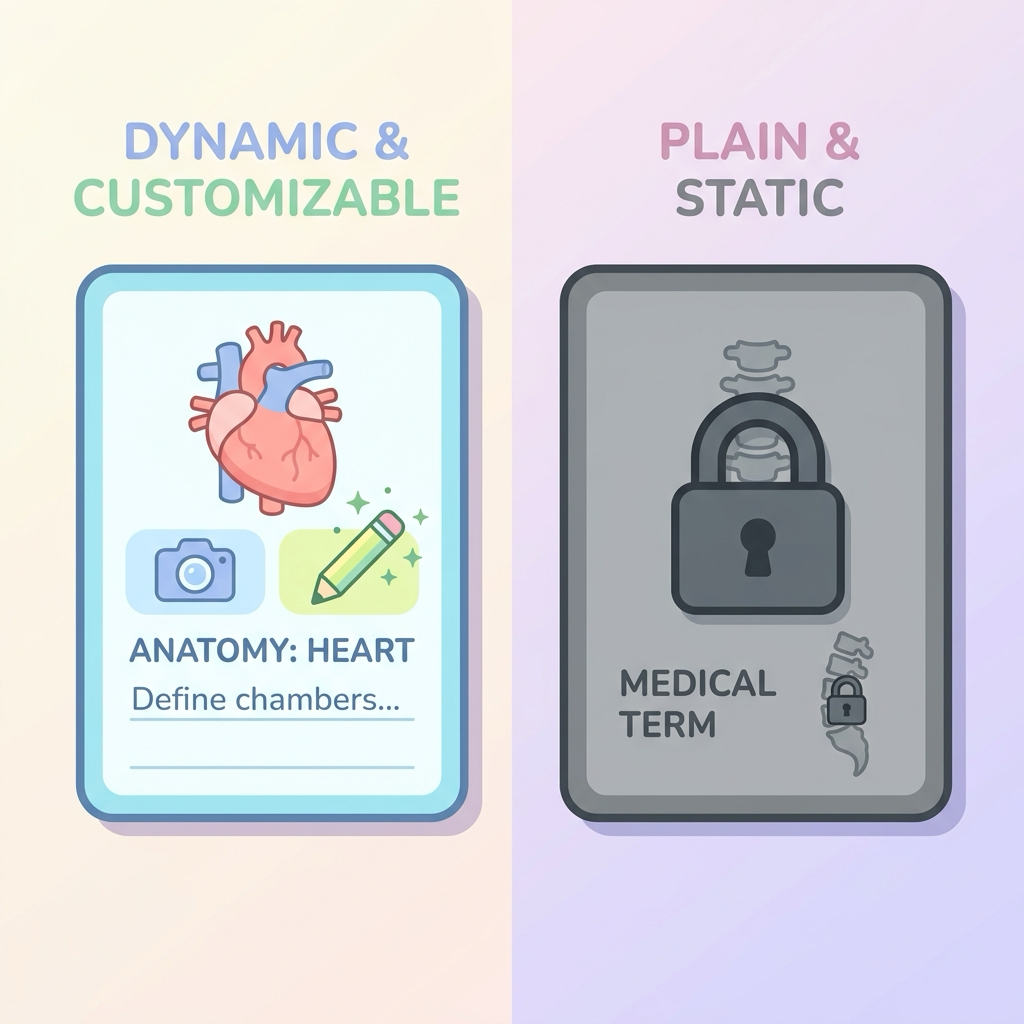
Floww vs Revisable AI: Why Generic Note Scanning Fails Medical Students
Key Takeaways (TL;DR)
- 1Revisable uses generic OCR document scanning that attempts to convert entire PDF pages or notes at once, producing noisy, paragraph-long cards that violate the minimum information principle.
- 2Generic scanning algorithms struggle with medical shorthand, complex pharmacological tables, and messy margin notes, frequently generating blanks over trivial grammar rather than clinical diagnostic keywords.
- 3Floww is purpose-built for medical revision, employing a clinical vision engine that understands medical abbreviations, anatomical hierarchies, and diagnostic triads in 5 seconds.
- 4While Revisable treats flashcards as automated text extraction, Floww pairs targeted photo-to-card creation with the modern FSRS spaced repetition algorithm to ensure exam-day mastery.
Floww vs Revisable AI: Why Generic Note Scanning Fails Medical Students
The introduction of artificial intelligence into study workflows has triggered a flood of promises for medical aspirants. The most alluring promise of all: “Simply upload your notes or PDF, and AI will automatically turn your entire syllabus into flashcards.”
Among the tools pursuing this automated promise is Revisable AI, an automated note-to-flashcard scanner designed for general academic students. On the other side stands Floww, an intelligent revision workstation purpose-built exclusively for Indian medical graduates preparing for NEET-PG and INI-CET.
Both platforms recognize that manually typing thousands of flashcards is an unsustainable bottleneck. However, the technology used to bridge that gap reveals a profound quality difference:
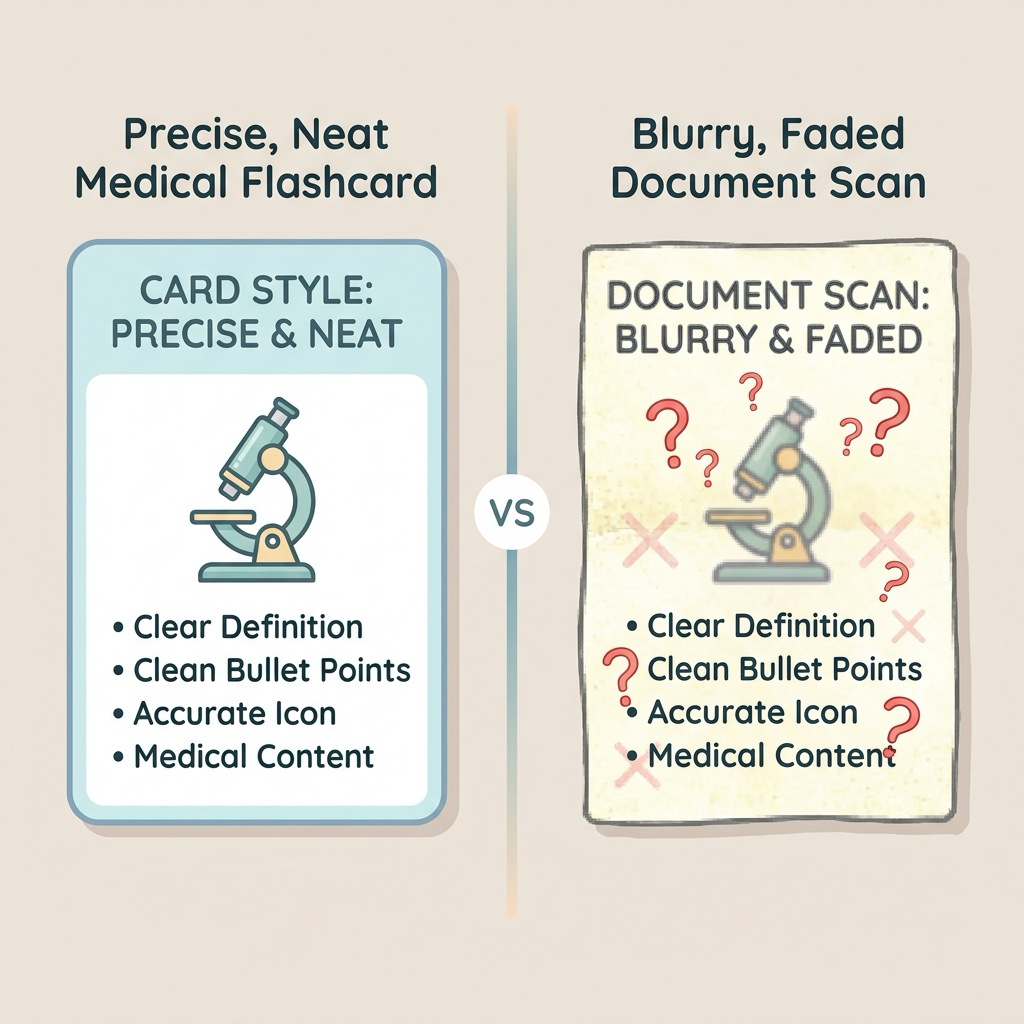
Revisable relies on generic, high-volume document scanning that converts raw paragraphs into noisy, multi-sentence cards that fail basic cognitive rules. Floww utilizes targeted, medical-grade vision AI that captures atomic clinical concepts in five seconds with surgical precision.
In this in-depth comparative review, we break down why automated document scanning often backfires in medical education, how card quality dictates exam-day recall, and why domain-specific architecture matters when preparing for competitive exams.
The Promise vs Reality of Generic AI Note Scanning
When students first hear about tools like Revisable, the appeal is obvious: take an entire 50-page PDF of Cardiology or Pharmacology notes, press upload, and receive 300 flashcards five minutes later.
However, once students actually attempt to review these auto-generated decks, the reality falls drastically short of expectations. Across r/indianmedschool and medical study groups, the consensus on generic document scanners is strikingly consistent:
“I tried uploading my BTR notes to an automated AI flashcard generator. What I got back was unusable. It made cards asking me to fill in prepositions like ‘is associated with’ rather than the actual antibody name, and every card was three paragraphs long. I spent more time fixing the cards than studying.”
The Three Critical Flaws of Generic AI Scanners:
1. Violation of the "Minimum Information Principle"
In cognitive science, Piotr Wozniak’s foundational research on memory formulation established the Minimum Information Principle (SuperMemo Research, 1999): a flashcard must be as simple and atomic as possible. A card should test exactly one cognitive association.
Generic document scanners like Revisable do not understand atomicity. When scanning a lecture note, Revisable typically extracts a whole sentence:
"The patient presented with a history of recurrent pulmonary infections and sweat chloride testing revealed a concentration exceeding 60 mmol/L, confirming the diagnosis of cystic fibrosis secondary to a mutation in the CFTR gene located on chromosome 7."
Revisable then generates a cloze over [cystic fibrosis]. During review, the student must read forty words of redundant filler just to retrieve one fact. Reviewing such cards takes 15 to 20 seconds each. Over a 300-card morning review, cognitive fatigue sets in within 20 minutes, leading to rapid study abandonment.
2. Hallucination and Misreading of Medical Shorthand
Medical notes are dense with specialized symbols, arrows, abbreviations, and non-standard syntax:
↑ BP, ↓ HR, irregular resp(Cushing's triad)c/o SOB x 3d, S3 gallop (+)Rx: DOC = Ceftriaxone 1g IV OD
Generic AI scanners trained on general undergraduate essays or business documents routinely misinterpret these notations. They translate Rx as "prescription symbol," miss bidirectional arrows denoting feedback loops, and frequently misread handwritten margin annotations. In a high-stakes exam where confusing Type I and Type II errors costs valuable marks, inaccurate card conversion is disastrous.
3. The "Passive Upload" Psychological Trap
When an app promises to convert an entire chapter automatically, students fall into a passive mindset. You upload a 100-page file, receive 800 cards, and suddenly face an insurmountable queue of cards you didn't thoughtfully curate.
Because you played no role in framing the questions, the cards feel alien. Research by Karpicke and Blunt (Science, 2011) proves that the cognitive effort involved in identifying what to retrieve is fundamental to long-term memory consolidation. Dumping unvetted AI cards into your brain skips this vital synthesis stage.
How Floww Solves Advanced Card Creation
Floww was built on a different premise: AI should eliminate authoring friction, not replace cognitive engagement. Instead of indiscriminate bulk scanning, Floww provides Targeted Concept Capture.
1. Clinical-Grade Vision Intelligence
Floww's AI Photo-to-Flashcard engine is trained specifically on medical literature, textbook diagrams, and Indian PG coaching notes:
- It understands medical abbreviations (
DOC,MOA,ADR,Ix,C/I). - It recognizes handwritten annotations in the margins of Dr. Zainab Vora’s BTR workbooks or Marrow lecture notes.
- It automatically isolates the single high-yield core association, converting complex data into clean, atomic cards.
Instead of scanning an entire page of fifty concepts indiscriminately, you snap a photo of the exact table, diagram, or paragraph you struggled with during your question session. Five seconds later, you have a structured card ready to test.
2. Format Intelligence: Atomic Cloze vs Clinical Vignette
Unlike Revisable’s rigid sentence-chopping approach, Floww analyzes the pedagogical nature of your material:
- If you photograph a receptor table or enzyme pathway, Floww constructs an atomic Cloze Deletion card where only the critical biochemical or pharmacological marker is blanked out.
- If you capture a Grand Test mistake explanation, Floww constructs a Basic Q&A Vignette card, placing the patient presentation on the front and the clinical differential on the back.
Read our complete analysis on cloze deletion vs basic flashcards for medical students to see why format flexibility is critical for 3rd-order clinical questions.
3. FSRS: Precision Spaced Repetition
Card creation is only half the equation; the other half is interval scheduling. Revisable uses standard, unoptimized spacing intervals that treat all memory traces equally.
Floww is powered by the Free Spaced Repetition Scheduler (FSRS), which continuously adapts to your personal memory stability and retrievability curves. Cards that you find volatile (such as glycogen storage disease enzymes) are presented at precisely calibrated intervals, while concepts you know deeply are pushed outward, cutting total daily review time by up to 30%. Master your daily pacing with our guide on how many flashcards to do per day for NEET-PG.
Direct Comparison: Floww vs Revisable AI
The following table contrasts the capabilities and clinical suitability of both platforms:
| Evaluation Dimension | Floww | Revisable AI | Medical Preparation Impact |
|---|---|---|---|
| Target Audience | Exclusively Medical (NEET-PG, INI-CET) | General Academic / High School | Floww understands clinical vocabulary & context |
| Card Creation Approach | Targeted 5-sec AI capture of specific concepts | Bulk page/PDF document scanning | Floww ensures cards are atomic and memorable |
| Card Quality & Length | Atomic, high-yield (single fact per card) | Cluttered, paragraph-length clozes | Floww cuts review time from 15s to 4s per card |
| Medical Shorthand Support | Full recognition of medical symbols & margin notes | Poor (often hallucinates abbreviations) | Floww prevents dangerous factual errors |
| Curated Pre-Made Decks | High-yield decks for all 19 medical subjects | None (must generate all cards yourself) | Floww provides instant curriculum coverage |
| Spaced Repetition Model | Modern FSRS (dynamic decay calculations) | Generic fixed intervals | Floww prevents review backlog paralysis |
| Integrated Tools | Rank Predictor, MCQ Tracker, Mind Maps | Flashcard generator only | Floww provides a complete revision dashboard |
Practical Example: Generating a Card from a Medical Note
To see the stark difference in card quality, look at how both systems process the following study note on Wilson's Disease:
"Wilson disease (hepatolenticular degeneration) is an autosomal recessive disorder of copper metabolism caused by mutations in ATP7B gene on chromosome 13. Results in decreased ceruloplasmin, Kayser-Fleischer rings, and hepatic copper accumulation. Treatment of choice is Penicillamine or Trientine."
What Revisable AI Generates:
- Card: "Wilson disease is an autosomal recessive disorder of copper metabolism caused by mutations in [ATP7B gene] on chromosome 13 which results in decreased ceruloplasmin, Kayser-Fleischer rings, and hepatic copper accumulation where treatment of choice is Penicillamine."
- The Problem: The card is 41 words long. The student reads the entire history every time, cueing themselves on surrounding words without testing whether they know the copper transport gene or the chelating agent independently.
What Floww Generates:
- Card 1 (Atomic Cloze): "Wilson disease is caused by mutations in the [ATP7B gene] on chromosome [13], impairing biliary copper excretion."
- Card 2 (Clinical Biomarker): "What serum protein finding is characteristic of Wilson disease, and what ocular sign is diagnostic on slit-lamp exam?" → Answer: Decreased serum ceruloplasmin (< 20 mg/dL); Kayser-Fleischer rings (copper deposition in Descemet's membrane).
- Card 3 (Pharmacology): "First-line chelating agent for symptomatic Wilson disease is [D-Penicillamine] (or Trientine), co-administered with [Pyridoxine (Vit B6)]."
Floww breaks the clinical entity into three atomic, mutually reinforcing memory units. Each card can be reviewed in 4 seconds, and each directly maps to a distinct multiple-choice question on NEET-PG or INI-CET.
The Verdict: Which Tool Belongs in Your Study Arsenal?
Revisable AI is suitable if:
- You are studying general humanities, high school vocabulary, or non-technical undergraduate coursework.
- You have large plain-text PDFs and do not mind multi-sentence, text-heavy flashcards.
- You do not need clinical accuracy, medical shorthand decoding, or specialized spaced repetition algorithms.
Floww is the definitive choice if:
- You are an MBBS student or graduate preparing for NEET-PG, INI-CET, or USMLE.
- You want AI card creation that produces clean, atomic, exam-focused cards in five seconds without manual clean-up.
- You value psychological ownership and want to build a personalized deck around your own coaching notes and Grand Test mistakes.
- You demand a modern spaced repetition engine powered by FSRS that protects your precious study time during the final revision sprint.
Discover our full framework on how to make medical flashcards for NEET-PG, explore premade vs self-made flashcard strategies, or review our transparent pricing options to start studying with clinical-grade AI today.

Written by Floww Editorial
Medical Learning Editorial Team
Evidence-led guidance for NEET-PG and INI-CET preparation, focused on active recall, spaced repetition, and sustainable revision workflows.