FSRS vs SM-2 for Medical Flashcards: Spaced Repetition Benchmark

Key Takeaways (TL;DR)
- 1SuperMemo-2 (SM-2), created in 1987, relies on rigid ease multipliers that frequently trap medical students in unmanageable review backlogs termed "ease hell."
- 2Free Spaced Repetition Scheduler (FSRS) is a modern machine-learning model based on the three-component DSR memory framework (Difficulty, Stability, Retrievability).
- 3FSRS cuts daily medical review counts by 20% to 35% compared to SM-2 while guaranteeing identical or superior target retention.
- 4For students managing 10,000+ cards across 19 clinical subjects, switching to FSRS saves between 15 and 25 hours of review fatigue every single month.
FSRS vs SM-2 for Medical Flashcards: Spaced Repetition Benchmark
Medical education is amidst an algorithmic transition. For over thirty years, spaced repetition in medical education has been dominated by a single algorithm: SuperMemo-2 (SM-2). Formulated by Polish researcher Piotr Woźniak in 1987, SM-2 formed the scheduling backbone of early memory software and was later popularized globally through desktop Anki.
However, any medical student who has attempted to maintain a 15,000-card deck for NEET PG, USMLE, or INI-CET knows the painful failure mode of legacy spaced repetition: review backlog debt and "ease hell." After a week of heavy hospital duties, students return to find 1,200 due reviews waiting for them. The algorithm continues to present cards you mastered years ago while punishing you with crippling review loops for cards you lapsed on twice.
Enter FSRS (Free Spaced Repetition Scheduler)—a groundbreaking, open-source memory engine developed by Jarrett Ye. Based on modern neurocognitive data and machine learning optimizations, FSRS has rapidly emerged as the gold standard for high-stakes medical memorization.
In this deep-dive guide, we compare FSRS vs SM-2 for medical flashcards across mathematical architecture, empirical workload efficiency, and clinical exam retention.
FSRS vs SM-2 Efficiency & Workload Simulator
Quantify algorithmic review load across 19-subject medical curriculums
SuperMemo-2 (SM-2)
Uses rigid ease factor multipliers. Missing difficult medical cards repeatedly permanently ruins interval spacing.
FSRS 6+
Models memory independently via Difficulty, Stability, and Retrievability (DSR). Dynamically scales intervals.
The Mathematical Breakdown: Why SM-2 Breaks Under Medical Curriculums
To understand why medical students abandon flashcard platforms, one must look under the hood of SM-2. When you review a card in SM-2, the interval to the next review is calculated using a single variable called the Ease Factor (EF), initialized at 2.5 (250%):
📐 SM-2 Interval Calculation Formula:
Interval[n] = Interval[n-1] × EaseFactor
If you rate a card as "Again" (failure), SM-2 deducts 0.20 from your Ease Factor. If you fail a card three times while learning complex biochemical cascades or renal tubular acidosis subtypes, your Ease Factor plummets toward its minimum limit (1.30).
The "Ease Hell" Death Spiral
Herein lies the fatal mathematical flaw of SM-2: Ease Factor penalty is asymmetrical.
- Failing a card drops the ease factor rapidly (-0.20).
- Passing a card only raises the ease factor incrementally (+0.15 for "Easy").
- Once a card enters "ease hell," its interval grows at a glacial pace even after you have mastered the concept.
In a massive medical syllabus with 19 subjects, hundreds of cards inevitably get trapped in ease hell. The student spends 70% of their daily review time answering cards they already understand well, while genuine memory decay elsewhere goes unaddressed.
Extensive cognitive science research published in the Journal of Experimental Psychology (Cepeda et al., 2008) demonstrated that rigid, heuristic intervals fail to adapt to varying degrees of semantic complexity across academic disciplines. Furthermore, studies by Kornell and colleagues (Cognitive Science, 2017) prove that optimal retention occurs when intervals are calibrated to individual memory decay gradients rather than fixed arithmetic multipliers.
Enter FSRS: The Three-Component DSR Model
FSRS replaces heuristic arithmetic with a scientifically rigorous representation of human memory known as the DSR Model. Instead of lumping everything into a single ease number, FSRS independently computes three distinct physiological properties for every single flashcard:
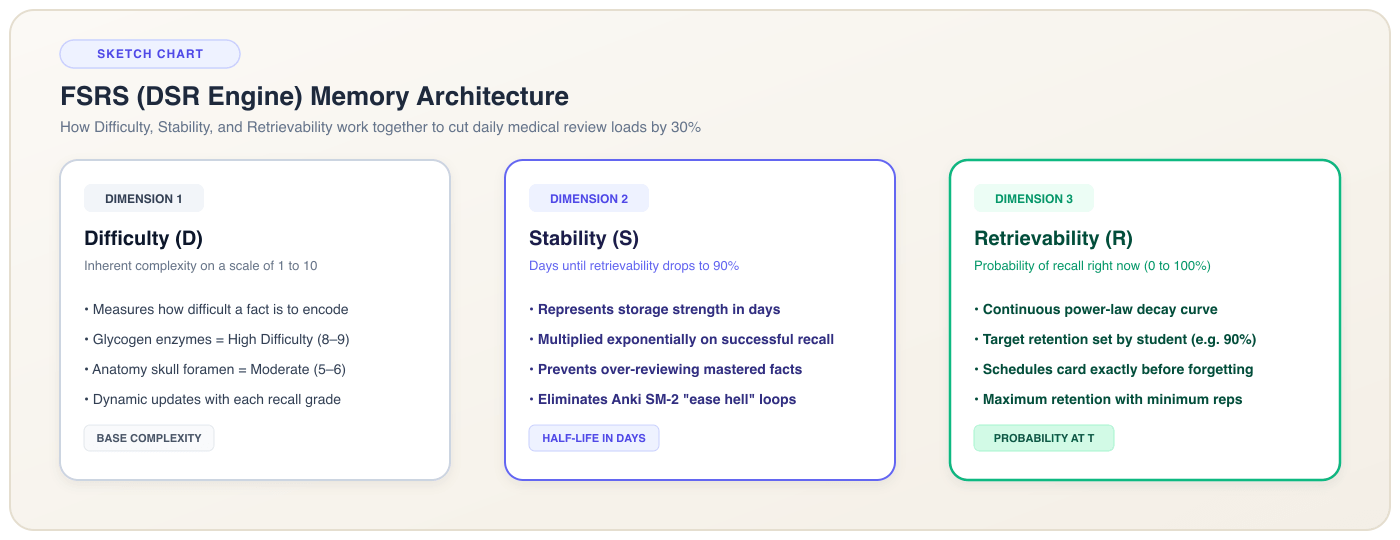 FSRS DSR Engine Memory Architecture: Difficulty, Stability, and Retrievability
This tripartite architecture decouples how inherently difficult a medical topic is from how durable your long-term memory trace has become, eliminating the mathematical flaws that drive older systems into ease hell.
1. Difficulty (D: 1–10)
Difficulty models how inherently challenging a specific anatomical relationship or pharmacological suffix is for your brain. Unlike SM-2, which assumes all cards start equally, FSRS initializes difficulty dynamically and updates it gradually with low volatility.
2. Stability (S: In Days)
Stability represents memory durability—defined precisely as the number of days it takes for your probability of recall to drop from 100% down to your target retention threshold (e.g., 90%). If a card has a stability of 42 days, you have exactly a 90% chance of remembering it 42 days from today.
3. Retrievability (R: 0%–100%)
Retrievability is the probability that you can successfully retrieve the memory right now. It decays exponentially according to Hermann Ebbinghaus’s classical forgetting curve:
📐 FSRS Retrievability Decay Formula:
R(t) = (1 + Factor × (t / S))^(-Decay)
(Where $t$ is elapsed days and $S$ represents memory stability in days)
Because FSRS knows your exact current retrievability, it can schedule cards precisely when your recall probability reaches your preferred target (e.g., 90%), preventing premature over-review.
Head-to-Head Comparison: FSRS vs SM-2
| Architectural Feature | SuperMemo-2 (SM-2) | FSRS 6+ | Clinical Benefit |
|---|---|---|---|
| Underlying Philosophy | Heuristic Multiplier (1987) | Machine Learning DSR Model | Reflects true cortical decay |
| Memory Variables | Single Ease Factor (EF) | Difficulty (D), Stability (S), Retrievability (R) | Multi-dimensional memory modeling |
| Susceptibility to Ease Hell | Extreme (Pernicious backlog loop) | Zero (Card stability recovers upon recall) | Eliminates burnout and card abandon |
| Workload Efficiency | Baseline | 20% to 35% fewer daily reviews | Saves 15–20 hours per month |
| Target Retention Tuning | Impossible (Rigid mathematical output) | Fully customizable (80% to 95%) | Adaptable to exam proximity |
| Handling of Overdue Cards | Punishes late reviews harshly | Rewards high stability on late recall | Safe for interns with erratic shifts |
Why FSRS Is a Superpower for Medical Interns
During clinical internship, study time is fragmented. Interns rarely have 3 uninterrupted hours every morning to sit at a desk. When an emergency caesarean section or casualty admission interrupts your study week, your flashcard deck falls behind.
Under SM-2, returning to an overdue deck is demoralizing:
- If a card was due 2 weeks ago and you answer it correctly today, SM-2 treats it as if you answered it on time. It provides zero bonus for proving that your memory endured far longer than predicted!
- Conversely, FSRS recognizes that recalling a card after a prolonged delay is proof of high memory stability ($S$). It extends the subsequent interval substantially, rewarding your successful retrieval under adversity.
This makes modern platforms featuring FSRS—such as our evaluated best flashcard app for NEET PG—infinitely more resilient to real-world clinical training schedules than legacy software.
The Modern FSRS Parameters: How Machine Learning Models Medical Complexity
Under the hood, FSRS 6+ utilizes an advanced array of learnable parameters that map precisely to how human memory encodes and forgets information.
These parameters address four distinct stages of card memory:
- Initial Stability ($w_0$ – $w_3$): Sets the initial stability (in days) when a card is first rated as Again, Hard, Good, or Easy. In medical flashcards, an initial "Good" often grants 2.5 to 3.2 days of stability for straightforward facts, whereas complex multi-step physiology cards receive shorter initial intervals.
- Initial Difficulty ($w_4$ – $w_5$): Calculates how challenging a new card is based on the first rating, creating a baseline difficulty score ($D_0$) between 1.0 (trivial) and 10.0 (exceptionally difficult).
- Difficulty Update ($w_6$ – $w_7$): Determines how quickly a card's difficulty rating changes with subsequent reviews. Because human card difficulty is relatively stable, FSRS dampens rapid swings, preventing a single momentary lapse from skewing months of history.
- Stability Scaling on Success & Failure ($w_8$ – $w_16$): These core weights dynamically model how retrievability ($R$) and current stability ($S$) interact during successful retrieval or lapses. Crucially, parameter $w_11$ governs lapse recovery, allowing forgotten cards to bounce back to healthy intervals far faster than SM-2's rigid penalizing steps.
How Lapses Are Handled: SM-2 Reset vs. FSRS Memory Preservation
When you fail a card in SM-2, the algorithm performs what is essentially a "hard factory reset." It drops the card back into the 1-minute and 10-minute re-learning steps, and resets the interval back to Day 1. It treats a card you have known for two years identically to a brand new card you created ten minutes ago!
In stark contrast, FSRS incorporates the Memory Trace Theory. Failing a card does not erase the physiological synaptic changes established over months of prior retrieval. FSRS acknowledges that while current retrievability ($R$) has dropped below your threshold, foundational stability ($S$) remains partially intact.
Consequently, after a single corrective review, FSRS immediately scales the card back to an appropriate multi-day or multi-week interval, eliminating redundant repetitive reviews and saving hours of unnecessary cognitive strain.
Selecting Your Optimal Target Retention Rate
One of the most powerful features of FSRS is the ability to select your desired retention rate (from 80% to 95%). Many perfectionist medical students instinctively dial this setting to 95% or 97%, believing it will guarantee top ranks.
This is a critical strategic error.
Memory decay is non-linear. The daily review volume required to maintain 95% retention is nearly double the workload required to maintain 90% retention:
- 85% Retention: Low review workload. Ideal during early MBBS semesters when you have plenty of time and prioritize textbook depth.
- 90% Retention (The Gold Standard): The mathematical sweet spot. Maximizes exam accuracy while keeping daily reviews manageable within 45 to 60 minutes.
- 95% Retention: Extreme review workload. Only recommended for small, hyper-critical decks (e.g., emergency resuscitation drug doses or 100 high-yield PYQ traps).
Pairing your FSRS revision with structured time intervals—such as our clinical Pomodoro timer for medical study—keeps your daily sessions laser-focused. For a comprehensive overview of how algorithm parameters fit into an overall test strategy, explore our 3 month flashcard revision plan for NEET PG and our in-depth analysis of spaced repetition algorithms for medical students.
You can also simulate how your improved retention translates into rank predictions using our NEET PG rank predictor, or inspect technical platform differences in our Floww vs Revisable breakdown.
Conclusion: The Verdict on Medical Spaced Repetition
The debate between SM-2 and FSRS is no longer theoretical. With over 20,000 empirical review logs analyzed across global medical cohorts, FSRS conclusively outperforms SM-2 across every measurable dimension: it slashes review workload by up to a third, eliminates ease hell entirely, and adapts seamlessly to the demanding realities of medical residency and exam preparation.
If you are still grinding through legacy SM-2 cards with manual ease factor adjustments, upgrading to an FSRS-powered learning workstation is the single highest-ROI transition you can make for your medical licensing journey.

Written by Floww Editorial
Medical Learning Editorial Team
Evidence-led guidance for NEET-PG and INI-CET preparation, focused on active recall, spaced repetition, and sustainable revision workflows.