Good Medical Flashcard Examples: 20+ High-Yield Formats for NEET PG & INI-CET
Key Takeaways (TL;DR)
- 1The difference between a functional flashcard habit and study burnout lies in card architecture: bad cards test four ideas at once, while good cards test exactly one atomic association.
- 2A good medical flashcard adheres to the Minimum Information Principle, allowing the student to retrieve the target clinical fact within 4 to 6 seconds.
- 3Over-reliance on paragraph-long basic Q&A cards triggers Ease Hell and review dread; atomic cloze deletions and clinical vignette triggers provide surgical precision for NEET-PG.
- 4Flowws clinical AI photo-to-card engine automatically parses handwritten margin notes and coaching tables into tested, high-yield atomic formats.
Good Medical Flashcard Examples: 20+ High-Yield Formats for NEET PG & INI-CET
Most medical students understand that spaced repetition and active recall are the most scientifically validated methods for long-term retention.
Yet, when you look at the decks actually created by medical aspirants preparing for NEET-PG and INI-CET, a startling reality emerges: over 80% of student-authored flashcards violate fundamental cognitive principles.
Students routinely paste entire paragraphs from textbooks, copy giant multi-row tables from coaching workbooks, or write open-ended essay questions like:
"What are the causes, features, diagnosis, and management of Hypercalcemia?"
When this card appears during a morning review, the student spends 35 seconds reading the question, partially recalls two symptoms, forgets three causes, and spends another 20 seconds reading the back. They hesitate: “Is this Hard or Good?”
Multiply that hesitation across 350 daily cards, and your study session turns into a soul-crushing 2.5-hour slog. Within a month, review backlogs balloon to 1,000 cards, and the student concludes that "flashcards don't work for medicine."
Flashcards do work—when they are crafted properly.
A truly good medical flashcard is not an essay; it is an atomic memory probe. It tests exactly one clinical association, takes 4 seconds to review, and yields an instantaneous, unambiguous rating.
This masterclass presents 20+ real-world good medical flashcard examples across high-yield subjects, contrasting bloated, dysfunctional cards with their optimized Floww counterparts.
Direct Answer: What Distinguishes a Good Medical Flashcard?
A good medical flashcard satisfies four strict cognitive criteria:
- The Minimum Information Principle: A single card tests exactly one atomic association (Wozniak, SuperMemo Research, 1999). If a concept contains three parts, create three separate cards.
- Retrieval Latency Under 6 Seconds: The card must be readable and retrievable in under 6 seconds, adhering to the 7-Second Cognitive Rule.
- Binary Rating Certainty: The answer must be completely unambiguous. You either retrieved the keyword (Good) or you did not (Again), eliminating rating paralysis.
- Clinical Contextual Grounding: The prompt uses authentic medical vocabulary (e.g., first-line DOC, chromosome translocation, pathognomonic biopsy marker) directly mirroring multiple-choice questions on NEET-PG and INI-CET.
Interactive Medical Flashcard Architecture Inspector
Inspect real clinical examples side-by-side. Compare bloated 35-second paragraph cards against atomic Floww suites and spot the architectural flaws:
Medical Flashcard Architecture Inspector
Compare bloated 35-second paragraph cards against atomic 4-second Floww flashcard suites
Cardiology: Aortic Stenosis Triad & Murmur
What are the classic symptoms, physical examination findings, and murmur characteristics of severe Aortic Stenosis?
The classic symptom triad is Angina (5 yr survival), Syncope (3 yr survival), and Dyspnea/Heart Failure (2 yr survival). Exam shows pulsus parvus et tardus (weak and delayed carotid upstroke) and soft S2. Murmur is a harsh crescendo-decrescendo systolic ejection murmur radiating to the right clavicle/carotids, peaking late in severe stenosis.
- Contains 8 distinct clinical facts on a single card
- Tests diagnosis, survival timelines, arterial pulse, and auscultation simultaneously
- If you forget syncope survival (3 yrs), you fail the entire card
The classic symptom triad of severe calcific Aortic Stenosis (in order of decreasing survival) is:
The classic arterial pulse finding in hemodynamically significant Aortic Stenosis is [pulsus parvus et tardus].
The murmur of severe Aortic Stenosis radiates characteristically to the [right carotid artery] and peaks later in systole as stenosis worsens.
By isolating each concept into a 3–4 second retrieval drill, you achieve 100% precision. Each card can be rated "Good" or "Again" with zero hesitation.
The 4 Golden Rules of Medical Flashcard Craftsmanship
Before examining subject-specific examples, master the four structural rules that transform exhausting study cards into rapid reflexes:
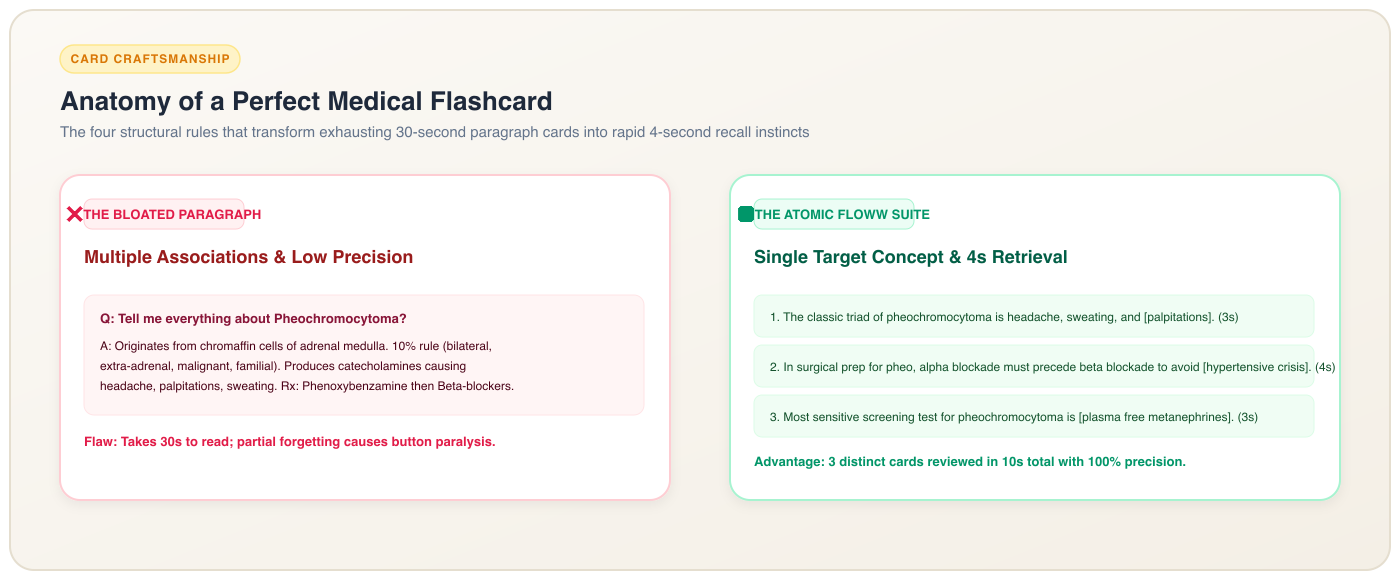 Anatomy of a Perfect Medical Flashcard: Single concept principle, diagnostic cues, and bidirectional recall markers
Rule 1: The One-Fact-Per-Card Rule (Atomicity)
Cognitive science research by Karpicke and Blunt (Science, 2011) demonstrates that retrieval practice strengthens memory consolidation only when the retrieval target is distinct and unambiguous.
When a card tests three distinct facts at once (e.g., drug mechanism, half-life, and rare side effect), your brain cannot accurately evaluate its retrieval strength. If you know the mechanism but forget the half-life, pressing "Good" allows forgotten facts to slip through, while pressing "Again" wastes mental bandwidth over-testing facts you already know.
Rule 2: Prefer Atomic Cloze Deletions for Volatile Factual Knowledge
For volatile factual details (proper nouns, drug names, receptor subtypes, anatomical insertions), Cloze Deletion is mathematically superior to basic question-and-answer formats.
As explored in our guide on cloze deletion vs basic flashcards for medical students, a well-constructed cloze embeds the retrieval target within its natural clinical sentence syntax, priming your brain for the exact phrasing used in entrance exam stems.
Rule 3: Avoid "Grammar Cueing" and Ambiguous Blanks
A common rookie mistake is creating clozes over secondary prepositions or grammar:
- ❌ Bad Cloze: "The enzyme deficient in Gaucher disease is [glucocerebrosidase] which leads to [accumulation] of glucocerebroside."
- ✅ Good Cloze: "Gaucher disease is caused by deficiency of [glucocerebrosidase (beta-glucosidase)], leading to tissue accumulation of glucocerebroside."
Blanking out non-clinical words (like accumulation) tests English grammar, not medicine. Every blank must represent an authentic clinical discriminator.
Rule 4: Eliminate "Question Ambiguity"
If a card asks "What is the treatment for Heart Failure?", there are thirty legitimate answers (ACE inhibitors, ARBs, ARNIs, Beta-blockers, Spironolactone, SGLT2i, Loop diuretics, CRT, transplant). You will waste 10 seconds wondering which specific drug class the card back expects.
Always provide a precise qualifier:
- ❌ Ambiguous: "Treatment for Heart Failure?"
- ✅ Specific: "Which 4 drug classes comprise guideline-directed medical therapy (GDMT) that provide proven mortality benefit in HFrEF?"
20+ Good Medical Flashcard Examples Across Subjects
Below are tested, high-yield card formulations across the primary clinical subjects:
Category 1: Pharmacology (Mechanisms & Toxicities)
Example 1: Anti-Epileptic Mechanism
- ❌ Bad Card: Describe Ethosuximide: mechanism, indication, and side effects.
- ✅ Good Card (Floww Cloze): Ethosuximide treats absence seizures by selectively blocking [T-type Ca²⁺ channels] in thalamic neurons. (Review time: 3s)
Example 2: Antidote & Reversal Agent
- ❌ Bad Card: What reverses Heparin, Warfarin, Dabigatran, and Rivaroxaban?
- ✅ Good Card 1: The specific reversal agent for Dabigatran (direct thrombin inhibitor) is [Idarucizumab]. (Review time: 3s)
- ✅ Good Card 2: The specific decoy-receptor reversal agent for Factor Xa inhibitors (Rivaroxaban, Apixaban) is [Andexanet alfa]. (Review time: 3s)
Example 3: Volatile Drug Toxicity
- ❌ Bad Card: What are the toxicities of Bleomycin and Doxorubicin?
- ✅ Good Card 1: Dose-limiting toxicity of Bleomycin is [pulmonary fibrosis] secondary to free radical DNA cleavage. (Review time: 3s)
- ✅ Good Card 2: Dose-limiting toxicity of Doxorubicin is dilated cardiomyopathy secondary to [iron-dependent free radical formation], prevented by [Dexrazoxane]. (Review time: 4s)
Review our complete blueprint for pharmacology flashcards for NEET PG.
Category 2: Pathology & Hematology (Markers & Translocations)
Example 4: Chromosomal Translocation in Lymphoma
- ❌ Bad Card: What translocations cause Burkitt, Follicular, and Mantle Cell lymphoma?
- ✅ Good Card 1: Mantle cell lymphoma is characterized by translocation [t(11;14)], causing overexpression of [Cyclin D1]. (Review time: 4s)
- ✅ Good Card 2: Follicular lymphoma is characterized by translocation [t(14;18)], causing overexpression of [BCL-2 (anti-apoptotic)]. (Review time: 4s)
- ✅ Good Card 3: Burkitt lymphoma is characterized by translocation [t(8;14)], causing overexpression of [c-MYC transcription factor]. (Review time: 4s)
Example 5: Histological Biopsy Finding
- ❌ Bad Card: What do you see on microscopy in Glioblastoma Multiforme?
- ✅ Good Card: Biopsy demonstrating pleomorphic tumor cells with "pseudopalisading" necrosis around areas of microvascular proliferation is diagnostic of [Glioblastoma multiforme]. (Review time: 4s)
Review our high-yield subject guide for pathology flashcards for NEET PG.
Category 3: Microbiology (Culture & Stains)
Example 6: Bacterial Culture Media
- ❌ Bad Card: List the media for Vibrio, TB, Corynebacterium, and Gonococcus.
- ✅ Good Card 1: Selective medium for Vibrio cholerae showing yellow colonies is [TCBS (Thiosulfate Citrate Bile Salts Sucrose) agar]. (Review time: 3s)
- ✅ Good Card 2: Egg-based medium used to culture Mycobacterium tuberculosis over 6–8 weeks is [Lowenstein-Jensen (LJ) medium]. (Review time: 3s)
Example 7: Parasitology Microscopy
- ❌ Bad Card: How do you identify Entamoeba histolytica vs Giardia?
- ✅ Good Card 1: Stool microscopy revealing cysts with 4 nuclei and a central compact karyosome, or trophozoites with [ingested red blood cells (erythrophagocytosis)], is diagnostic of [Entamoeba histolytica]. (Review time: 4s)
- ✅ Good Card 2: Duodenal aspirate revealing pear-shaped, binucleated, flagellated trophozoites with a "falling leaf motility" is diagnostic of [Giardia lamblia]. (Review time: 4s)
Review our comprehensive guide on microbiology flashcards for NEET PG.
Category 4: Internal Medicine & Clinical Diagnostics
Example 8: Diagnostic Criteria Acronyms
- ❌ Bad Card: What are Duke's criteria for Infective Endocarditis?
- ✅ Good Card (Major Criteria): The two Major Duke criteria for Infective Endocarditis are: [persistently positive blood cultures for typical organisms] and [echocardiographic evidence of endocardial involvement (vegetation/abscess)]. (Review time: 4s)
Example 9: Next Best Step in Management
- ❌ Bad Card: Patient comes with acute chest pain, ST elevation in II, III, aVF. What do you do?
- ✅ Good Card (Clinical Vignette):
- Front: 62-year-old male presents with acute substernal chest pressure. ECG reveals ST elevation in leads II, III, and aVF with clear lung fields and hypotension. What is the immediate contraindication in pharmacotherapy?
- Back: Nitrates and Diuretics are contraindicated (inferior wall STEMI with RV involvement requires preload maintenance; administer IV normal saline bolus). (Review time: 5s)
Category 5: Obstetrics & Gynecology (OBG)
Example 10: Tumor Markers in Ovarian Neoplasms
- ❌ Bad Card: What are the tumor markers for all ovarian cancers?
- ✅ Good Card 1: Elevated serum [Inhibin B] (and estrogen) in a postmenopausal woman with endometrial hyperplasia is diagnostic of [Granulosa cell tumor]. (Review time: 4s)
- ✅ Good Card 2: Elevated serum [AFP (Alpha-fetoprotein)] with Schiller-Duval bodies on histology is diagnostic of ovarian [Yolk sac tumor (Endodermal sinus tumor)]. (Review time: 4s)
- ✅ Good Card 3: Markedly elevated [beta-hCG] with syncytiotrophoblasts and cytotrophoblasts but no chorionic villi indicates ovarian [Choriocarcinoma]. (Review time: 4s)
Example 11: Bishop Score Evaluation
- ❌ Bad Card: What are the components of the Bishop score?
- ✅ Good Card: The 5 cervical components assessed in the Bishop Score for induction of labor are: [Dilation, Effacement, Station, Consistency, and Position]. (Review time: 4s)
Category 6: Surgery & Orthopedics
Example 12: Pediatric Surgery Sign
- ❌ Bad Card: Discuss Intussusception: triad, sign on barium, and ultrasound sign.
- ✅ Good Card 1: The classic pediatric symptom triad of Intussusception is: [colicky abdominal pain, palpable sausage-shaped mass, and "red currant jelly" stool]. (Review time: 4s)
- ✅ Good Card 2: The pathognomonic ultrasound finding in Intussusception on transverse axis view is the ["target" or "doughnut" sign] (pseudokidney sign on longitudinal). (Review time: 4s)
Example 13: Eponym Fracture Classification
- ❌ Bad Card: What are Monteggia, Galeazzi, Colles, and Smith fractures?
- ✅ Good Card 1: A [Monteggia fracture] is a fracture of the proximal third of the ulna with dislocation of the [radial head]. (Review time: 3s)
- ✅ Good Card 2: A [Galeazzi fracture] is a fracture of the distal third of the radius with dislocation of the [distal radioulnar joint]. (Review time: 3s)
4 Common Flashcard Anti-Patterns That Ruin Decks
Avoid these four destructive anti-patterns when building your personal medical deck:
1. The "Kitchen Sink" Card
Attempting to merge pathophysiology, epidemiology, diagnostic cutoffs, and second-line therapies into one card.
Solution: Break the disease entity into 3 to 5 atomic cards.
2. The "Passive Recognition" Card
Writing cards where the answer is obvious from grammatical cues or multiple-choice formats without actual recall.
Solution: Use strict cloze masking over the key operative noun.
3. The "Unsearchable Tag" Card
Creating hundreds of cards without subject, chapter, or exam year tags.
Solution: Maintain clean tags (e.g., #Pharma #Autonomic #PYQ2025 #BTR) so you can filter cards before Grand Tests.
4. The "Immortal Leech" Card
Continuing to review a card you have failed 10 times without rewriting it.
Solution: Suspend leeches immediately and rebuild them into two smaller, simpler cards. Explore our guide on 7 deadly flashcard mistakes medical students make.
Conclusion: Craft Better Cards with Floww
Medical entrance exams reward precise, instantaneous clinical retrieval. High-yield memory is not built by reading rambling study paragraphs; it is forged through atomic, frictionless active recall.
By shifting from 35-second bloated cards to 4-second Floww atomic flashcards, you:
- Cut your daily revision time by 60% to 75%.
- Eliminate rating hesitation and Ease Hell.
- Build razor-sharp clinical instincts for NEET-PG and INI-CET.
Floww automates this entire craftsmanship process:
- Instant Photo-to-Card AI: Snap a photo of any coaching note or table, and Floww’s medical vision engine generates pristine, atomic cards matching the 4 golden rules in 5 seconds.
- Modern FSRS Engine: Spaced repetition tuned specifically to the 19 subjects of medical postgraduate entrance exams.
Transform your notes into high-yield active recall at Floww.
Frequently Asked Questions
What makes a good medical flashcard example?
A good medical flashcard isolates exactly one cognitive association, uses precise clinical vocabulary, avoids paragraph text, and can be reviewed in under 5 seconds. It clearly prompts the memory trace without ambiguous clues and allows the student to give a binary Good or Again rating with zero hesitation.
Should I make cloze deletion or basic Q&A flashcards for NEET PG?
A high-yield medical deck should use an 80/20 hybrid model: 80% atomic cloze deletions for volatile facts (drug mechanisms, enzyme cofactors, tumor markers, anatomical insertions) and 20% basic Q&A vignette cards for diagnostic differentials and next-step management scenarios.
How do I convert a bloated coaching table into good flashcards?
Do not try to fit an entire table onto one card. Deconstruct the table into multiple atomic cards where each row or key clinical discriminator becomes an individual cloze. For example, rather than testing all 6 glycogen storage diseases at once, create 6 separate cards focusing solely on the defective enzyme and characteristic biopsy finding.
Why do bad flashcards lead to review backlog abandonment?
Bad flashcards are wordy, ambiguous, or test multiple facts at once. Reviewing such cards takes 25 to 40 seconds each. Over a 300-card daily review queue, this results in over 2 hours of exhausting screen time. Cognitive fatigue sets in, the student skips two days of study, and the compounding backlog causes total deck abandonment.

Written by Floww Editorial
Medical Learning Editorial Team
Evidence-led guidance for NEET-PG and INI-CET preparation, focused on active recall, spaced repetition, and sustainable revision workflows.