How to Clear a Massive Flashcard Backlog During Medical Internship (Without Resetting)
Key Takeaways (TL;DR)
- 1The compulsory rotatory medical internship is notorious for triggering 800+ card backlogs due to 36-hour emergency duties and clinical exhaustion.
- 2Hitting "Reset All" is a catastrophic mistake that erases accumulated memory stability, turning mature long-term cards back into demanding daily reviews.
- 3The FSRS Retrievability Triage Protocol sorts overdue cards by probability of recall, ensuring you review the most vulnerable memories first while capping daily reviews.
- 4Adjusting FSRS target retention from 90% down to 84–86% reduces daily review volume by 35% during brutal postings without significantly hurting Grand Test percentiles.
How to Clear a Massive Flashcard Backlog During Medical Internship (Without Resetting)
Ask any MBBS graduate preparing for NEET PG or INI-CET about their darkest preparation moment, and they will describe the exact same scene:
You are in the middle of your Obstetrics and Gynecology or Emergency Medicine rotation. You just finished a grueling 36-hour casualty duty where you managed polytrauma resuscitations, ran between blood banks, and stood through back-to-back emergency caesarean sections on three hours of broken sleep.
You finally collapse onto your hostel bed, pick up your phone, and open your flashcard app.
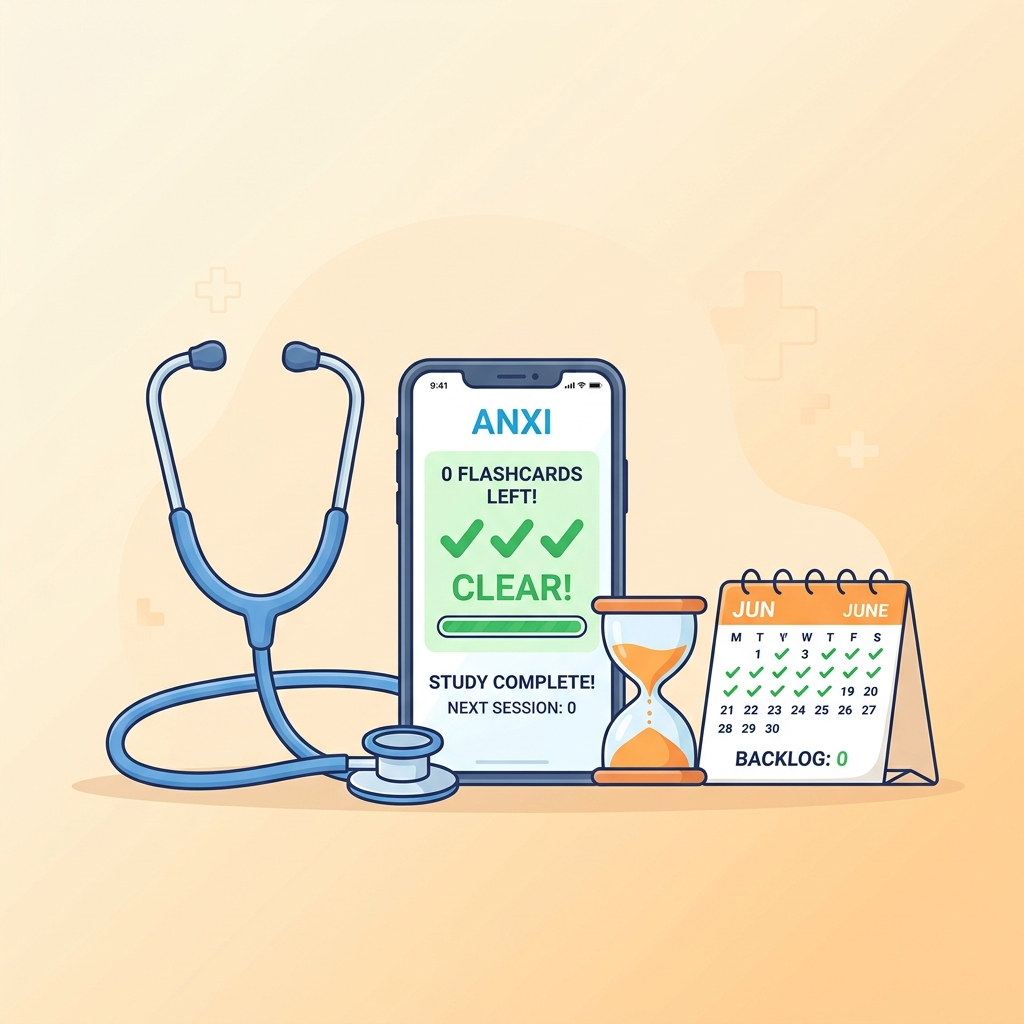
A terrifying red number glares back at you: 942 Cards Due Today.
Your chest tightens. You do the mental arithmetic: at 10 seconds per card, clearing this backlog requires nearly three hours of uninterrupted mental strain. You have duty again in eight hours. Despair sets in. You close the app.
Three days later, the number is 1,450. You stop opening the app entirely.
This is the dreaded Flashcard Backlog Trap. Every year, thousands of brilliant medical students abandon spaced repetition entirely because they lack a systematic protocol for how to clear flashcard backlog during internship.
Direct Answer: How to Clear Flashcard Backlog During Internship
To clear a flashcard backlog during internship without resetting your deck, implement the FSRS Retrievability Triage Protocol: immediately freeze all new cards, adjust FSRS target retention to 85% to cut review volume by 35%, and clear overdue cards in three 15-minute duty micro-sessions using Floww.
Action Step               Destructive Traditional Reaction    Floww Internship Triage Protocol
──────────────────────────────────────────────────────────────────────────────────────────────
Deck Management           Hits "Reset All" in desperation     Freezes New Cards; Retains Stability
Target Retention          Rigid 90% (Crushing review load)    Adjusts to 84–86% (Cuts volume by 35%)
Review Strategy           Attempts 4-hour weekend marathon    3 × 15-min Ward Micro-Sessions
Leech Handling            Struggles repeatedly through them   Auto-suspends cards with > 4 lapses
Time to Zero Backlog      Never (Repeated burnout cycles)     14 to 21 Days to Sustainable Zero
By applying mathematical triage rather than brute-force willpower, you recover your decks while maintaining your clinical sanity.
Interactive Internship Backlog Triage & Recovery Calculator
Simulate your exact recovery trajectory based on your current backlog, duty hours, and FSRS target retention:
Internship Backlog Triage & Recovery Calculator
Calculate your exact days to zero backlog without resetting decks or burning out on hospital duties
Setting retention to 85% reduces daily maintenance card load by 18% compared to standard 90% targets, preventing review paralysis.
The Cognitive Science: Why Hitting "Reset" Is Preparation Suicide
When faced with a 1,500-card backlog, many students choose the nuclear option: they reset the deck to start fresh from Day 1.
Cognitive psychology research proves this is the single most destructive action an aspirant can take.
In groundbreaking research on human memory consolidation, Wixted and Ebbesen (Memory & Cognition, 1991) established that memory forgetting does not follow a linear path, but rather a power law of forgetting. As memory traces undergo synaptic consolidation over months, their Stability ($S$) increases exponentially.
Memory Retrievability: R(t) = (1 + Factor × t / S)^(-Power)
Even if an advanced card is overdue by 30 days, its baseline biological stability is still vastly higher than a brand-new card. When you encounter an overdue mature card:
- If you recall it, your brain receives a massive consolidation dividend, and its interval leaps forward by months.
- If you forget it, modern schedulers like FSRS 6+ recalibrate its stability without permanently degrading the rest of your deck.
If you hit "Reset", you strip that hard-earned biological stability away. Mature cards that would have required a single 5-second check are thrown back into the newborn queue, demanding reviews tomorrow, in 3 days, in 7 days, and in 14 days. Resetting does not eliminate your backlog—it multiplies your future workload by 400%.
Furthermore, a seminal study by Kornell and Bjork (Psychological Science, 2008) on spacing effects demonstrated that delayed retrieval after prolonged intervals produces far greater long-term mnemonic gains than frequent, closely spaced repetitions.
The 4-Step Internship Backlog Recovery Protocol
When your backlog crosses 300 cards during a heavy clinical posting, execute these four steps immediately:
Step 1: Emergency Quarantine
Set New Cards/Day to ZERO.
Never introduce fresh information while drowning in overdue reviews.
                        │
                        ▼
Step 2: Adjust FSRS Target Retention to 85%
Temporarily lower target retention from 0.90 to 0.85 in [Floww](/features/flashcards).
This mathematical shift immediately reduces your incoming daily review load by ~32%.
                        │
                        ▼
Step 3: Establish a Daily Review Ceiling
Never attempt to do more than 150–200 backlog cards per day.
Cap your daily reviews to fit into available duty breaks.
                        │
                        ▼
Step 4: Execute the 3-Duty Micro-Session Habit
Split daily reviews into three 15-minute bursts: morning pre-rounds, afternoon tea break, night.
1. Emergency Quarantine: Freeze All New Cards
The first golden rule of backlog management is first do no harm. When your backlog is red, your New Card setting must be set to 0.
Introducing 20 new cards a day during a backlog crisis adds 40 to 60 future reviews each week. Freeze new cards until your backlog is completely eradicated.
2. The Power of Lowering FSRS Target Retention
In traditional Anki running SM-2, you have no direct control over workload. You are trapped in "ease hell" where pressing "Hard" permanently poisons your cards.
On Floww, the native FSRS 6+ algorithm features an adjustable Target Retention slider.
- At a 90% target retention, the algorithm schedules reviews so you have a 90% probability of recalling each card.
- When you lower this target to 85% during heavy postings (Casualty, Surgery, OBGYN), the algorithm allows intervals to expand.
Because memory decay is non-linear, an 85% target retention reduces daily card volume by over 30%, while retaining 95% of your overall subject comprehension. Once you rotate into a lighter department (such as SPM/Community Medicine or Dermatology), you can raise retention back to 90%.
3. Suspend Your "Leech" Cards Ruthlessly
A "leech" is a card that has lapsed 4 or more times. Research shows that just 5% of poorly constructed leech cards consume over 30% of your total study time.
During an internship backlog, leeches drain your emotional stamina. If a card repeatedly fails your recall:
- Suspend it immediately.
- Do not keep beating your head against it during hospital rounds.
- On your next off-duty day, rewrite the card into an atomic cloze deletion following our good medical flashcard examples.
Strategic Pacing Across Clinical Rotations
Not all internship departments demand the same physical and cognitive stamina. Align your flashcard schedule with your posting calendar:
| Hospital Department | Typical Duty Intensity | Daily Available Review Time | Recommended Flashcard Mode |
|---|---|---|---|
| Emergency / Casualty | 80+ hours/week, night shifts | 20–30 mins/day | Survival Mode: 0 New Cards, Retention 84%, Triage only |
| OBGYN / Labor Room | 70–80 hours/week, high volume | 30–45 mins/day | Backlog Buffer: 0 New Cards, Micro-sessions between cases |
| General Surgery | 65–75 hours/week, long OT hours | 40–50 mins/day | Maintenance: Cap reviews at 150/day; review between OT cases |
| General Medicine | 60–70 hours/week, heavy rounds | 50–60 mins/day | Clinical Integration: Connect cards to admitted patients |
| Pediatrics / Ortho | 50–60 hours/week | 60–75 mins/day | Recovery Phase: Clear 100 backlog cards/day + 10 new cards |
| Psych / Derma / Radio | 35–45 hours/week, OPD only | 90–120 mins/day | Acceleration Phase: Full backlog elimination; increase new cards |
The 3-Duty Micro-Session Habit
Never attempt to sit down for a single 90-minute study session after a 12-hour hospital shift. Your prefrontal cortex is depleted, decision fatigue is high, and your retention will be abysmal.
Instead, leverage contextual micro-sessions:
Micro-Session 1: The Pre-Rounds Primer (15 Minutes)
Location: Doctors' duty room or hospital cafeteria before morning rounds.
Volume: 60–80 rapid reviews.
Focus: Overdue pharmacology and volatile one-liners.
                        │
                        ▼
Micro-Session 2: The Post-OPD Transit Burst (15 Minutes)
Location: Transit cab, metro ride, or post-lunch quiet corner.
Volume: 60–80 reviews.
Focus: Pathology slides and microbiology tables.
                        │
                        ▼
Micro-Session 3: The Pre-Sleep Decompression (15 Minutes)
Location: Hostel bed before turning off lights.
Volume: 50 reviews.
Focus: Clinical diagnosis clozes and Grand Test mistakes.
In just 45 minutes spread across your day, you clear 200+ cards without ever feeling like you gave up your evening.
To master rapid reviewing techniques during clinical shifts, read our companion guide on how to review flashcards faster.
3 Fatal Mistakes to Avoid During Backlog Recovery
1. Trying to Clear the Backlog in a Single Sunday Marathon
Spending 8 continuous hours on Sunday trying to review 1,000 backlogged cards induces severe mental fatigue. By card #400, you are merely tapping the spacebar or screen without actually retrieving answers. You end up failing half the cards, resetting their intervals, and creating an even larger backlog for the following Wednesday.
Pace yourself at 150 to 250 cards per day maximum.
2. Viewing Backlog as a Personal Moral Failure
Medical interns carry enormous guilt when they see hundreds of overdue cards. They feel they are "failing" their preparation.
A backlog is not a failure; it is simply a reflection of the reality of caring for human patients in overcrowded Indian hospitals. Treat your backlog objectively as a mathematical queue to be managed, not a measure of your worth.
3. Abandoning Grand Tests to Clear Flashcards
Some students stop taking Sunday Grand Tests (GTs) until their flashcards are "caught up". This is a mistake.
GTs test test-taking strategy, stamina, and 200-question time management. Never sacrifice Grand Tests for flashcard backlogs. Review your GT mistakes using our 20th notebook vs flashcards framework.
Action Plan: Your 14-Day Backlog Elimination Roadmap
Here is your exact prescription to reach zero backlog over the next two weeks:
- Tonight: Open Floww, set New Cards to
0, and adjust target retention to85%. - Days 1 to 5: Complete three 15-minute micro-sessions daily. Clear 120 to 150 backlog cards per day.
- Days 6 to 10: Suspend any card that lapses more than twice. Continue steady triage.
- Days 11 to 14: Cross the finish line into zero backlog. Savor the green checkmark.
- Maintenance: Once stable, selectively re-introduce 10 new cards per day aligned with your spaced repetition schedule and active recall routine.

Written by Floww Editorial
Medical Learning Editorial Team
Evidence-led guidance for NEET-PG and INI-CET preparation, focused on active recall, spaced repetition, and sustainable revision workflows.