Microbiology Flashcards for NEET PG: High-Yield Bacteria, Viruses, and Culture Workflow
Key Takeaways (TL;DR)
- 1Microbiology is the single most volatile factual subject in the 19-subject NEET-PG syllabus, characterized by arbitrary culture media names, staining nuances, and microscopic morphologies.
- 2Passive reading of textbook tables leads to severe diagnostic confusion between morphologically similar organisms; active recall clozes isolate the pathognomonic differentiator in 4 seconds.
- 3A competitive microbiology flashcard system must deconstruct organisms across three distinct tiers: microscopic morphology, selective culture media, and virulence toxin mechanisms.
- 4Pairing Flowws AI photo-to-card capture of Dr. Zainab Voras BTR microbiology tables with FSRS spaced repetition eliminates memory decay before exam day.
Microbiology Flashcards for NEET PG: High-Yield Bacteria, Viruses, and Culture Workflow
Among the 19 subjects tested on NEET-PG and INI-CET, Medical Microbiology is infamous for being the most volatile factual discipline.
Unlike Physiology or Pharmacology, where clinical concepts are often grounded in logical cascades and receptor mechanics, Microbiology requires remembering thousands of arbitrary, unconnected proper nouns:
- Which specific peptone agar turns green when Pseudomonas aeruginosa produces pyocyanin?
- What is the exact incubation temperature for demonstrating tumbling motility in Listeria monocytogenes?
- Which viral family contains a segmented negative-sense single-stranded RNA genome with helical symmetry?
- What is the pathognomonic appearance of Schistosoma haematobium eggs on urine microscopy?
Students who rely on highlighting notes or passively re-reading summary workbooks often report high initial confidence. Yet, in Grand Tests (GTs), they consistently lose easy marks on straightforward "one-liner" microbiology questions.
When four similar culture media or parasitic ova appear as MCQ options, passive familiarity collapses into second-guessing.
The solution is transforming dense microbiology tables into an atomic active recall flashcard workflow. By isolating the single definitive clinical discriminator for every pathogen into a 4-second retrieval card, you convert overwhelming factual clutter into reflex-level exam instincts.
Direct Answer: How to Master NEET-PG Microbiology with Flashcards
To achieve top-tier retention in NEET-PG Microbiology using flashcards, follow this 4-step clinical protocol:
- Deconstruct Organisms into 3 Atomic Tiers: Never create a single card asking "Describe Corynebacterium diphtheriae". Break the organism into three distinct 4-second cards: (1) Gram stain & Albert stain morphology, (2) Potassium tellurite & Tinsdale culture media, and (3) EF-2 ADP-ribosylation toxin mechanism.
- Apply Image Occlusion to Stains and Eggs: Use image occlusion flashcards for visual parasitology (protozoan cysts, helminth ova), blood smears (Malaria ring forms, Leishmania LD bodies), and fungal wet mounts (India ink halo, KOH mount broad-based budding).
- Target High-Volatility Culture Media Tables: Convert selective, indicator, and transport media into one-to-one matching clozes. Knowing that TCBS = yellow colonies for Vibrio takes 3 seconds of review.
- Deploy Mobile Micro-Bursts with FSRS: Review 50 microbiology cards during hospital transit or OPD breaks. The FSRS algorithm prevents review overload by spacing mature bacteria outward while drilling volatile parasites.
Interactive Microbiology High-Yield Recall Lab
Test your recall on the highest-yield repeat topics across Bacteriology, Virology, Mycology, Parasitology, and Culture Media using our interactive drill below:
Microbiology High-Yield Recall Lab
Test volatile bacteriology, selective media, viral genomes, and mycology stains in 4-second clozes
Albert stain reveals metachromatic volutin granules composed of in a Chinese-letter pattern.
Vibrio cholerae produces large, yellow, sucrose-fermenting colonies on .
Hepatitis B is unique among DNA viruses as it contains a genome with reverse transcriptase.
On lumbar puncture CSF wet mount, negative staining with demonstrates a wide gelatinous polysaccharide capsule.
Pruritus ani is diagnosed by observing plano-convex, D-shaped eggs using the on perianal skin.
The Anatomy of Microbiology Volatility: The 3 Core Tiers
In cognitive psychology, the challenge of medical memorization is explained by proactive and retroactive interference (Roediger & Karpicke, 2006). When you study forty different Gram-negative bacilli in a single afternoon, the features of Klebsiella, Enterobacter, Serratia, and Proteus bleed into one another.
To inoculate your brain against interference, every microbiology flashcard deck must categorize pathogens into three distinct architectural tiers:
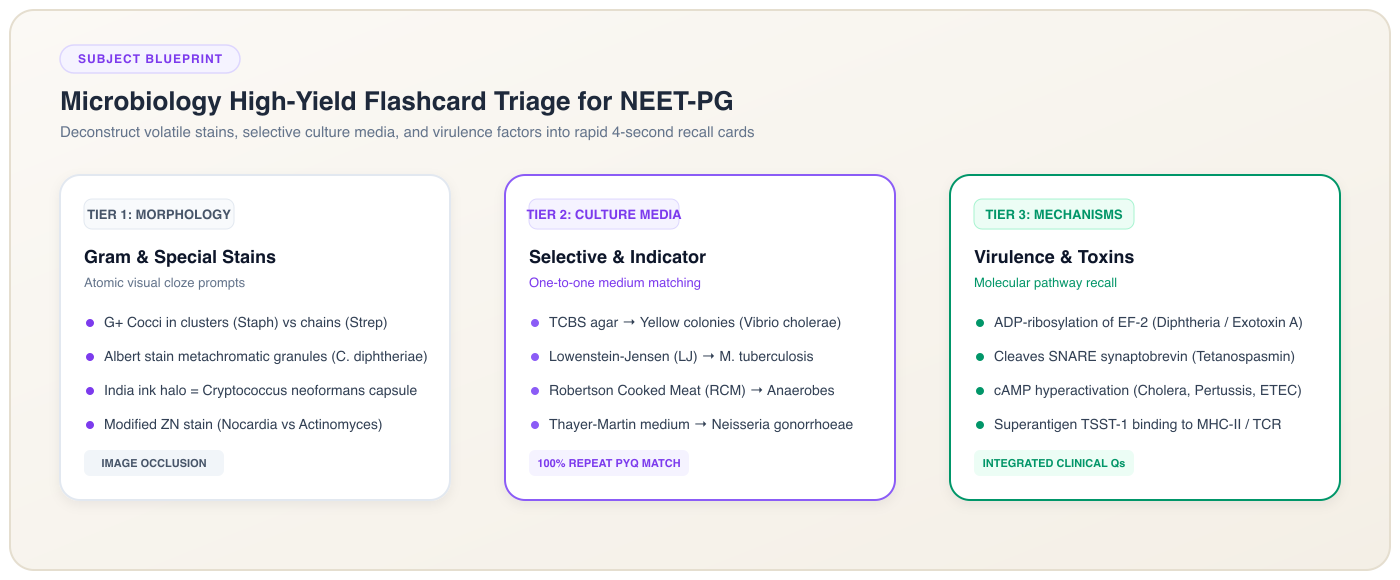 Microbiology High-Yield Classification Matrix: Gram stain triage, media selection, and toxin mechanisms for NEET-PG
Tier 1: Microscopic Morphology & Staining Reactions
The initial trigger for any clinical vignette question on NEET-PG is the microscopic description. Your cards must train immediate visual pattern recognition:
- Gram-Positive Cocci:
- Clusters (Catalase +) → Staphylococcus (Coagulase differentiates S. aureus from CoNS).
- Pairs / Chains (Catalase -) → Streptococcus (Hemolysis on Blood Agar: Alpha vs Beta vs Gamma).
- Lancet-shaped diplococci, bile soluble, optochin sensitive → Streptococcus pneumoniae.
- Gram-Negative Diplococci:
- Kidney-bean shaped, intracellular in neutrophils → Neisseria gonorrhoeae / Neisseria meningitidis.
- Special Bacterial Stains:
- Albert Stain / Neisser Stain: Metachromatic volutin granules of C. diphtheriae (contain polymerized inorganic polyphosphate).
- Modified Ziehl-Neelsen (1% H₂SO₄): Nocardia (partially acid-fast) vs Actinomyces (non-acid-fast).
- Fontana Stain / Silver Stain: Spirochetes (Treponema pallidum).
Tier 2: Culture Media, Biochemical Reactions & Growth Conditions
Indian medical entrance exams place disproportionate weight on culture media and biochemical reactions. These are pure recall questions that can be answered in 5 seconds on exam day:
| Organism | Selective / Indicator Medium | Characteristic Growth / Colony Appearance |
|---|---|---|
| Vibrio cholerae | TCBS (Thiosulfate Citrate Bile Salts) | Yellow colonies (sucrose fermentation in alkaline pH) |
| Mycobacterium tuberculosis | Lowenstein-Jensen (LJ) Medium | Rough, tough, buff colonies (takes 6–8 weeks) |
| Corynebacterium diphtheriae | Potassium Tellurite / Hoyle’s | Grey-black colonies (reduction of tellurite) |
| Neisseria gonorrhoeae | Thayer-Martin / New York City | Chocolate agar with Vanc, Colistin, Nystatin, Trimethoprim |
| Pseudomonas aeruginosa | Cetrimide Agar | Blue-green pigment (pyocyanin) with fruity grape-like odor |
| Campylobacter jejuni | Skirrow's / Butzler's Medium | Microaerophilic growth at 42°C ("seagull wing" morphology) |
| Clostridium perfringens | Robertson's Cooked Meat (RCM) | Meat turns red (saccharolytic activity) with Nagler reaction |
Review our comparative card creation guide on how to make medical flashcards for NEET PG.
Tier 3: Toxins, Virulence Factors & Molecular Mechanisms
Third-order clinical vignettes present a patient with specific symptoms and ask for the molecular mechanism of the causal bacterial toxin:
- ADP-Ribosylation of Elongation Factor-2 (EF-2):
- Diphtheria Toxin (Corynebacterium diphtheriae).
- Exotoxin A (Pseudomonas aeruginosa).
- Clinical Consequence: Halts eukaryotic host protein synthesis, causing pseudomembranous pharyngitis and tissue necrosis.
- Cleavage of SNARE Proteins (Synaptobrevin):
- Tetanospasmin (Clostridium tetani): Cleaves synaptobrevin in inhibitory Renshaw interneurons → blocks GABA and Glycine release → spastic paralysis, trismus, risus sardonicus.
- Botulinum Toxin (Clostridium botulinum): Cleaves SNARE in peripheral cholinergic motor terminals → blocks Acetylcholine release → flaccid descending paralysis.
- cAMP Hyperactivation:
- Cholera Toxin: Constitutive activation of Gs alpha subunit → persistent adenylate cyclase → massive secretory rice-water diarrhea.
- Pertussis Toxin: Disables Gi alpha subunit → adenylate cyclase cannot be inhibited → whooping cough and severe lymphocytosis.
- Heat-Labile Toxin of ETEC: Stimulates adenylate cyclase (Heat-Stable stimulates guanylate cyclase - “Labile in the Air, Stable on the Ground”).
High-Yield Card Architecture: Turning Notes into 4-Second Reflexes
When revising microbiology from coaching workbooks like Dr. Zainab Vora's BTR or Marrow notes, avoid the fatal mistake of writing paragraph cards. Let us examine how to atomize complex microbiology data:
Example 1: Mycology (Systemic Dimorphic Fungi)
❌ The 30-Second Bloated Note Card:
- Front: Discuss Blastomycosis, Coccidioidomycosis, and Histoplasmosis: geography, tissue form morphology, and presentation.
- Back: Blastomyces is found in Ohio/Mississippi river valleys, Great Lakes; in tissue it forms broad-based budding yeasts with double-contoured walls. Coccidioides is in Southwestern US (San Joaquin valley); in tissue it forms large spherules containing endospores. Histoplasma is in Ohio/Mississippi valleys (bird/bat guano in caves); in tissue it forms tiny intracellular yeasts inside macrophages.
- Review Time: 30 to 45 seconds. Severe cognitive drag.
✅ The 4-Second Floww Atomic Cards:
- Card 1 (Blastomyces Morphology): In tissue biopsy at 37°C, Blastomyces dermatitidis appears as yeasts with [broad-based budding] and single broad necks. (Review time: 3s)
- Card 2 (Coccidioides Morphology): In lung biopsy at 37°C, Coccidioides immitis forms thick-walled [spherules filled with endospores] (larger than RBCs). (Review time: 4s)
- Card 3 (Histoplasma Cytology): In bone marrow aspirate, tiny oval yeasts packed inside [macrophages] with narrow-based budding is diagnostic of [Histoplasma capsulatum]. (Review time: 4s)
Review our high-yield subject guide for pathology flashcards for NEET PG to see how biopsy cytology links with active recall.
Example 2: Parasitology (Helminth Egg Morphology)
Visual questions on parasitic ova appear in nearly every NEET-PG and INI-CET examination. Image occlusion is the gold standard for mastering these:
- Card 1 (Ascaris lumbricoides): Corticated, bile-stained, golden-brown egg with a thick mammillated albuminous outer coat → [Fertilized Ascaris egg].
- Card 2 (Enterobius vermicularis): Non-bile stained, planoconvex, [D-shaped egg] containing a tadpole larva → diagnosed via perianal cellophane tape test.
- Card 3 (Trichuris trichiura): Barrel-shaped, bile-stained egg with [bipolar clear mucoid plugs] → whipworm (associated with rectal prolapse in children).
- Card 4 (Ancylostoma duodenale): Non-bile stained, oval egg with a clear space between the thin transparent shell and segmented ovum (4–8 blastomeres) → [Hookworm egg].
Learn how to create visual cards with our dedicated tutorial on image occlusion flashcards for anatomy and visual subjects.
Example 3: Virology (Hepatitis Serology Matrix)
Hepatitis B serology is the classic "confuser" question on entrance exams. Deconstruct it into four single-association rules:
HBsAg (+) ──────────► Active Hepatitis B infection (Acute or Chronic)
Anti-HBs (+) ───────► Immunity (Vaccination if sole positive; Recovery if with Anti-HBc)
HBeAg (+) ──────────► High viral replication, high DNA load, high infectivity
IgM Anti-HBc (+) ───► Sole positive marker in the "WINDOW PERIOD"
- Card 1: The first serological marker to appear in acute Hepatitis B, indicating active infection, is [HBsAg].
- Card 2: During the serological "Window Period" of HBV infection, when both HBsAg and Anti-HBs are negative, the sole diagnostic marker is [IgM anti-HBc].
- Card 3: What serological finding differentiates Hepatitis B vaccination from resolved natural infection? → [Vaccination produces only Anti-HBs; natural infection produces both Anti-HBs and Anti-HBc IgG].
The 4-Week Microbiology Revision Blueprint
To conquer all of Microbiology before your next Grand Test, execute this structured 4-week pacing schedule:
| Week | Target Focus | Daily New Cards | Daily Reviews | High-Yield Milestone |
|---|---|---|---|---|
| Week 1 | General Bacteriology & Gram-Positive Cocci | 35 new cards | ~40 reviews | Master Staph, Strep, Albert stain, media |
| Week 2 | Gram-Negative Bacilli & Anaerobes | 40 new cards | ~75 reviews | Enteric fever, Vibrio, Clostridium, Nagler reaction |
| Week 3 | Virology (Hepatitis, HIV, Arboviruses, Herpes) | 35 new cards | ~110 reviews | Viral genomes, serology panels, envelope status |
| Week 4 | Parasitology, Mycology & Visual Stains | 30 new cards | ~140 reviews | Egg morphology, dimorphic fungi, India ink |
By dedicating just 25 minutes each morning to clearing your microbiology deck, you will build an impregnable foundation across all four sub-disciplines.
Calculate your exact pacing requirements with our daily flashcard calculator for NEET-PG.
4 Common Microbiology Flashcard Mistakes to Avoid
- Making Organism "Summary Cards": Avoid cards that list six symptoms, four drugs, and two stains on one card. Break every organism into 3 to 4 atomic cards.
- Ignoring Colony Characteristics: When studying bacteria, always include the colony color on specific media (e.g., Serratia marcescens = red pigment prodigiosin; Pseudomonas = pyocyanin blue-green).
- Delaying Parasite Egg Cards: Do not wait until the last month to memorize helminth ova. Create visual image occlusion cards during your first pass.
- Neglecting Antifungal and Antiviral Mechanisms: Link Microbiology directly to Pharmacology. For example, pair Cryptococcus neoformans with Amphotericin B (binds ergosterol) and Flucytosine (inhibits thymidylate synthase).
Master overall deck health with our guide on 7 deadly flashcard mistakes medical students make.
Conclusion: Lock Volatile Micro Facts with Floww
Microbiology does not require superhuman intelligence; it requires disciplined, systematic active recall.
When you deconstruct volatile culture media, staining reactions, and toxin mechanisms into rapid 4-second atomic flashcards, you eliminate exam-hall second-guessing and unlock effortless clinical marks.
Floww is the ultimate revision companion for NEET-PG Microbiology:
- Instant Photo-to-Card AI: Photograph any microbiology table from BTR, Marrow, or Ananthanarayan and convert it into clean clozes in 5 seconds.
- Modern FSRS Engine: Automatically schedules difficult stains and parasites at optimal intervals while pushing stable bacteria outward.
- Full Mobile Support: Review 50 microbiology cards during ward rounds with one-thumb gestures.
Master NEET-PG Microbiology today at Floww.
Frequently Asked Questions
How do you make effective microbiology flashcards for NEET PG?
To make effective microbiology flashcards, isolate single diagnostic associations using atomic cloze deletions rather than summarizing entire organisms. Create separate cards for Gram stain morphology, selective culture media (e.g., TCBS for Vibrio, Lowenstein-Jensen for TB), toxin mechanisms (e.g., EF-2 ribosylation), and drug of choice.
How many microbiology flashcards should a NEET PG aspirant review daily?
A competitive NEET-PG aspirant should review between 40 and 60 microbiology flashcards daily during active subject revision, scaling down to 20 to 30 maintenance cards during the final 3 months. Because microbiology facts are volatile, reviews should be kept under 5 seconds per card using atomic clozes.
What are the highest-yield microbiology topics for NEET PG and INI-CET?
The highest-yield topics include: atypical bacteria (Chlamydia, Mycoplasma, Rickettsia), selective culture media and colony colors, mycobacterial stains and gene tests (GeneXpert / CBNAAT), viral hepatitis serology markers, dimorphic fungi, opportunistic parasitic infections (Cryptosporidium, Toxoplasma), and bacterial exotoxin mechanisms.
Why does traditional note reading fail in medical microbiology?
Traditional note reading relies on passive visual recognition. When presented with similar-sounding culture media or Gram-negative bacilli in a 4-option MCQ, passive learners experience proactive interference. Active recall flashcards force effortful retrieval of the specific discriminator, creating durable synaptic pathways.

Written by Floww Editorial
Medical Learning Editorial Team
Evidence-led guidance for NEET-PG and INI-CET preparation, focused on active recall, spaced repetition, and sustainable revision workflows.