Pharmacology Flashcards for NEET PG: The Active Recall Blueprint

Key Takeaways (TL;DR)
- 1Pharmacology is the single most volatile subject in the NEET PG syllabus, characterized by hundreds of look-alike drug suffixes and complex toxicities.
- 2Atomic flashcard architecture isolates mechanism of action, first-line clinical indications, and idiosyncratic toxicities into separate cards to eliminate card bloat.
- 3Cloze deletions and structured classification trees allow students to retain antimicrobial and antiarrhythmic spectra without rote memorization.
- 4Pairing daily pharmacology spaced reviews with Grand Test error logging prevents high-yield clinical MCQs from slipping under exam pressure.
Pharmacology Flashcards for NEET PG: The Active Recall Blueprint
Medical pharmacology is notorious across Indian medical colleges as the ultimate "volatile subject." A student can master the entire autonomic nervous system on Monday, only to confuse alpha-1 adrenergic antagonists with alpha-2 agonists by Friday afternoon.
With over 800 individual pharmacological agents, intricate molecular signaling cascades, idiosyncratic adverse reactions, and subtle drug-drug interactions, passive review strategies collapse rapidly. Rereading massive coaching workbooks or highlighting thick pharmacotherapy textbooks produces what cognitive psychologists call "recognition memory"—a deceptive familiarity that shatters when faced with a 4-line clinical vignette on NEET PG or INI-CET.
A pivotal clinical trial in medical education published in Medical Teacher (Larsen et al., 2018) proved that repeated retrieval practice (test-enhanced learning) produced significantly superior long-term clinical retention and drug selection accuracy compared to repeated textbook reading. Furthermore, research in pharmacy education (Tabibian et al., 2014) demonstrated that automated spaced repetition intervals dramatically lowered the decay rate of antimicrobial classifications among postgraduate students.
To conquer this cognitive challenge, adopting pharmacology flashcards for NEET PG built on atomic principles is the gold standard method for top rankers.
Clinical Pharmacology Active Recall Lab
Simulate high-yield NEET PG drug mechanism and toxicity cards
Amiodarone
Why Traditional Pharmacology Revision Fails: The Interference Trap
Discussions on medical subreddits like r/indianmedschool and r/medicalschoolanki repeatedly return to a common complaint: "I study pharmacology for weeks, but during Grand Tests, all drug names sound identical."
This phenomenon is explained by proactive and retroactive cognitive interference. When two pieces of information share high surface similarity—such as the antiarrhythmic agents Flecainide and Encainide, or the immunosuppressants Tacrolimus and Sirolimus—the brain overwrites older memory traces with newer ones unless distinct neural hooks are established.
Standard revision fails for three specific reasons:
- The Comprehensive Table Trap: Students attempt to memorize dense 20-row classification tables from K.D. Tripathi or coaching notes. Looking at the full table gives peripheral visual cues that vanish during exams.
- Conflating Mechanism with Indication: Memorizing that a drug is an "SGLT2 inhibitor" does not guarantee you will remember its eGFR contraindication cutoffs or its risk of euglycemic DKA.
- Absence of Systematic Spacing: Reviewing drugs once every two months allows memory stability to drop to near zero, forcing you to relearn the subject from scratch each revision cycle.
Modern digital workflows powered by the best flashcard app for NEET PG and advanced spaced repetition algorithms for medical students prevent this decay by presenting cards at the exact moment forgetting begins.
The Atomic Card Architecture: The 4-Card Formula per Drug
The single greatest mistake students make when building pharmacology decks is creating "encyclopedia cards"—pasting the drug's mechanism, 12 indications, 8 adverse effects, and 4 contraindications onto the back of a single card. When you review such a card, you glance at the front, read two bullet points on the back, click "Good," and deceive yourself into thinking you know the card.
Instead, top scorers split every high-yield pharmacological agent into up to four atomic cards:
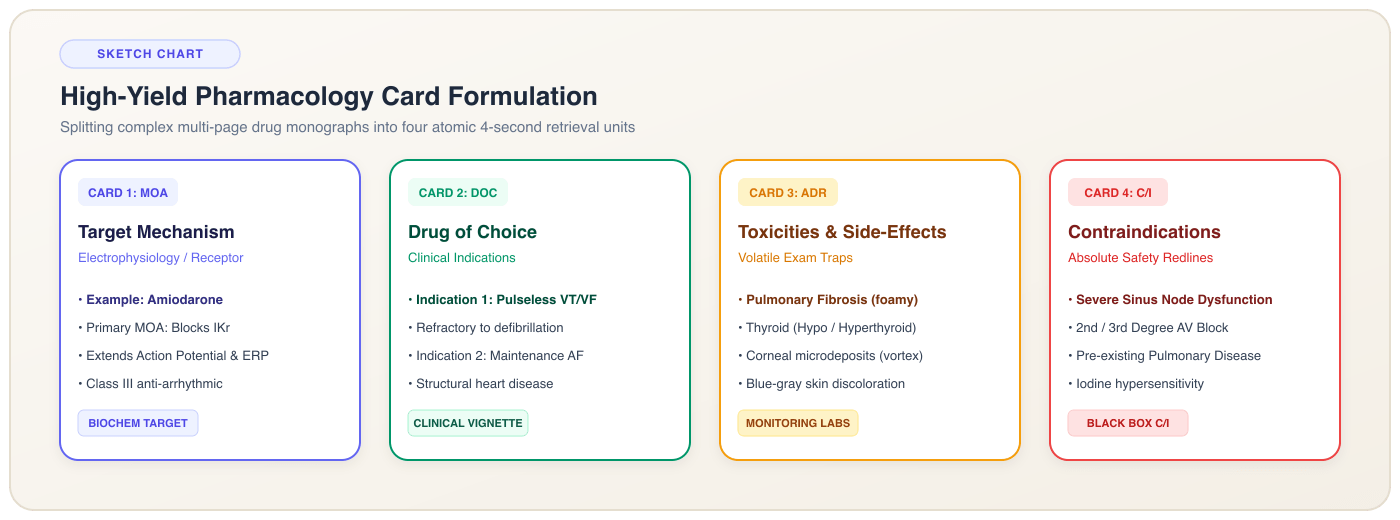 High-Yield Pharmacology Atomic Card Formulation: 4-Card Formula per Clinical Drug
Breaking down complex pharmacology into focused, single-objective cards ensures effortless active recall and prevents the false sense of mastery caused by bulky paragraphs.
Card 1: Mechanism & Molecular Target
- Front: "What is the primary electrophysiological mechanism of Class III antiarrhythmics (e.g., Amiodarone, Sotalol)?"
- Back: "Blockade of voltage-gated potassium (K+) channels → prolongs Phase 3 repolarization and increases effective refractory period (ERP)."
Card 2: High-Yield Clinical Scenario
- Front: "Drug of choice for rate control in atrial fibrillation with coexisting systolic heart failure (HFrEF)?"
- Back: "Beta-blockers (Carvedilol, Bisoprolol, Metoprolol succinate) or Digoxin. (Non-dihydropyridine CCBs are contraindicated due to negative inotropy)."
Card 3: Idiosyncratic Adverse Effect
- Front: "Which antimicrobial commonly causes visual disturbances and dose-dependent optic neuropathy (red-green color blindness)?"
- Back: "Ethambutol. (Requires baseline visual acuity and Ishihara color chart testing before initiation)."
Card 4: Clinical Trap & Interaction
- Front: "Why is co-administration of Linezolid and SSRIs (e.g., Sertraline) strictly contraindicated?"
- Back: "Linezolid possesses weak, non-selective MAO inhibitor activity → precipitously triggers Serotonin Syndrome."
High-Yield Pharmacology Subject Modules
Different classes of pharmacology present unique mnemonic hurdles. Here is how to structure flashcards across the most volatile high-yield modules:
1. Antimicrobial Ribosomal and Cell Wall Inhibitors
Antimicrobials represent 25% to 30% of all pharmacology questions in recent exams.
- Ribosomal Subunits: Use simple Cloze deletions: "Tetracyclines and Aminoglycosides bind to the [30S] ribosomal subunit, whereas Macrolides, Chloramphenicol, and Clindamycin bind to the [50S] subunit."
- Resistance Mechanisms: Create specific cards for target mutations: "MRSA confers beta-lactam resistance via alteration of [PBP-2a], encoded by the [mecA] gene."
2. Autonomic Nervous System (ANS) Receptors
Rather than memorizing isolated effects, anchor ANS cards around second-messenger cascades:
- Gq receptors: Alpha-1, M1, M3 (Phospholipase C → IP3/DAG → ↑ intracellular Ca2+).
- Gs receptors: Beta-1, Beta-2, Beta-3, D1 (Adenylyl cyclase → ↑ cAMP).
- Gi receptors: Alpha-2, M2, D2 (Inhibits adenylyl cyclase → ↓ cAMP).
3. Chemotherapeutic Cell-Cycle Specificity
Oncology questions frequently test cell cycle checkpoints:
- S-Phase Specific: Antimetabolites (Methotrexate, 5-FU, 6-MP, Cytarabine, Gemcitabine).
- G2-Phase Specific: Bleomycin, Etoposide.
- M-Phase Specific: Vinca alkaloids (inhibit microtubule assembly) and Taxanes (inhibit microtubule disassembly).
- Cell Cycle Non-Specific: Alkylating agents (Cyclophosphamide, Cisplatin, Busulfan).
| Pharmacology Domain | Core Card Format | Key Cognitive Hook | Recommended Daily Volume |
|---|---|---|---|
| Antimicrobials | Cloze deletion + Mechanism | Subunit target, resistance genes | 25–35 cards |
| Autonomic Nervous System | Front/Back | Second messenger cascade (Gq/Gs/Gi) | 20–25 cards |
| Cardiovascular / Antiarrhythmics | Vector Diagram + Occlusion | Action potential phase (Phase 0–4) | 15–20 cards |
| Central Nervous System / Psych | Vignette-based Front/Back | Receptor subtype, withdrawal traps | 20–25 cards |
High-Yield Toxicology and Antidote Card Templates
Toxicology questions are consistent scoring opportunities on medical licensing exams because they feature definitive, binary clinical pairs. However, memorizing lists of antidotes without understanding their competitive or allosteric mechanism leads to disastrous errors when question stems describe mixed poisonings.
Here are the highest-yield antidote flashcard architectures to incorporate into your deck:
1. The Receptor-Specific Antidotes
- Beta-Blocker Toxicity:
- Front: "First-line antidote for refractory hemodynamic instability in severe Beta-blocker overdose when atropine and fluids fail?"
- Back: "Intravenous Glucagon. (Stimulates glucagon Gs-protein receptors on myocardial cells, bypassing blocked beta-adrenergic receptors to increase intracellular cAMP)."
- Calcium Channel Blocker Overdose:
- Front: "Emergency metabolic therapy for severe non-dihydropyridine CCB (Verapamil/Diltiazem) poisoning with profound shock?"
- Back: "High-Dose Insulin Euglycemia Therapy (HIET) + IV Calcium Gluconate. (Insulin switches myocardial metabolism from fatty acids to carbohydrates, improving cardiac contractility)."
- Organophosphate Poisoning (The Dual Agent Rule):
- Front: "Why must Pralidoxime (2-PAM) and Atropine be co-administered in acute organophosphate toxicity?"
- Back: "Atropine blocks muscarinic receptor overstimulation (drying secretions, bronchodilation) but does NOT reverse neuromuscular junction paralysis. Pralidoxime regenerates acetylcholinesterase at nicotinic skeletal muscle sites before enzyme aging occurs."
2. Pharmacogenomics and HLA-Mediated Drug Reactions
Modern licensing examinations have shifted heavily toward clinical genetics and personalized pharmacotherapy. NExT and INI-CET frequently feature vignette questions where a patient develops a life-threatening skin eruption or severe marrow suppression due to an unaddressed genetic polymorphism.
Creating dedicated flashcards for these four genetic linkages is mandatory:
- Abacavir Hypersensitivity (HLA-B*5701):
- Card: "Prior to initiating Abacavir-containing antiretroviral regimens, testing for which human leukocyte antigen allele is mandatory?"
- Answer: "HLA-B*5701. (Carrier status carries an extreme risk of multiorgan hypersensitivity syndrome: fever, rash, GI distress, and lethal respiratory collapse on re-challenge)."
- Carbamazepine and Stevens-Johnson Syndrome (HLA-B*1502 & HLA-A*3101):
- Card: "Patients of Asian descent must be screened for which allele before starting Carbamazepine for trigeminal neuralgia or epilepsy?"
- Answer: "HLA-B*1502 (associated with Stevens-Johnson Syndrome / Toxic Epidermal Necrolysis). HLA-A*3101 carries heightened risk in European and Japanese cohorts."
- Azathioprine / 6-Mercaptopurine and TPMT / NUDT15 Deficiency:
- Card: "Dosing of Azathioprine in inflammatory bowel disease or autoimmune hepatitis must be adjusted based on activity of which enzymes?"
- Answer: "Thiopurine S-methyltransferase (TPMT) and NUDT15. Low enzymatic activity leads to toxic accumulation of 6-thioguanine nucleotides and fatal bone marrow aplasia."
- Warfarin Sensitivity (CYP2C9 and VKORC1):
- Card: "Polymorphisms in which two genes dramatically decrease required maintenance dosing of Warfarin?"
- Answer: "CYP2C9 (decreased hepatic clearance of the active S-enantiomer) and VKORC1 (increased sensitivity of Vitamin K epoxide reductase enzyme complex)."
Integrating Pharmacology into Your 90-Day Revision Plan
Reviewing pharmacology cards must never be an isolated, haphazard activity. It should be embedded directly into your structured 3 month flashcard revision plan for NEET PG.
- Morning Micro-Sprint (15 Minutes): Dedicate the first 15 minutes of your study day to clearing your daily pharmacology queue. Because drug cards are short, high-efficiency atomic cards, an aspirant can comfortably review 80 cards in just 12 to 15 minutes.
- Grand Test Error Harvesting: Following every full-length mock or subject-wise test, extract every missed drug MCQ into a new card. If you missed a question on Sacubitril/Valsartan, do not just write "Sacubitril is an ARNI." Create a card testing why an ACE-inhibitor must be washed out for 36 hours prior to starting Sacubitril (angioedema risk due to bradykinin breakdown inhibition).
- Pacing with Time Boxing: Use our interactive Pomodoro timer for medical study to maintain intense 25-minute study sprints, alternating between pharmacology flashcards and active clinical question solving.
- Calibrate with Performance Analytics: Monitor how your subject-wise retention impacts your predicted score using the NEET PG rank predictor, and explore comparative tool mechanics in our Floww vs Revisable comparison.
By structuring your pharmacology decks into atomic, evidence-backed flashcards, you eliminate cognitive interference and build instant, bulletproof recall for the most volatile questions on exam day.

Written by Floww Editorial
Medical Learning Editorial Team
Evidence-led guidance for NEET-PG and INI-CET preparation, focused on active recall, spaced repetition, and sustainable revision workflows.