Premade vs Self-Made Flashcards for NEET-PG: When to Borrow and When to Build
Key Takeaways (TL;DR)
- 1Before AI, students were trapped in a 70/30 rule (70% premade, 30% self-made) because typing cards took 90+ seconds each, risking time bankruptcy.
- 2Floww’s targeted photo-to-card feature inverts this to an 80/20 rule: 80% self-made and 20% premade. Snapping a photo of a textbook or GT note takes just 5 seconds.
- 3The secret to spaced repetition is not deck size, but consistency. When cards are hyper-personalized to your own errors, review friction drops and daily adherence exceeds 85%.
- 4Beware of tools that misunderstand this: Neuroflip offers zero custom card creation, while generic scanners like Revisable produce shallow, noisy cards lacking clinical nuance.
Premade vs Self-Made Flashcards for NEET-PG: When to Borrow and When to Build
Every medical student entering the world of spaced repetition confronts the same agonizing dilemma: Should I spend hundreds of hours crafting my own flashcards, or should I download someone else’s massive 20,000-card deck?
For years, the debate was stuck in a painful trade-off. Purists argued that the true memory benefit comes only from making your own cards. Pragmatists correctly pointed out that manually typing cards for a 19-subject NEET-PG syllabus leaves zero time to actually solve MCQs.
But artificial intelligence and targeted vision capture have completely rewritten this equation.
Should you use premade flashcards or make your own for NEET-PG?
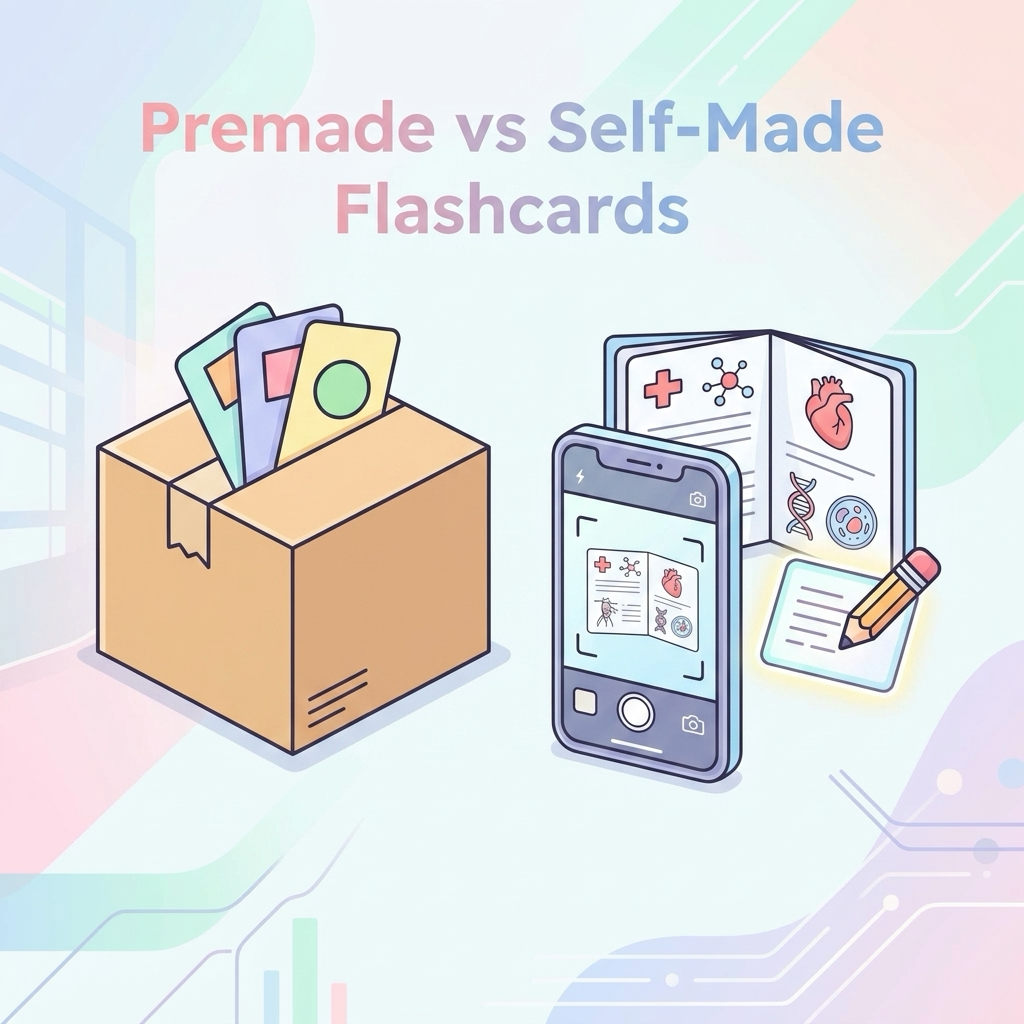
With modern AI vision, the new gold standard is the 80/20 Inverted Rule: 80% self-made and 20% premade. Before AI, students were forced into a 70% premade compromise because typing took too long. Today, snapping a photo of your notes or Grand Test (GT) errors takes 5 seconds, giving you hyper-personalized cards that guarantee the daily consistency needed to outrank peers who abandon generic decks.
The Deck Strategy Evolution: Before vs. After AI
Earlier, typing cards took 90+ seconds each, forcing a 70/30 compromise. Today, instant photo-targeting inverts the ratio to 80% Self-Made—driving the consistency that wins top ranks.
80% Self-Made / 20% Premade (Hyper-Targeted)
📸 What to make yourself (80%):
- ✓GT / QBank Incorrects: Snap photo of explanation, target the exact missed fact
- ✓Your Teacher's Pearls: Marrow, PrepLadder, BTR slides and handwritten margin notes
- ✓Confused Discriminators: Two diseases or drugs you constantly mix up
📦 What to borrow premade (20%):
- ✓Standard Pharma: Antidotes, receptors, and first-line drugs of choice
- ✓Standard Micro: Culture media, vector vectors, and egg morphology
- ✓Fixed Criteria: Forensic IPC codes, PSM immunization schedules
The AI paradigm shift: why the 70/30 rule inverted to 80/20
To understand why your deck strategy must change today, you have to look at how card creation evolved over the last decade.
1. The Pre-AI Era: The 70/30 Compromise (Survival Mode)
Before automated concept extraction, making flashcards was clerical torture. For every single card, you had to:
- Read your handwritten notes or Harrison's paragraph.
- Manually type the question stem.
- Format cloze deletions or copy-paste images using screenshot shortcuts.
- Tag the subject and adjust interval settings.
Each card took 90 to 120 seconds. For a comprehensive 10,000-card deck across 19 subjects, that meant 250 dedicated hours of data entry—time stolen directly from Grand Tests and clinical revision.
Because nobody had 250 hours to waste, students were forced into the 70/30 compromise: download a massive community deck (like AnKing, MangoMedic, or I_Anki) for 70% of the syllabus, and type personal cards for only 30%.
The tragic consequence? Card abandonment.
As documented in countless student threads on r/medicalschoolanki and r/indianmedschool, over 70% of students who download a 15,000-card premade deck quit within six weeks. Reviewing someone else's cards feels like grading someone else's homework. The phrasing is alien, the cards test details you never learned in class, and your daily review queue rapidly explodes into an insurmountable backlog.
2. The Current AI Era: The 80/20 Inversion (Targeted & Personalized)
Floww's targeted photo-to-card engine has eliminated the clerical bottleneck entirely:
- Instant Photo Capture: You take a photo of your handwritten BTR notes, coaching slides (Marrow, PrepLadder, DBMCI), or Grand Test explanations.
- Targeted Concept Cropping: You lasso or highlight the exact table, diagnostic discriminator, or clinical line you missed.
- Atomic Transformation: In 5 seconds, Floww generates a sharp, atomic card adhering to the One-Question Rule, with direct bidirectional linking back to the source note.
Because creating a card dropped from 90 seconds to 5 seconds, the time penalty vanished.
You no longer need to borrow someone else’s 15,000 cards. You can now build an 80% self-made, hyper-targeted deck tailored exactly to your mind, while keeping 20% premade cards purely as standardized reference benchmarks (e.g. drug receptor classifications and microbiology stains).
The Paradigm Shift: Before vs. After AI
How targeted vision tools inverted the economics of medical flashcard creation.
| Metric / Feature | Before AI (Classic) | After AI (Floww Era) |
|---|---|---|
| Optimal Deck Ratio | 70% Premade / 30% Self-Made | 80% Self-Made / 20% Premade |
| Creation Time per Card | 90–120 seconds (manual typing) | 5–8 seconds (snap & target) |
| 60-Day Review Adherence | ~24% (high abandonment) | >85% (radical consistency) |
| Psychological Ownership | Low (studying someone else's notes) | Total (anchored to your mistakes) |
| Exam Discriminator Focus | Generic high-yield facts | Hyper-focused on your GT errors |
The consistency secret: why personalized cards outrank generic decks
Every medical aspirant knows that spaced repetition algorithms (like FSRS) mathematically optimize memory retention. But an algorithm is only as good as the student’s willingness to open the app every single day.
This is where the psychological difference between premade and self-made cards determines your NEET-PG rank:
1. The Friction of "Someone Else's Cards"
When you study a generic premade deck, your brain must constantly translate someone else's grammar, someone else's abbreviations, and someone else's clinical priorities.
You look at a card and think: “Why does this matter? Did Dr. Marrow teach this? Is this even in the 2026 exam blueprint?”
That tiny hesitation introduces cognitive friction. After 50 reviews, cognitive fatigue sets in. After two weeks, you skip a day. After three weeks, your backlog hits 600 cards, and you abandon the deck entirely.
2. The Power of Psychological Ownership
When a card is created by you—from a question you personally got wrong in yesterday's Grand Test or a BTR slide you know is high-yield—the experience flips completely:
- You remember the exact emotional sting of getting that question wrong.
- The prompt is written in the exact terminology of your primary teacher.
- The retrieval effort feels meaningful because you are directly repairing a verified weakness.
Research on active memory demonstrates that personal relevance and self-generation create vastly stronger neural pathways than passive recognition (Kornell & Bjork, 2008; Craik & Lockhart, 1972).
The Spaced Repetition Law: No matter which deck you start with, your ultimate rank depends on consistency. And consistency comes from personalized cards. Once you stay consistent with your flashcards, you will outrank almost everyone who abandons them.
The competitor traps: why legacy tools can't support the 80/20 rule
When students look for flashcard apps to execute this modern strategy, they run into two major stumbling blocks:
1. The Neuroflip Trap: Zero Custom Card Creation
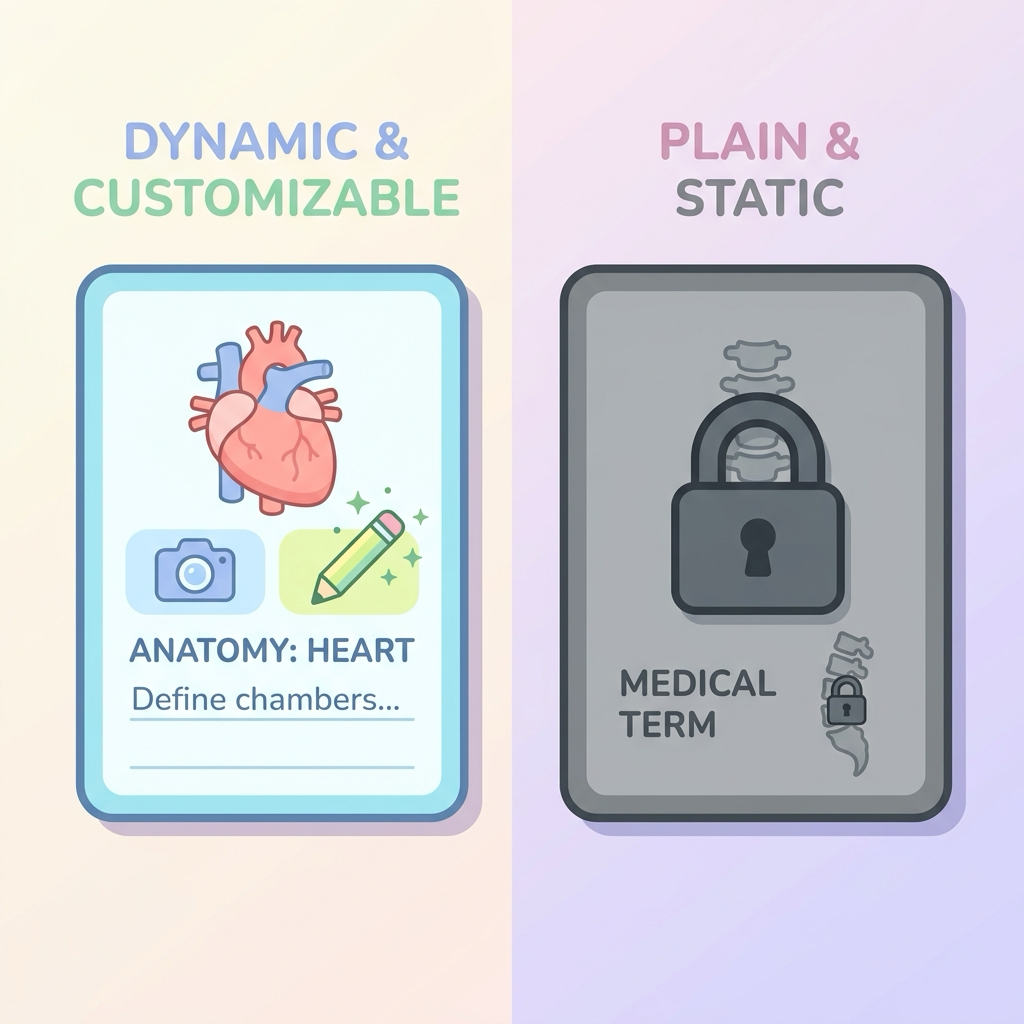
Apps like Neuroflip offer curated high-yield revision micro-notes and BTR-aligned flashcards. While pre-made summary snippets look convenient, Neuroflip is trapped in the pre-AI mindset because it completely lacks custom card creation.
When an app blocks you from creating your own cards:
- You cannot convert Grand Test mistakes into cards. If you lose 4 marks on a tricky hyperkalemia ECG question in a test series, you have literally no way to save that correction into your spaced repetition queue.
- You cannot update outdated guidelines, drug dosages, or staging criteria.
- You are locked into passive re-reading of someone else's static cards.
A flashcard platform without custom card creation is just a digital textbook broken into smaller cards. It cannot adapt to your personal forgetting curve.
2. The Revisable AI Trap: Generic Scanning Below the Medical Mark
Tools like Revisable AI recognize that students want automated card creation, but their generation engine is built on generic, uncurated document scanning:
- Violates the One-Question Rule: The scanner ingests three paragraphs of text and spits out a messy 5-line card containing four different questions. As outlined in our guide on how to make medical flashcards, overloaded cards destroy active recall because you cannot grade yourself honestly.
- Superficial Cloze Deletions: Generic AI frequently puts cloze deletions on obvious connecting grammar (e.g.,
The patient [was admitted] to the hospital) rather than on high-yield clinical discriminators, enzyme markers, or first-line drug choices. - Zero Bidirectional Context: When you get a card wrong, Revisable gives you no way to inspect the parent note outline.
Floww eliminates both traps: our medical flashcard platform gives you a verified high-yield foundation, while our targeted vision engine lets you snap any page, crop the exact medical concept, and generate a precision atomic card linked directly to your note context.
The 80/20 Action Plan: How to Study Daily
Here is the exact daily protocol to outrank your competition using the 80/20 rule:
1. Keep Your 20% Premade Base Strictly Curated
Do not download 15,000 premade cards. Activate premade cards only for the 20% of the syllabus that consists of pure, arbitrary associations:
- Standard Pharmacology receptors, antidotes, and first-line drugs.
- Microbiology culture media and vector classifications.
- Forensic Medicine IPC sections and legal thresholds.
Review these in a short 15-minute morning sprint using active recall principles.
2. Generate Your 80% from Questions and Primary Notes
Every afternoon or evening, after solving a 50-MCQ module or analyzing your weekly Grand Test:
- Open your error log.
- For every question you missed due to factual omission or a confused discriminator, take a screenshot or photo.
- Crop the exact explanation highlight.
- Let Floww generate one atomic card with one clear question and one gradable answer.
This takes less than 10 minutes for an entire test review, producing 10–15 hyper-targeted cards that address your real weaknesses.
3. Cap Your Total Daily Reviews
As we proved in our guide on how many flashcards per day for NEET-PG, your goal is a workload you can repeat for six months without burnout:
- Cap total daily flashcard study at 45 to 60 minutes.
- Complete all due reviews before adding new cards.
- Trust spaced repetition scheduling to space out your custom cards over expanding intervals.
The bottom line
The old advice to rely 70% on premade decks was a compromise born from the pain of manual typing. That compromise is obsolete.
With targeted AI vision, you can now build a flashcard collection that is:
- 80% self-made: Anchored to your exact errors, your teacher's slides, and your personal clinical gaps.
- 20% premade: Grounded in standardized medical facts.
- 100% consistent: Because when the cards are yours, you actually do them.
Don't let someone else's 20,000-card deck become an abandoned chore on your phone. Build the cards that fix your mistakes, stay consistent every single day, and watch your Grand Test percentiles climb.

Written by Floww Editorial
Medical Learning Editorial Team
Evidence-led guidance for NEET-PG and INI-CET preparation, focused on active recall, spaced repetition, and sustainable revision workflows.