Spaced Repetition Schedule for Medical Students: Daily, Weekly & Duty Shifts

Key Takeaways (TL;DR)
- 1A sustainable medical spaced repetition schedule relies on micro-sessions: 20 minutes in the morning and 15 minutes of duty dead-time beats a 2-hour evening marathon every time.
- 2Keep your daily new card intake strictly under 15–25 cards per day during clinical postings to prevent exponential review avalanches.
- 3Modern FSRS 6+ algorithms calculate interval spacing based on retrieval stability and memory difficulty, reducing daily review volume by 25–30% compared to legacy SM-2 schedulers.
- 4Implement a weekly GT buffer day: pause new cards every Sunday to reconcile mock exam errors and reset review queues to absolute zero.
Spaced Repetition Schedule for Medical Students: Daily, Weekly & Duty Shifts
Ask any MBBS student or postgraduate aspirant why they abandoned their flashcards, and you will hear the exact same lament:
"I started with enthusiasm and made 80 cards a day from my pharmacology lectures. By week three, my daily due count hit 450 cards. Between morning surgery postings, afternoon OPD, and evening question banks, I could not spend two hours swiping cards. I missed two days on casualty duty, woke up to 900 overdue cards, and deleted the app."
This is the classic review backlog trap. It does not happen because spaced repetition fails to work; it happens because students design their study schedule around an idealized lecture hall reality rather than the exhausting, fragmented demands of medical school.
Medical education is uniquely demanding. You cannot sit at a quiet desk for four uninterrupted hours every evening. Your schedule is punctuated by ward rounds, 12-hour emergency casualty postings, professor vivas, and 200-question Grand Tests (GTs).
If your spaced repetition routine requires hours of continuous desk time, it is guaranteed to fail.
A truly sustainable spaced repetition schedule for medical students works in micro-moments. It integrates effortlessly into clinical routines, leverages next-generation schedulers like FSRS 6+, and maintains 90% exam retention in just 20 to 35 minutes of total daily study.
Direct Answer: What Is the Optimal Medical Spaced Repetition Schedule?
The optimal spaced repetition schedule for medical students divides daily reviews into three bite-sized blocks: 20 minutes of morning queue clearance (80–100 cards), 10–15 minutes of mobile micro-reviews during hospital dead-time, and 15 minutes of evening synthesis to add 15–25 new mistake cards. This 35-minute routine preserves 90% long-term retention while preventing backlog paralysis.
07:00 – 07:20 | Block 1: Morning Queue Clearance (Overnight due cards, fresh mental stamina)
13:30 – 13:45 | Block 2: Duty Dead-Time Swipes (Mobile micro-bursts during tea/ward breaks)
21:00 – 21:20 | Block 3: QBank Error Logging (Turn 15–20 high-yield mistakes into atomic cards)
By capping new cards at 20 daily, your long-term review queue stabilizes at 140–180 cards per day—a volume easily cleared in under 25 minutes using the Floww mobile flashcard engine.
Interactive Clinical Schedule Planner
Use our interactive clinical calculator below to generate a customized daily schedule and weekly rhythm based on your current academic stage and hospital workload:
Spaced Repetition Schedule Planner for Medical Students
Simulate a sustainable daily, weekly, and duty-shift spaced repetition routine customized to your clinical workload.
Session 1: Morning Coffee Run & Commute (35% of time)
Clear overnight volatile reviews before hospital rounds or library lectures start.
Session 2: Duty Dead-Time & Ward Micro-Bursts (30% of time)
Mobile app reviews during elevator rides, post-OPD tea, or waiting between lab results.
Session 3: Bedtime Synthesis & New Mistake Capture (35% of time)
Turn today's QBank mistakes into new atomic cards and finish remaining reviews.
"Doing 15 minutes every single day is 10× more effective than cramming 3 hours on Sunday."
The Mathematics of Memory: Why Traditional Schedules Fail
To construct a schedule that survives medical school, you must first understand the mathematics of spaced repetition.
In classic cognitive psychology research by Cepeda et al. (Psychological Bulletin, 2006), distributed practice across expanding retention intervals demonstrated substantial memory superiority over massed repetition. Furthermore, Kornell (Applied Cognitive Psychology, 2009) proved that spacing out flashcard practice yielded superior recall across 90% of learners compared to massed cramming.
However, many medical students misunderstand how daily reviews accumulate.
The Exponential Multiplier Rule
Every new card you add to your deck does not disappear tomorrow. It follows an exponential schedule: Day 1, Day 3, Day 7, Day 16, Day 35.
Daily Reviews ≈ Daily New Cards × [1 / (1 - R)] × k
Where R is your desired retention rate (e.g., 0.90) and k is an algorithm efficiency constant.
Under legacy SM-2 algorithms, every 10 new cards you introduce daily generates approximately 70 to 100 daily reviews once your deck reaches maturity.
| Daily New Cards | 30-Day Total Cards | Expected Daily Reviews (SM-2) | Expected Daily Reviews (FSRS 6+) | Daily Time Needed (at 5s/card) |
|---|---|---|---|---|
| 10 cards | 300 cards | 70–90 reviews | 50–65 reviews | 5–7 minutes |
| 20 cards | 600 cards | 150–180 reviews | 110–135 reviews | 11–15 minutes |
| 35 cards | 1,050 cards | 260–310 reviews | 190–225 reviews | 18–25 minutes |
| 50 cards | 1,500 cards | 380–450 reviews | 280–330 reviews | 30–40 minutes |
| 100 cards (Trap) | 3,000 cards | 800–1,000 reviews | 580–720 reviews | 65–90 minutes (Burnout) |
Key Insight: Adding 50 cards a day might feel manageable during a relaxed weekend, but within four weeks it forces you into 400 reviews every single day. If you hit a 36-hour casualty rotation or fall ill, two missed days creates an 800-card backlog that takes days to clear.
This is why mastering how many flashcards per day for NEET PG is the single most critical habit for academic longevity.
The 3-Block Daily Spaced Repetition Protocol
Instead of scheduling a single monolithic flashcard block in the evening when your prefrontal cortex is depleted, partition your reviews into three distinct clinical blocks:
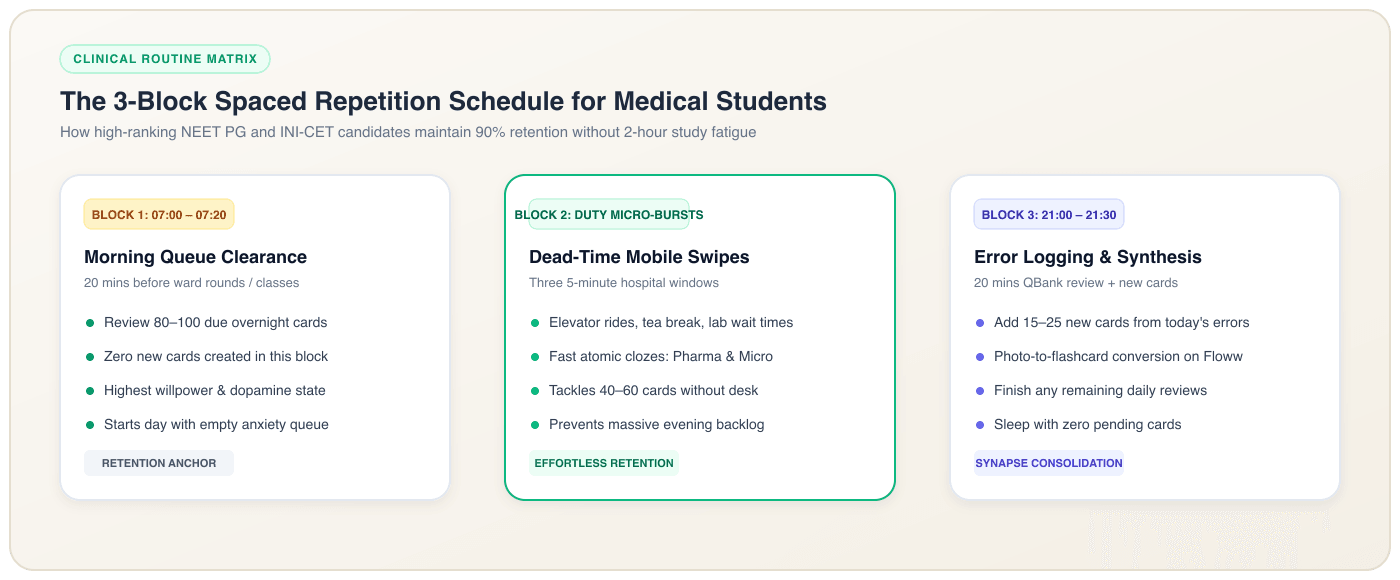 The 3-Block Spaced Repetition Schedule for Medical Students
Block 1: Morning Clearance (07:00 – 07:20)
- Duration: 15–20 minutes
- Target: 80–100 due reviews (Zero new cards)
- Context: Over morning coffee, before stepping out of the hostel or home.
Your cognitive stamina and working memory are highest immediately after waking. When you open your deck first thing in the morning, your only mission is to eliminate red (overdue) cards.
Never create new cards in Block 1. Keep your brain focused entirely on rapid active retrieval. Because morning cards represent concepts you have already seen, you can achieve review speeds of 4 to 5 seconds per card, as outlined in our guide on how to review flashcards faster.
Clearing 80 cards before 07:30 provides an immense psychological victory: you walk into your morning ward postings with zero pending review anxiety.
Block 2: Duty Dead-Time Micro-Bursts (13:00 – 14:00)
- Duration: Three 3- to 5-minute bursts (12–15 minutes total)
- Target: 40–60 reviews
- Context: Hospital elevator rides, waiting for blood gas results, post-rounds tea break.
Hospital duties are filled with dead time: 4 minutes waiting for a senior resident, 6 minutes waiting for ultrasound reports, 5 minutes riding the hospital lift.
Rather than mindlessly scrolling social media, open the Floww mobile app. Complete 15 rapid clozes on pharmacology flashcards or microbiology classifications.
Because Floww cards are strictly atomic and adhere to good medical flashcard examples, you do not need 20 minutes of deep focus. You can answer two drug mechanism clozes while walking down the corridor and slip your phone back into your white coat pocket.
By the time afternoon postings end, you have passively completed 50 reviews without sitting at a desk once.
Block 3: Evening Error Logging & Synthesis (21:00 – 21:30)
- Duration: 20–25 minutes
- Target: Finish remaining daily reviews + Add 15–20 new mistake cards
- Context: Post-dinner study desk after completing your daily question bank module.
Block 3 is your creation window. During your evening question bank session (solving 40–60 Marrow or PrepLadder MCQs), you will encounter questions you missed due to factual recall failures.
Do not write extensive notes in a physical diary. Take 10 seconds to snap a photo or type an atomic cloze card into Floww.
Once your 15–20 new cards are logged, do a final 5-minute sweep of any remaining reviews. When your queue hits zero, close your device and sleep. Your overnight sleep spindles will consolidate the newly activated synapses without cognitive clutter (Karpicke & Roediger, Science, 2008).
Adapting Schedules Across Medical Stages
Not every medical student shares the same daily rhythm. Here is how top performers tailor their spaced repetition calendar based on their academic stage:
1. The Pre-Final MBBS Routine (2nd & 3rd Year)
- Primary Objective: Build foundational decks for high-yield volatile subjects (Pharmacology, Pathology, Microbiology).
- Daily Time Commitment: 15–20 minutes.
- New Cards: 12–15 cards per day following college lectures.
- Review Pacing: 1 daily block in the late afternoon after college hours.
- Weekend Rule: Saturday afternoon dedicated to image occlusion cards for anatomical relations and histopathology slides.
2. The Final Year & Dedicated NEET PG Aspirant
- Primary Objective: Systematic coverage of all 19 subjects alongside question banks.
- Daily Time Commitment: 30–40 minutes.
- New Cards: 25–30 cards per day.
- Review Pacing: Two 15-minute blocks (Morning clearance + Evening error logging).
- Weekend Rule: Zero new cards on mock exam days. Reconcile test errors on Sunday morning.
3. The Compulsory Rotatory Intern (Hospital Postings)
- Primary Objective: Survive duty fatigue while preventing syllabus decay.
- Daily Time Commitment: 15–20 minutes maximum.
- New Cards: 10–15 cards per day (Mistakes only).
- Review Pacing: Pure mobile micro-sessions during ward duty breaks.
- FSRS Tweak: Lower target retention from 90% to 86–88%. This single setting adjustment reduces daily review volume by 25%, making the schedule duty-proof.
The 7-Day Weekly Periodization: The Anti-Backlog Buffer
The number one structural flaw in student schedules is treating all seven days of the week identically.
If you plan to add 25 new cards every Monday through Sunday, your schedule has zero tolerance for disruptions. The moment you take a 3-hour Grand Test or get assigned emergency casualty duty, your schedule collapses.
Professional medical learners use weekly periodization:
| Day of Week | Academic Focus | Spaced Repetition Mode | New Cards Target | Daily Reviews |
|---|---|---|---|---|
| Monday | Primary Subject Module | Standard 3-Block Schedule | 20–25 new cards | ~130 reviews |
| Tuesday | Primary Subject Module | Standard 3-Block Schedule | 20–25 new cards | ~130 reviews |
| Wednesday | Primary Subject Module | Standard 3-Block Schedule | 20–25 new cards | ~130 reviews |
| Thursday | Primary Subject Module | Standard 3-Block Schedule | 20–25 new cards | ~130 reviews |
| Friday | High-Yield Volatile Revision | Red & Leech Card Blitz | 0 new cards | ~110 reviews |
| Saturday | Grand Test (GT) / 200 MCQs | Pre-Exam Queue Triage | 0 new cards | ~60 priority reviews |
| Sunday | GT Error Analysis | Queue Reset & Error Capture | 20 GT mistake cards | Clean to Zero |
The "Zero New Card" Friday Rule
Notice Friday: Zero new cards.
By pausing new card creation every Friday, you give your memory scheduler a breather. Friday becomes your consolidation window to review difficult "Leech" cards (cards you have failed three or more times).
The Sunday Backlog Reset
Sunday is your buffer day. After taking your 200-question Grand Test on Saturday, you spend Sunday reviewing your mistake logs.
Instead of adding 100 random cards, pick the top 20 questions you missed due to factual memory lapses. Create 20 clean cloze cards in Floww. Then, clear your entire review queue until the app displays the celebratory "All caught up!" screen.
Starting Monday morning with an empty backlog restores your mental focus and eliminates study dread.
Algorithm Optimization: Why FSRS 6+ Changes the Schedule Equation
Your schedule is only as good as the mathematical engine powering your intervals.
For nearly four decades, medical flashcards relied on the SM-2 algorithm developed in 1987. SM-2 uses rigid, heuristic multiplication factors that assume all medical concepts decay at identical rates.
When you rate a card "Hard" in SM-2, it permanently degrades the card's Ease Factor—a phenomenon known as Ease Hell. Over time, hundreds of cards get trapped in 1-day or 2-day review loops, bloating your daily schedule with unnecessary over-testing.
Legacy SM-2 Scheduler:
Card Created ──> 1 Day ──> 3 Days ──> 7 Days ──> Ease Degradation ──> Schedule Bloat (2+ Hours/Day)

Modern FSRS 6+ Engine:
Card Created ──> DSR Stability Modeling ──> Target Retention Optimization ──> 28% Fewer Reviews
Floww implements the next-generation FSRS 6+ (Free Spaced Repetition Scheduler) engine, which models memory across three independent cognitive dimensions:
- Difficulty (D): How inherently complex the medical fact is (e.g., standard anatomy vs complex antiarrhythmic Vaughan Williams classes).
- Stability (S): The duration over which the memory trace remains accessible before recall probability drops below your target.
- Retrievability (R): The instantaneous probability of retrieving the fact at any exact moment.
As demonstrated in our comprehensive comparison of FSRS vs SM-2 for medical flashcards, FSRS cuts your daily review load by 25% to 30% while achieving the exact same 90% exam recall rate.
For a busy medical intern, this is the difference between spending 45 exhausting minutes on cards versus clearing them in a crisp 18-minute session.
5 Fatal Mistakes That Ruin Your Spaced Repetition Schedule
Avoid these five behavioral pitfalls to keep your spaced repetition routine unbreakable:
Mistake 1: Treating Flashcards as a Primary Learning Tool
Flashcards are designed for retention consolidation, not first-pass comprehension. If you create flashcards for cardiac electrophysiology before understanding the basic action potential curve, you are memorizing meaningless syllables.
The Rule: Read your notes or watch your conceptual video lectures first. Once you understand the physiological mechanism, use flashcards to lock in the volatile numbers, drug names, and diagnostic criteria.
Mistake 2: Writing Multi-Fact Paragraph Cards
A card that asks "Discuss the clinical presentation, staging, and management of Multiple Myeloma" is not a flashcard; it is an essay.
Reviewing a paragraph card takes 35 seconds. Reviewing 200 of them takes two hours.
The Rule: Strict atomicity. One card = one fact. Review latency must stay under 6 seconds per card.
Mistake 3: Reviewing in Bed Before Sleep While Exhausted
Attempting to clear 150 due reviews at 23:30 while lying in bed leads to "grading drift": you tap "Good" on cards you barely recalled just to make the screen go away.
This corrupts your algorithm's stability calculations and guarantees you will miss those exact facts in your next Grand Test.
The Rule: If you are exhausted, clear only the top 30 red cards and sleep. It is far better to do a focused 15-minute session tomorrow morning than a compromised 40-minute session at midnight.
Mistake 4: Hoarding Massive Shared Decks (Deck Bloat)
Downloading a 15,000-card pre-made deck sounds tempting until you realize it contains thousands of low-yield trivia cards you never covered in class.
As analyzed in premade vs self made flashcards for NEET PG, your highest-yielding flashcards are the atomic cards you create from your personal mock exam errors.
The Rule: Prioritize a lean, personal deck of 2,000–3,500 high-yield error cards over an impersonal 20,000-card shared monster.
Mistake 5: Giving Up When a Backlog Occurs
Every medical student eventually falls behind. You get assigned a week of night duties, catch a viral fever, or attend a family event, and your due queue jumps to 400 cards.
Do not delete the deck or restart from scratch.
The Protocol:
- Set new cards to zero immediately.
- Filter your deck by FSRS Retrievability (ascending).
- Clear 50 cards per day. Within four days, your backlog is cleared, and your routine is fully restored.
Final Month Before the Exam: How the Schedule Shifts
In the final 30 days before NEET PG or INI-CET, your spaced repetition schedule changes dramatically.
You no longer have time to add cards from textbook chapters. Your entire routine shifts to high-speed volatility triage.
As detailed in our tactical guide on how to use flashcards in the last month before NEET PG, your daily new card target drops to zero for theory, and your entire 20-minute daily review window focuses on:
- Drug of Choice (DOC) tables
- Enzyme deficiencies and chromosomal translocations
- Staging and classification criteria
- Personal Grand Test error tags
By maintaining a disciplined, 20-minute daily spaced repetition schedule throughout your preparation, you walk into the exam hall with your volatile memory locked into permanent long-term storage—giving you the speed, confidence, and precision needed to secure a top rank.
Build Your Personalized Medical Flashcard Schedule with Floww
Ready to experience a spaced repetition routine that fits your actual hospital duties?
Floww combines the mathematical power of FSRS 6+ with an instant AI photo-to-card engine designed specifically for medical entrance exams:
- Zero Ease Hell: Adaptive scheduling that respects your clinical fatigue.
- 5-Second Review Speeds: Atomic clozes designed for mobile duty breaks.
- Instant Notes Conversion: Snap a photo of your coaching workbook or GT mistake log, and Floww creates exam-ready flashcards in seconds.
Start studying on Floww for free and turn your daily clinical dead-time into unstoppable exam retention.

Written by Floww Editorial
Medical Learning Editorial Team
Evidence-led guidance for NEET-PG and INI-CET preparation, focused on active recall, spaced repetition, and sustainable revision workflows.