How to Review Flashcards Faster: The 2026 Medical Speed & Retention Guide
Key Takeaways (TL;DR)
- 1The primary bottleneck in medical flashcards is card bloat: spending 20 to 30 seconds per card turns a 300-card daily review queue into a grueling 2.5-hour chore.
- 2Applying the 7-Second Cognitive Rule stops review stagnation: if a clinical keyword or drug mechanism is not retrieved within 7 seconds, hit Again immediately to save cognitive stamina.
- 3Splitting dense clinical notes into atomic, single-association cards reduces review latency from 25 seconds down to 4 to 6 seconds per card without compromising recall.
- 4Switching from marathon desktop study sessions to four 6-minute mobile micro-bursts allows interns and residents to conquer 300 daily cards between hospital duties.
How to Review Flashcards Faster: The 2026 Medical Speed & Retention Guide
Every medical student who adopts spaced repetition eventually encounters the dreaded Review Wall.
It begins with good intentions: you create 50 cards for General Pharmacology, 60 cards for Hematology, and 40 cards from your latest Grand Test mistake log. For the first two weeks, the routine feels manageable. But as intervals compound across all 19 medical subjects, your daily review queue swells to 350, 450, or even 600 cards.
If you spend 25 seconds on each card—re-reading entire paragraphs, agonizing over the answer, and debating whether to press "Hard" or "Good"—a 350-card queue consumes nearly 2.5 hours of pure, exhausting screen time.
For an MBBS intern completing a 12-hour casualty duty, or a final-year student balancing clinical postings with Q-bank targets, 2.5 hours of flashcard reviews is mathematically unsustainable. Within three weeks, reviews slip for two days, the backlog hits 1,000 cards, and the student abandons the deck altogether.
Learning how to review flashcards faster is not about superficial skimming or cheating active recall. It is about eliminating cognitive friction, structuring atomic cards, and training rapid clinical automaticity.
When you optimize your review velocity to an average of 5 seconds per card, that same 350-card queue is cleared in just 29 minutes.
Direct Answer: How to Review Medical Flashcards Faster
To review medical flashcards faster without sacrificing long-term exam retention, implement three evidence-based protocols:
- Enforce the 7-Second Cognitive Rule: If you cannot retrieve the target keyword within 5 to 7 seconds, tap Again immediately. Lingering for 30 seconds activates false cueing, causes mental exhaustion, and distorts interval scheduling.
- Atomize Your Card Architecture: Restructure multi-sentence lecture paragraphs into single-association clozes and discrete clinical triggers. A card testing one clinical biomarker takes 4 seconds; a card testing four related symptoms takes 25 seconds.
- Transition to Mobile Micro-Bursts: Replace single 90-minute evening desktop marathons with four 6-to-7-minute mobile review bursts throughout the day during hospital commutes, ward transitions, and duty breaks.
By combining atomic card design with the modern FSRS spaced repetition scheduler, medical graduates routinely cut their daily review burden by 50% to 70% while improving first-pass recall in competitive entrance exams.
Interactive Flashcard Speed & Pacing Simulator
Use the interactive simulator below to benchmark your current seconds-per-card, calculate the exact hours you will reclaim over your 90-day NEET-PG revision phase, and test your diagnostic reflex using the 7-Second Rule Drill:
Medical Flashcard Speed & Pacing Simulator
Calculate daily time reclaimed, benchmark your seconds-per-card, and apply the 7-second rule
Review Overload & Card Bloat Warning
You are spending over 16 seconds per card. Cards likely contain entire paragraphs, multiple questions, or you are getting stuck in the "re-learning during review" trap.
90 mins
1.5 hours/day
25 mins
0.4 hours/day
+65 mins
Reclaimed for Q-Banks
+97.5 hrs
≈ 27 Full Grand Tests
Why Medical Flashcard Reviews Take Too Long: The 4 Root Causes
Before you can accelerate your review pace, you must diagnose why your reviews are dragging. Across medical discussion forums like r/indianmedschool and r/medicalschoolanki, slow review speeds consistently stem from four distinct architectural and behavioral errors:
1. Violation of the Minimum Information Principle (Card Bloat)
The single most frequent reason for sluggish review sessions is card bloat. In cognitive science, Piotr Wozniak’s foundational work on spaced learning established the Minimum Information Principle (SuperMemo Research, 1999): a flashcard must test exactly one atomic association.
When students create cards by copying whole textbook paragraphs or dumping lecture slides directly into card backs, each card becomes a miniature reading comprehension test:
Bloated Card Example:
"What are the clinical features, genetic defect, diagnostic laboratory findings, and treatment of Wilson's Disease?"
Reviewing this single card requires:
- Recalling hepatolenticular degeneration and Kayser-Fleischer rings.
- Remembering chromosome 13 and the ATP7B mutation.
- Checking low ceruloplasmin and elevated urinary copper.
- Recalling D-penicillamine, trientine, and zinc acetate.
You spend 35 seconds reading and confirming each point. If you remember three components but forget zinc acetate, what button do you press? If you hit "Good", you mask a knowledge gap. If you hit "Again", you waste time re-testing three facts you already mastered.
Breaking this monolithic card into four atomic cards allows you to review all four facts in 16 seconds total—half the time of the single bloated card—with 100% precision.
2. The "Re-Learning During Review" Trap
Many medical students confuse reviewing with initial learning.
When a forgotten card appears, students often sit and stare at the screen for 45 seconds, trying to logically deduce or force-reconstruct the answer from contextual cues. When they finally reveal the answer, they spend another minute re-reading the entire explanation.
Reviewing is a retrieval drill, not a lecture hall. Groundbreaking research by Roediger and Karpicke (Psychological Science, 2006) proved that testing enhances memory consolidation through rapid, effortful retrieval. However, when retrieval takes longer than 10 seconds, the brain transitions from direct memory retrieval to erratic problem-solving. Staring at a card you do not know simply depletes your daily glucose reserves and slows your review pace to a crawl.
3. Rating Hesitation & "The Hard Button Trap"
In traditional spaced repetition algorithms like SM-2, students are presented with four rating choices: Again, Hard, Good, and Easy.
A typical student spends 4 to 8 seconds after every single card deliberating:
- "I knew it, but it took me a few seconds... is that Hard or Good?"
- "I almost forgot the enzyme, but I remembered the first two letters... maybe Hard?"
This post-answer hesitation adds 5 to 8 seconds of dead time to every card. Over a 300-card session, rating hesitation alone wastes 25 to 40 minutes. Worse, repeatedly pressing "Hard" in legacy algorithms triggers Ease Hell, permanently depressing the card's interval multiplier and forcing you to see it dozens of unnecessary times in subsequent weeks.
4. Marathon Session Fatigue
Sitting down at 10:30 PM after a grueling 12-hour ward posting to grind 400 flashcards on a desktop monitor is a recipe for cognitive collapse.
By card 120, your reading speed plummets. Eye strain sets in, your attention drifts to social media notifications, and your average time per card climbs from 8 seconds to 28 seconds. What should have been a 35-minute review session stretches into a miserable two-hour struggle.
The 7-Second Cognitive Rule: Why Lingering Destroys Retention
To dramatically increase your review speed without harming exam accuracy, adopt the 7-Second Rule:
The 7-Second Rule:
When a flashcard appears, you have exactly 7 seconds to retrieve the core clinical association. If the answer does not trigger within 7 seconds, tap Again immediately. Do not ruminate. Do not try to guess. Do not read surrounding hints.
Card Presented
      │
      ▼
Can you recall in < 7s?
 ├── YES ──► Reveal Answer ──► Check Keyword ──► Tap "Good" (Total: 4–6s)
 └── NO  ──► Tap "Again" Immediately (Total: 3–5s) ──► Re-consolidate in 10 mins
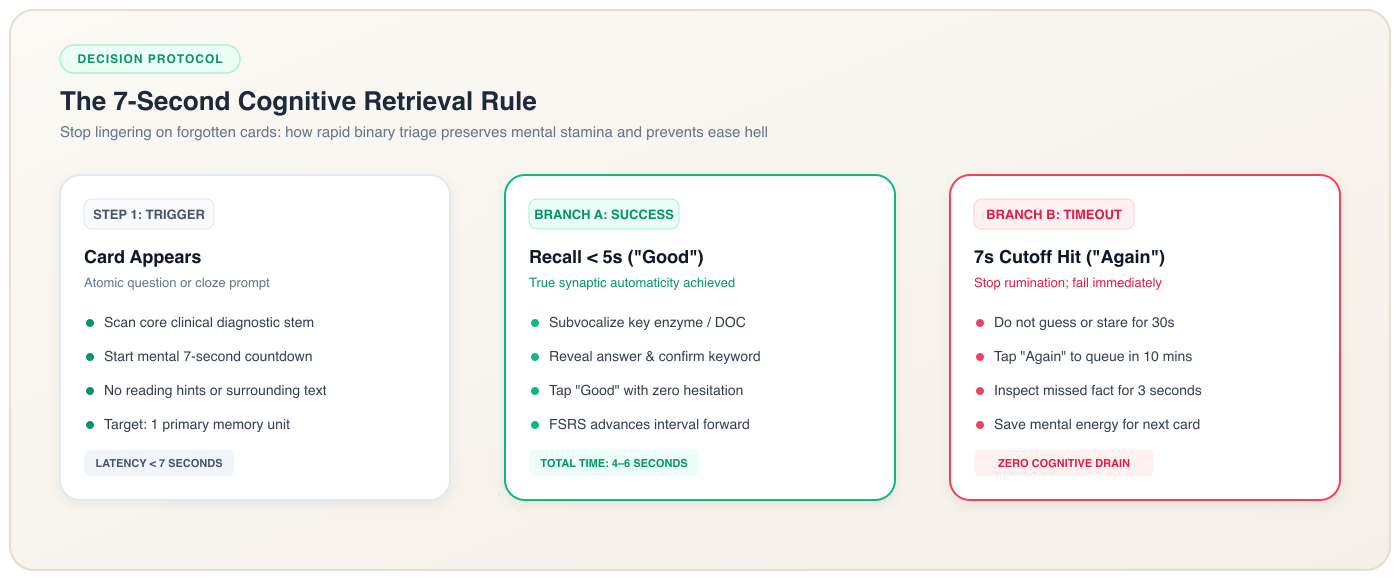 The 7-Second Rule Decision Tree: Rapid binary recall protocol versus prolonged rumination for medical flashcards
The Cognitive Neuroscience Behind Rapid Retrieval
Why is rapid failure superior to prolonged rumination?
- Retrieval is Structurally Binary: Research by Kornell, Hays, and Bjork (Journal of Memory and Language, 2009) demonstrated that successful memory retrieval in cued recall follows an all-or-none activation threshold. If the synaptic pathway is primed, retrieval latency in trained students is typically under 3.5 seconds.
- Prolonged Staring Generates Interference: When you stare at a question for 30 seconds, your brain begins activating adjacent, incorrect clinical concepts (e.g., confusing Carbamazepine with Valproate or Lamotrigine). This creates proactive interference, muddying the memory trace you are attempting to solidify.
- Speed Protects Cognitive Stamina: Failing quickly preserves your mental energy. Hitting "Again" in 4 seconds means the algorithm will resurface the card in 10 minutes. Seeing a card twice with fresh attention takes 8 seconds total and cements the memory far more effectively than staring at it once for 45 seconds.
Explore our comprehensive analysis on active recall vs rereading for NEET-PG to understand the physiological basis of memory consolidation.
Card Architecture Makeover: Turning 25-Second Bloat into 4-Second Reflexes
The absolute fastest way to speed up your reviews is to fix your cards. Let us examine three real-world transformations from high-yield medical subjects:
Transformation 1: Pharmacology (Anti-Arrhythmic Agents)
❌ The 25-Second Bloated Card:
- Front: What is the mechanism of action, clinical ECG effect, adverse reaction profile, and contraindications of Amiodarone?
- Back: Amiodarone is a Class III anti-arrhythmic that blocks potassium channels (also alpha, beta, and sodium channels). It prolongs the QT interval on ECG. Adverse effects include pulmonary fibrosis, thyroid dysfunction (hypo and hyper due to high iodine content), corneal microdeposits, blue-gray skin discoloration, and hepatotoxicity. Contraindicated in severe sinus-node dysfunction and 2nd/3rd degree AV block.
- Review Time: 25 to 35 seconds. High cognitive fatigue. Inevitable partial forgetting.
✅ The 4-Second Floww Atomic Cards:
- Card 1 (Mechanism): Amiodarone predominantly blocks [cardiac K⁺ channels] (Class III), prolonging action potential duration. (Review time: 3s)
- Card 2 (ECG Effect): On surface ECG, Amiodarone primarily prolongs the [QT interval] with very low risk of Torsades de Pointes. (Review time: 4s)
- Card 3 (Pulmonary ADR): The most fatal chronic toxicity of long-term Amiodarone therapy is [pulmonary fibrosis]. (Review time: 3s)
- Card 4 (Endocrine ADR): Amiodarone causes thyroid dysfunction because it contains 37% by weight of [iodine], inhibiting peripheral T4 to T3 conversion. (Review time: 5s)
Total time to review all 4 atomic cards: 15 seconds (saving 10 to 20 seconds while guaranteeing 100% testable mastery).
Transformation 2: Pathology (Hodgkin Lymphoma Diagnostics)
❌ The 30-Second Paragraph Card:
- Front: Describe the microscopic appearance, immunohistochemistry markers, and variants of Reed-Sternberg cells in Hodgkin Lymphoma.
- Back: Reed-Sternberg cells are large binucleated giant cells with prominent owl-eyed inclusion-like nucleoli. They are classically positive for CD15 and CD30, and negative for CD20 and CD45. Variants include Lacunar cells (seen in Nodular Sclerosis) and L&H "popcorn" cells (seen in Nodular Lymphocyte Predominant type, which are CD20+ and CD15/30-).
- Review Time: 30 seconds.
✅ The 4-Second Floww Atomic Cards:
- Card 1 (Core IHC): Classic Reed-Sternberg cells in Hodgkin lymphoma are immunopositive for [CD15] and [CD30]. (Review time: 4s)
- Card 2 (Variant IHC): The "popcorn" (L&H) cells of Nodular Lymphocyte Predominant Hodgkin lymphoma are positive for [CD20] (and negative for CD15/CD30). (Review time: 4s)
- Card 3 (Histology): "Owl-eye" inclusion nucleoli within large binucleated cells are diagnostic of [Reed-Sternberg cells]. (Review time: 3s)
Dive deeper into structuring diagnostic clozes in our dedicated guide on cloze deletion vs basic flashcards for medical students.
Transformation 3: Microbiology (Branching Filamentous Bacilli)
❌ The Bloated Table Card:
- Front: How do you differentiate Nocardia from Actinomyces?
- Back: Nocardia is aerobic, weakly acid-fast (modified Kinyoun positive), exogenous transmission, causes pulmonary infections and brain abscesses, treated with TMP-SMX. Actinomyces is anaerobic, not acid-fast, endogenous oral flora, causes cervicofacial "lumpy jaw" with sulfur granules, treated with Penicillin G.
- Review Time: 28 seconds.
✅ The 4-Second Floww Atomic Cards:
- Card 1 (Acid-Fastness): Between Nocardia and Actinomyces, only [Nocardia] is partially/weakly acid-fast on modified Ziehl-Neelsen stain. (Review time: 3s)
- Card 2 (Oxygen Requirement): [Actinomyces] is an obligate anaerobe, whereas Nocardia is strictly aerobic. (Review time: 3s)
- Card 3 (Pharmacology DOC): Drug of choice for systemic Nocardiosis is [TMP-SMX (Co-trimoxazole)]; for Actinomycosis it is [Penicillin G]. (Review time: 4s)
Review our high-yield subject strategy for microbiology and pharmacology flashcards for NEET-PG to master rapid drug and bug associations.
Speed Review Benchmarks & Pacing Matrix
The table below illustrates the dramatic compounding effect of review speed on daily study efficiency, monthly time savings, and cognitive endurance:
| Metric / Dimension | Sluggish (Overthinking) | Average (Hesitating) | Target (Optimal Pacing) | Elite (Atomic Flow) |
|---|---|---|---|---|
| Average Seconds per Card | 25 – 35s | 14 – 18s | 5 – 7s | 3 – 4s |
| Cards Cleared per Hour | 100 – 140 cards | 200 – 250 cards | 500 – 720 cards | 900 – 1,200 cards |
| Time for 300 Daily Cards | 125 – 175 minutes (~2.5 hrs) | 70 – 90 minutes (~1.3 hrs) | 25 – 35 minutes | 15 – 20 minutes |
| Monthly Time Required | 62 to 87 hours | 35 to 45 hours | 12 to 17 hours | 7 to 10 hours |
| Monthly Hours Reclaimed | Baseline (0 hrs) | +35 hours saved | +55 hours saved | +65 hours saved |
| Grand Test Equivalence | 0 GTs | ~10 Full Grand Tests | ~16 Full Grand Tests | ~19 Full Grand Tests |
| Cognitive Fatigue Level | Severe exhaustion / burn-out | Moderate eye strain & drift | Minimal; highly stimulating | Effortless daily habit |
| Ideal Card Types | Uncut textbook paragraphs | Multi-cloze sentences | Atomic clozes & visual cards | High-yield one-liners & IHC |
Notice the staggering mathematical difference: moving from 25 seconds to 6 seconds per card reclaims over 50 hours of study time every month. In competitive exams like NEET-PG and INI-CET, that extra time can be invested directly into solving 2,500 multiple-choice questions or completing 15 full Grand Tests with comprehensive error analysis.
Calculate your personalized daily capacity with our daily flashcard calculator for NEET-PG.
The Micro-Burst Hospital Ward Protocol for Interns and Residents
One of the most powerful mindset shifts for medical students is abandoning the belief that flashcards must be reviewed in a single, uninterrupted study block at your desk.
Interns on casualty postings, surgery rotations, or intensive care duties simply do not have two hours of uninterrupted evening time. When you attempt to do 300 cards at night, your fatigue guarantees an excruciatingly slow pace.
The solution is the Micro-Burst Protocol: dividing your daily queue into four 6-minute mobile sessions.
┌────────────────────────────────────────────────────────────────────────┐
│                   THE 4-BURST WARD ROUTINE (300 CARDS)                  │
├──────────────────┬─────────────────┬─────────────────┬─────────────────┤
│ Burst 1: Commute │ Burst 2: Post-OPD│ Burst 3: Lull   │ Burst 4: Night  │
│ 75 Cards         │ 75 Cards        │ 75 Cards        │ 75 Cards        │
│ 6.2 Minutes      │ 6.2 Minutes     │ 6.2 Minutes     │ 6.2 Minutes     │
│ Morning Cab/Bus  │ Tea/Lunch Break │ Ward Transition │ Before Sleep    │
└──────────────────┴─────────────────┴─────────────────┴─────────────────┘
                   TOTAL DAILY TIME: ~25 MINUTES (ZERO BACKLOG)
The 4 Micro-Bursts:
- Burst 1: The Morning Commute (75 Cards / ~6 mins)
Open your deck on your smartphone while on the hospital bus, metro, or auto-rickshaw. Because cards are atomic and you enforce the 7-second rule, your mind is alert and cuts through 75 cards before you even step foot into the hospital. - Burst 2: The Post-OPD Tea Break (75 Cards / ~6 mins)
Instead of mindlessly scrolling Instagram or Twitter during a 10-minute tea break in the canteen, clear your second batch of 75 cards. It takes barely 6 minutes and requires zero physical setup. - Burst 3: The Afternoon Lull / Duty Handover (75 Cards / ~6 mins)
Between finishing ward rounds and waiting for senior lab signatures or radiology reports, knock out your third burst. By 4:00 PM, you have already completed 225 of your 300 daily reviews. - Burst 4: The Evening Buffer (75 Cards / ~6 mins)
Before dinner or winding down for sleep, clear the final 75 cards. You end your day with zero due reviews, zero backlog anxiety, and your evening remains completely free for question banks and high-yield videos.
Floww is engineered specifically for this mobile micro-burst workflow: with instant gesture controls and lightning-fast cloud synchronization, you can complete a 15-card burst in the elevator between ward floors. Start reviewing today at app.floww.website.
How FSRS Eliminates Backlog Debt Compared to Legacy SM-2
Even if you execute lightning-fast 5-second reviews, your software's underlying mathematical algorithm determines whether your total workload stays manageable or balloons uncontrollably.
Traditional medical flashcard apps rely on SM-2, an algorithm developed in 1987. SM-2 has two fundamental mathematical weaknesses that slow down your reviews:
- Rigid Interval Growth Multipliers: When you hit "Hard" on a card in SM-2, the algorithm permanently reduces the card's ease factor. Over time, hundreds of cards get trapped in an artificial review cycle where they appear every 3 to 5 days, even after you have learned them thoroughly. This creates hundreds of redundant, low-efficiency reviews.
- Failure to Model Forgetting Curves Accurately: SM-2 assumes all memory decays linearly. It does not account for modern cognitive dimensions like memory stability and memory retrievability.
Daily Review Load Comparison:
SM-2 (Legacy): ████████████████████ (380 cards/day - Ease Hell & Redundant Reviews)
FSRS (Floww) : █████████████        (265 cards/day - 30% Fewer Reviews, Same Retention)
Floww utilizes FSRS v4.5 (Free Spaced Repetition Scheduler), the modern state-of-the-art memory algorithm. FSRS continuously analyzes your personal retrieval stability and retrievability probabilities:
- Cards that you grasp quickly are pushed out aggressively, eliminating redundant reviews of mature cards.
- Volatile cards (such as enzyme cofactors or staging classifications) are given targeted micro-intervals until stability is achieved.
- By eliminating unnecessary reviews, FSRS cuts your daily card volume by 20% to 30% without any drop in exam retention.
Read our complete mathematical breakdown on FSRS vs SM-2 for medical flashcards.
5 Common Speed-Review Mistakes to Avoid
While increasing your review speed is essential for surviving medical entrance preparation, speeding up incorrectly can undermine your learning. Watch out for these five critical pitfalls:
1. Speed-Reading Without Active Retrieval (The "Spacebar Trap")
The most dangerous mistake is tapping the screen to reveal the answer before your brain has actually attempted retrieval. If you glance at the front for one second, immediately flip, and say "Yeah, I knew that", you are engaging in passive recognition rather than active recall.
The Fix: You do not need to whisper the entire answer aloud, but you must distinctly visualize or sub-vocalize the specific keyword before revealing the card. If you cannot produce the keyword before flipping, you did not recall it—press Again.
2. Tolerating "Leech" Cards
A leech card is a card you have failed 5, 8, or 12 times. Every time it appears, you stare at it, struggle, fail, and feel frustrated.
Leeches are symptoms of poor initial encoding or terrible card formatting. If you fail a card more than 4 times, suspend it immediately. Do not keep reviewing it. Open your core textbook or coaching video, re-learn the clinical mechanism from scratch, and create two new atomic cards. Review our guide on common flashcard mistakes medical students make to identify leeches quickly.
3. Reviewing Brand New Cards at High Speed
Speed-review protocols apply strictly to due reviews (spaced repetition), not to brand new learning.
When you create or unlock 30 new cards on Vasculitis or Glomerulonephritis, take your time. Read the clinical rationale, inspect the biopsy micrographs, and understand the pathophysiology. Once a card is encoded into your memory, subsequent reviews must be fast and reflexive.
4. Overusing the "Hard" Button
If an app offers "Hard", "Good", and "Easy", avoid using "Hard" as an escape hatch for cards you forgot.
If you struggled to remember a drug or biomarker, it is not "Hard"—it is Again. Using "Hard" keeps the card alive in an ambiguous state, causing it to reappear tomorrow while diluting your retention statistics. Treat your reviews as binary: either you retrieved it effortlessly (Good), or you need to see it again (Again).
5. Neglecting Question Bank Integration
Flashcards are the world's most powerful tool for factual retention, but they do not replace clinical question banks. Flashcards build rapid recall of isolated facts; solving MCQs on Marrow, PrepLadder, or UWorld teaches you how to synthesize multiple facts within a complex patient vignette.
Spend 30 to 45 minutes clearing your daily flashcard queue at high speed, then dedicate the bulk of your study day to active question bank practice and Grand Tests. Build a sustainable schedule with our 3-month flashcard revision plan for NEET-PG.
Student Scenarios: Speed Pacing Across Study Phases
Different preparation stages demand different review paces and daily targets:
Scenario A: The MBBS Intern on Duty
- Daily Review Target: 200 – 250 cards.
- Target Speed: 4 to 6 seconds per card.
- Execution: Strictly mobile micro-bursts (4 sessions of 50 cards).
- Focus: High-yield volatile facts, previous year exam topics (PYQs), and drug-of-choice tables. Zero desktop dependencies.
Scenario B: The Post-Intern Dedicated Study Phase
- Daily Review Target: 350 – 450 cards.
- Target Speed: 5 to 7 seconds per card.
- Execution: Two 20-minute sessions (one morning review block, one pre-dinner block).
- Focus: Grand Test error logs, image occlusion for anatomy and dermatology, and pharmacology mechanisms.
Scenario C: The Final 30 Days Before NEET-PG
- Daily Review Target: 500+ cards.
- Target Speed: 3 to 5 seconds per card (pure instinct testing).
- Execution: Rapid-fire triage. Mature cards are reviewed in under 4 seconds. Any leech or low-yield card is suspended without hesitation to protect mental bandwidth for full mock exams.
Conclusion: Reclaim Your Time with Floww
Medical entrance exams like NEET-PG and INI-CET are not tests of how many hours you can endure staring at an Anki screen. They are tests of how reliably and rapidly you can retrieve high-yield clinical facts under intense exam pressure.
Reviewing flashcards at 25 seconds per card creates review backlogs, causes cognitive burnout, and steals precious hours away from clinical question practice. By enforcing the 7-Second Rule, transforming bloated cards into atomic memory units, and leveraging mobile micro-bursts, you can cut your daily review time from 2.5 hours down to just 25 minutes.
Floww is built from the ground up to support this lightning-fast revision workflow:
- Instant Photo-to-Card AI: Snap a picture of any complex coaching note, BTR table, or Grand Test explanation, and Floww extracts clean, atomic flashcards in 5 seconds.
- Modern FSRS Scheduler: Eliminates unnecessary reviews of mature cards, cutting your daily review volume by 20% to 30%.
- Mobile-First Experience: Built for one-thumb reviews between ward duties, eliminating desktop friction.
Stop drowning in review backlogs. Transform your flashcard reviews into rapid clinical reflexes at Floww.
Frequently Asked Questions
How many seconds should medical students spend on each flashcard?
For atomic factual flashcards (such as drug mechanisms, enzyme cofactors, or anatomy insertions), students should spend between 4 and 7 seconds per card. Clinical case vignettes with lab values should take no more than 10 to 12 seconds. Consistently spending over 15 seconds per card indicates either excessive card length or a failure of initial conceptual understanding.
Does reviewing flashcards faster decrease long-term memory retention?
No. Cognitive retrieval research demonstrates that memory retrieval is largely binary: either the neurological trace is primed and accessible within 5 to 7 seconds, or the learner is engaging in effortful guessing. Staring at a forgotten card for 45 seconds reinforces erroneous mental pathways and causes acute cognitive fatigue, whereas failing the card quickly resets the optimal spacing interval for rapid reconsolidation.
What is the fastest way to clear a massive 500+ flashcard backlog?
To clear a heavy backlog, first filter cards by subject or tag, apply the 7-second rule strictly, and suspend repetitive leech cards that you have failed more than 4 times. Break your backlog into 75-card micro-bursts across the day rather than attempting a single 3-hour marathon, and ensure your scheduler runs modern FSRS rather than legacy SM-2 to avoid compounding penalty intervals.
Why is Floww faster for daily medical reviews than desktop Anki?
Floww is optimized specifically for mobile medical workflow: it features one-thumb gesture reviews, instant AI photo-to-card atomic generation, and the modern FSRS algorithm that eliminates unnecessary reviews of stable cards. This cuts daily review volume by 20 to 30% compared to legacy desktop setups with complex add-ons.

Written by Floww Editorial
Medical Learning Editorial Team
Evidence-led guidance for NEET-PG and INI-CET preparation, focused on active recall, spaced repetition, and sustainable revision workflows.